100% deposit bonus
100% Deposit Bonus: Turnover Maths and the Modelled Cash Value
Doubling the deposit is the market's default offer; the model below shows what the standard terms convert it into.
The shortlist, before the detail
The board below carries this month's featured offers with their headline terms. The prose that follows models offers of this kind and never repeats those figures; the operator's own page is always the binding version.
Roulette King picks
Top roulette offers this month
The shortlist first, then the arithmetic. Four featured packages carry the headline terms below; the rest of the page models what offers of this kind usually cost and what a licence would have added.
Terms checked at the October 2026 review · 18+ · T&Cs apply. Offers move often: the operator’s own page is always the binding version.
- 1
 Night Luck82/100Casino welcome bonus 805% up to €6,400 + 280 FS
- MuchBetter · VISA · Apple Pay
- Crypto welcome 140% up to 1,600 USDT
- VIP pack 800% up to €14,500
Visit siteNight Luck18+ · T&Cs apply - 2
 EliteSpin80/100Welcome bonus €/£5,000 + 500 FS
- MuchBetter · NETELLER · MasterCard
- Lootboxes up to €/£20,000 or 500 FS
- BGaming festival: €80,000 prize pool
Visit siteEliteSpin18+ · T&Cs apply - 3
 Winbeast78/100Welcome pack €5,000 + 500 FS + €650 free bet
- MasterCard · Litecoin · MuchBetter
- Code FORTUNE: wheel on €40+ deposits
- Monday boost: 40% up to €300 (BOOST1)
Visit siteWinbeast18+ · T&Cs apply - 4
 Betportal75/100Welcome package 300% up to €/£1,000 + 150 FS
- Trustly · Bitcoin · Bank transfer
- 1st deposit: 150% up to €/£500 + 100 FS
- 2nd deposit: 100% up to €/£300 + 50 FS
Visit siteBetportal18+ · T&Cs apply
Placements on this board are paid, and the order is part of that arrangement. Featured brands hold no UK Gambling Commission licence, so GamStop, independent dispute resolution and segregated-funds rules do not reach them. Gambling can be addictive. Play responsibly. How we are paid.
The default match: how 100% offers are structured
A 100% deposit bonus takes the simplest shape in the business: the operator matches the amount deposited, pound for pound, up to a stated ceiling. Deposit £50 and £50 of bonus funds appears alongside the cash balance; deposit £100 and the bonus rises to £100 unless the cap intervenes. That symmetry explains its dominance. The format is easy to explain in a headline, easy to banner across a homepage and easy to compare at a glance, which is exactly why the terms attached to it deserve closer attention than the headline itself.
Beneath the headline, the same components appear almost every time. There is a trigger, usually the first deposit, with a minimum qualifying amount that is often £10 or £20. There is a match percentage with a cap, which is the work those two little words "up to" are doing. There is a separate bonus balance, held apart from withdrawable cash until the wagering is cleared. There is a wagering multiplier, most commonly between 35x and 50x on this part of the market, dictating how much must be staked before bonus funds and any winnings connected to them convert to cash. And there is a supporting cast of rules covering maximum stakes, game contributions, expiry dates and payment methods, each of which can quietly reshape the deal.
The two-balance mechanics matter more than most players expect. Cash sits in one wallet and can be withdrawn at any moment; bonus funds sit in another and are locked. Winnings generated while bonus funds are in play usually return to the bonus wallet rather than the cash one, so an early good run frees nothing until the requirement is cleared. Where the option exists, declining the offer keeps every pound in cash from the first spin. Accepting it converts part of the balance into restricted funds immediately, and that trade, made in seconds at the cashier, is the whole game.
There is an asymmetry worth naming here. The marketing speaks in percentages, which are effortless to inflate; the cost lives in multipliers, durations and contribution tables, which take effort to find. Nothing about that arrangement is accidental, and it explains why the standard offer survives so many cycles of scrutiny intact: the part that is easy to read is designed to be read, and the part that decides the value is designed to be skimmed. Pricing the standard version properly means dragging the second part into the same light as the first.
Two structural points complete the picture. First, the match credits only on qualifying deposits, and since April 2020 debit cards have been the only cards that can fund gambling in the United Kingdom at all, because credit card gambling is banned. Second, the percentage says nothing about size. A 100% match of £10 and a 100% match of £200 are the same animal in different cages, and the multiplier riding on each matters far more than the percentage being advertised. The sections below price the standard version of the offer with a fixed model, so that differences between operators come from their terms rather than from their marketing.
The conversion model: standard terms, priced
To compare offers of this kind on equal terms, the model holds everything constant except the multiplier, and every assumption is stated here. The deposit is £50. The match is 100%, so £50 is credited as bonus funds. Wagering applies to the bonus in the first three rows and to the bonus plus the deposit in the fourth, which is the harshest common formulation. The house edge is set at 4%, a realistic figure for a typical slots mix, pricing every £100 staked at about £4 of expected cost. Turnover follows directly: 35 multiplied by £50 gives £1,750; 40 multiplied by £50 gives £2,000; 50 multiplied by £50 gives £2,500; and 40 multiplied by £100 gives £4,000. The final column reports the range the model produces once that expected cost is priced in and variance is taken into account, because a single figure would flatter the precision. The model further assumes the requirement is completed in full, on games contributing 100%, at stakes inside any maximum-bet limit.
| Model | Deposit | Bonus credited | Wagering on bonus | Modelled turnover | Modelled cash-out at 4% edge |
|---|---|---|---|---|---|
| 100% at 35x | £50 | £50 | 35x bonus | £1,750 | about £50 to £90 |
| 100% at 40x | £50 | £50 | 40x bonus | £2,000 | about £45 to £85 |
| 100% at 50x | £50 | £50 | 50x bonus | £2,500 | about £30 to £80 |
| 100% at 40x bonus and deposit | £50 | £50 | 40x of £100 | £4,000 | about £30 to £75 |
Read the rows as a sequence rather than as four separate deals. Moving from 35x to 40x adds £250 of turnover for the same £50 of bonus money. Moving from 40x to 50x adds another £500. The fourth row is the step change: applying 40x to £100 rather than to £50 doubles the turnover to £4,000, twice the first row, for an identical headline. Expected cost scales in step, at 4% of turnover throughout: about £70 on £1,750, about £80 on £2,000, about £100 on £2,500 and about £160 on £4,000. The bonus money itself never changes; only the length of the road does.
The ranges in the last column describe where outcomes typically land rather than where they are contractually headed, because slots are lumpy; long barren stretches and sudden clusters of wins both occur inside a single requirement. What the ranges make plain is the direction of travel. The tighter the multiplier, and the narrower the base it is applied to, the more of the starting £100 tends to survive the journey. The wider the base and the taller the multiplier, the more of the journey is funded by the deposit itself. That relationship, not the size of the match, is the real price list of this part of the market.
The market side by side: licences, focus and reputation
Brands in this part of the market divide into two camps: those licensed by the UK Gambling Commission, which places them inside the UK's consumer protections, and those facing British players from offshore without a UK licence. The table below lines up the familiar names against those two measures, alongside the market each brand concentrates on and what it is generally known for among players. Terms change often and promotions rotate, so treat the final column as a description of the scheme each brand sits inside rather than a verdict on any current promotion.
| Casino | Licence | Market focus | What it is known for | UK protections |
|---|---|---|---|---|
| PartyCasino | UKGC licensed | Casino-first brand | Match offers with published wagering | GamStop, independent dispute resolution, segregated funds |
| 888 Casino | UKGC licensed | Long-running standalone casino | Long-standing welcome shop | GamStop, independent dispute resolution, segregated funds |
| LeoVegas | UKGC licensed | Mobile-first casino | Tiered welcome | GamStop, independent dispute resolution, segregated funds |
| Casumo | UKGC licensed | Licensed casino | Gamified welcome | GamStop, independent dispute resolution, segregated funds |
| NetBet | UKGC licensed | Established casino | Match combinations | GamStop, independent dispute resolution, segregated funds |
| Magic Red | UKGC licensed | Licensed casino | Compact matches | GamStop, independent dispute resolution, segregated funds |
| Mr.Play | UKGC licensed | Licensed casino | Matches with spins | GamStop, independent dispute resolution, segregated funds |
| SpinGenie | UKGC licensed | Licensed casino | Spin-led welcome | GamStop, independent dispute resolution, segregated funds |
| Mr Vegas | UKGC licensed | Slots-led licensed brand | Multi-stage welcome | GamStop, independent dispute resolution, segregated funds |
| Unibet | UKGC licensed | European bookmaker roots | Steady terms | GamStop, independent dispute resolution, segregated funds |
| Kinghills | No UK licence | Offshore-facing casino | Match headlines outside the UK scheme | None of these; no GamStop, no approved dispute route, no segregation requirement |
Two names illustrate the spread. PartyCasino presents itself as a casino-first brand and is known for match offers with published wagering, which means the arithmetic on this page can be applied to its terms directly. Unibet, with its European bookmaker roots, is known for steady terms of the sort that change slowly and read the same from one month to the next. Both are UKGC licensed, so both sit inside GamStop, approved dispute resolution and the remaining protections described below. Kinghills, the offshore-facing entry in the table, sits outside all of it, and that gap is not a technicality; it is the difference between having a regulator and having an email address.
Turnover at each multiplier, and what it costs in time
Turnover is the total staked before the wagering counter reaches zero, and it decides whether a 100% deposit bonus behaves like a subsidy or a chore. Both winning and losing spins count toward it, which is worth stating plainly: the requirement is not cleared faster by losing, it is cleared by staking. The model's four rows produce £1,750, £2,000, £2,500 and £4,000 of turnover respectively, and those figures convert directly into time. At 20p a spin, £1,750 of turnover is 8,750 spins; at £1 a spin, the same turnover is 1,750 spins. At an unhurried eight seconds per spin, 1,750 spins takes just under four hours of continuous play. The 40x row takes about four and a half hours, the 50x row about five and a half, and the £4,000 row about nine.
Expected cost moves in step with turnover. A 4% house edge, the assumption throughout this page, prices £1,750 of staked play at about £70, £2,000 at about £80, £2,500 at about £100 and £4,000 at about £160. Set against the £100 of starting funds in the model, those figures explain the shape of the final column: at every multiplier shown, the expected cost is larger than the £50 of bonus money itself, and it grows faster than the bonus ever could. The match is not a gift of £50; it is a £50 rail ticket with a long walk attached, and the walk gets longer as the multiplier climbs.
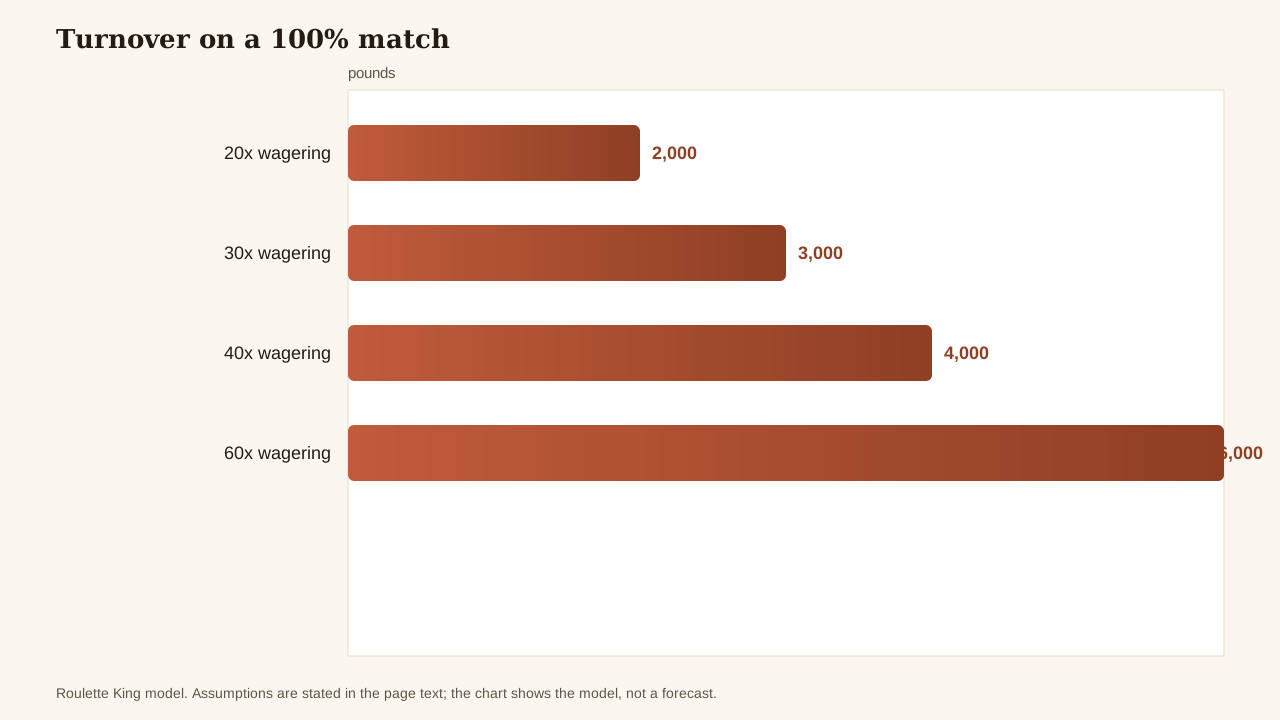
The model runs on a fixed £50 deposit, a 100% match and a 4% edge; individual circumstances differ. Enter your own deposit, the bonus credited and the multiplier to see the turnover and the playing time they imply.
Wagering calculator
Turnover before withdrawal, modelled from the bonus and the multiple the terms set.
Model illustration with stated inputs; the terms of a specific offer always override a model.
The terms that bite
Four clauses do most of the damage on offers of this kind. None of them appears in the headline, and all of them live in the terms. Each is set out below with the arithmetic that shows why it matters.
Maximum bet while wagering
Operators commonly cap the stake allowed while bonus funds are in play, most often somewhere between £2 and £5 per spin on this part of the market. The limit exists to stop a requirement being cleared in a handful of large wagers, and breaching it typically voids the bonus along with any winnings connected to it. The cap also changes the texture of the grind: at a £2 maximum, the model's £1,750 row is 875 spins, while the same turnover at 20p a spin is 8,750 of them. Fewer, larger swings mean a bumpier ride, and the ride is the point, because variance is what separates the outcomes in the model's ranges.
Game weighting
Not every game moves the counter at the same speed. Slots normally contribute 100%, so each pound staked counts as a pound. Table games, live dealer tables and video poker frequently contribute 10% or less, and some high-return slots are excluded altogether. Weighting quietly multiplies the turnover when the wrong games are played: to move the model's £1,750 row through a game contributing 10%, £17,500 would need to be staked, because £1,750 is one tenth of £17,500. Reading the contribution table before the first spin is the most valuable five minutes in the entire process, and skipping it is the most common expensive mistake.
Expiry
Bonus funds carry a clock, commonly set somewhere between 7 and 30 days on this part of the market, and the countdown usually begins when the bonus credits rather than when play starts. Anything unfinished when the clock runs out is forfeited, bonus and connected winnings together. The clock interacts with turnover directly. Clearing £1,750 inside a 7-day window means £250 of staked turnover every day, because £1,750 divided by 7 is £250; the model's 50x row inside the same window asks for more than £350 a day. Time, more than willingness, is what usually defeats tall multipliers.
Payment exclusions
Some deposits never qualify. Certain e-wallets and prepaid vouchers have historically been excluded from triggering offers, and the list differs between operators, so the payment method deserves a check before the qualifying deposit is made. Credit cards cannot fund gambling in the United Kingdom at all, a ban in force since April 2020, which leaves debit cards and whatever else each operator accepts. Deposit with an excluded method and the match simply never arrives; the balance plays as cash with no bonus attached, which is harmless, but it silently turns the intended deal into no deal at all.
The model in the earlier section assumes none of these traps spring: stakes inside the limit, games contributing in full, the clock respected and a qualifying method used. Real sessions are messier than that, which is one more reason the modelled ranges should be read as a guide to shape rather than a forecast of a specific evening.
What a UK licence buys
A licence from the UK Gambling Commission is not a badge; it is a bundle of protections, and each element matters most when something has already gone wrong. The first element is GamStop, the national self-exclusion scheme. One registration excludes a player from every UKGC-licensed operator at once, and operators are required to enforce it. A site outside the scheme cannot offer anything equivalent, however familiar its homepage looks.
The second is independent dispute resolution. When a player and a licensed operator disagree over a delayed withdrawal or a voided win, the complaint can be taken, free of charge, to a dispute resolution body approved by the Commission, and the operator is expected to act on the outcome. Offshore, the appeals process consists of writing to the operator again, in the hope that the second email lands differently from the first.
The third is segregated funds: licensed operators must keep player balances separate from operating money, so a company failure does not automatically turn balances into unsecured claims against a fading entity. The fourth is a regulator who acts. The Commission fines, suspends and revokes licences, publishes its enforcement, and has done so against household names. Enforcement on that scale is what gives the other protections their weight, because rules without consequences are suggestions.
Offers without a UK licence carry none of this. The match percentage may read identically and the homepage may borrow the same design language, but GamStop does not reach the site, no approved dispute body covers it, segregated funds are not required of it, and no regulator with enforcement powers watches it. Kinghills sits in that position in the comparison above, and the protections column of its row is the honest answer to what its licensing position buys. Whatever the headline says, the protections are part of the product, and this part of the market sells some of its offers without them.
Frequently asked questions
What is a 100% deposit bonus?
It is a welcome offer in which the operator matches the deposit pound for pound in bonus funds, up to a stated cap. Deposit £50 and £50 of bonus money is credited; the deposit itself normally stays as cash. The bonus is locked until its wagering requirement is cleared, and the terms rather than the percentage decide what the deal is worth. That is why this page prices the standard 100% deposit bonus through a model instead of simply repeating the headline.
What does the wagering requirement mean in pounds?
Multiply the bonus by the multiplier. A £50 bonus at 35x means £1,750 of staked turnover before withdrawal unlocks; at 40x it is £2,000; at 50x it is £2,500. Where the requirement applies to the bonus and the deposit together, the base doubles, so 40x of £100 is £4,000. Games that contribute less than 100% push the real figure higher still, because a pound staked on a 10% game counts as 10p toward the requirement.
What does the cap do?
The cap, written as "up to £100" or similar, limits the size of the match. Deposit £150 under a 100% up to £100 offer and the bonus is £100, with the remaining £50 playing as cash. The turnover requirement is calculated on the bonus actually credited, so the cap shrinks the deal and the requirement together. A second, quieter cap sometimes appears in the terms, limiting how much can be converted from bonus play into withdrawable cash, and that one shrinks the upside without touching the work.
Which payment methods qualify?
Debit cards qualify almost everywhere and are the default expectation. Credit cards cannot be used for gambling in the United Kingdom at all, following the ban that took effect in April 2020. Some operators exclude particular e-wallets or prepaid vouchers from triggering a bonus, and the exclusions differ between brands, so the terms deserve a read before the first deposit. Skrill and Neteller deposits in particular have been excluded by many operators over the years. A deposit made with an excluded method usually plays as cash with no match attached, which is harmless but pointless if the match was the reason for depositing.
How does expiry work?
The bonus carries a deadline, most often between 7 and 30 days, and it usually starts when the bonus credits rather than when play begins. When the deadline passes, the remaining bonus and any winnings still tied to it are removed. The practical test is whether the turnover fits the window: £1,750 across 7 days is £250 of staked turnover a day, and £2,500 across the same window is nearly £360 a day. If a realistic week of play cannot cover the requirement, the expiry clause settles the value of the offer on the player's behalf.
Is it worth taking a 100% match?
It depends on the terms and on the player, and the model shows the pattern. Lower multipliers applied to the bonus alone leave more of the starting funds intact on average, while 40x or 50x applied to bonus and deposit together consumes most of the value in expected cost. A match is worth considering when the requirement is one you would be comfortable meeting anyway, on games you would have played regardless, with money already set aside as an entertainment budget. It is not worth distorting play to chase, and declining is always an option; playing with cash only keeps every pound withdrawable from the first spin.
What does the licence gap mean?
It means the protections described in the licence section above do not apply. A brand facing British players without UKGC licensing sits outside GamStop, outside approved dispute resolution, outside the segregated funds rules and outside the Commission's enforcement. If a withdrawal is delayed or a win is voided, there is no UK body to escalate to, only the operator's own process. Some offshore-facing brands behave well; the difficulty is that nothing structural makes them. For anyone who values those protections, the practical answer is to stay with licensed operators, whatever the size of the match advertised elsewhere.