non gamstop paypal casinos
Non GamStop PayPal Casinos: Why the Rail Is Rare Offshore
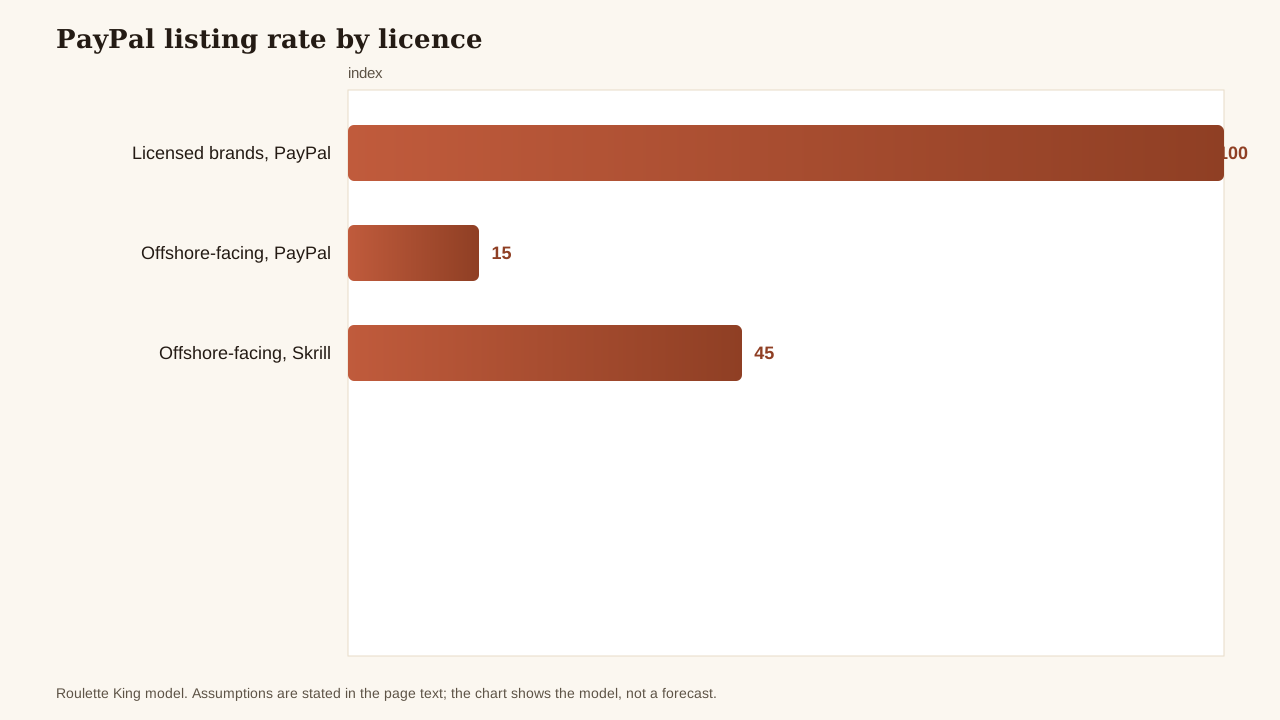
PayPal pulled back from unlicensed gambling years ago; the model below shows what the cashiers at this end of the market actually offer.
The shortlist, before the detail
The board below carries this month's featured offers with their headline terms. The prose that follows models offers of this kind and never repeats those figures; the operator's own page is always the binding version.
Roulette King picks
Top roulette offers this month
The shortlist first, then the arithmetic. Four featured packages carry the headline terms below; the rest of the page models what offers of this kind usually cost and what a licence would have added.
Terms checked at the October 2026 review · 18+ · T&Cs apply. Offers move often: the operator’s own page is always the binding version.
- 1
 Night Luck82/100Casino welcome bonus 805% up to €6,400 + 280 FS
- MuchBetter · VISA · Apple Pay
- Crypto welcome 140% up to 1,600 USDT
- VIP pack 800% up to €14,500
Visit siteNight Luck18+ · T&Cs apply - 2
 EliteSpin80/100Welcome bonus €/£5,000 + 500 FS
- MuchBetter · NETELLER · MasterCard
- Lootboxes up to €/£20,000 or 500 FS
- BGaming festival: €80,000 prize pool
Visit siteEliteSpin18+ · T&Cs apply - 3
 Winbeast78/100Welcome pack €5,000 + 500 FS + €650 free bet
- MasterCard · Litecoin · MuchBetter
- Code FORTUNE: wheel on €40+ deposits
- Monday boost: 40% up to €300 (BOOST1)
Visit siteWinbeast18+ · T&Cs apply - 4
 Betportal75/100Welcome package 300% up to €/£1,000 + 150 FS
- Trustly · Bitcoin · Bank transfer
- 1st deposit: 150% up to €/£500 + 100 FS
- 2nd deposit: 100% up to €/£300 + 50 FS
Visit siteBetportal18+ · T&Cs apply
Placements on this board are paid, and the order is part of that arrangement. Featured brands hold no UK Gambling Commission licence, so GamStop, independent dispute resolution and segregated-funds rules do not reach them. Gambling can be addictive. Play responsibly. How we are paid.
Why PayPal is missing at offshore-facing brands
The plain version first: PayPal casinos not on GamStop are rare because two gates stay shut at the same time. One gate belongs to PayPal itself, which treats gambling as a merchant category it will serve only on strict, published terms. The other is the licence gap, because the brands that court British readers from offshore run on licences issued far outside the UK regulatory perimeter. Neither gate opens because a customer wishes it would, and neither has moved in years.
Take PayPal's side of it. The company restricts gambling payments to operators it has approved in regulated markets, and it withdrew from much of the unlicensed gambling economy years ago after sustained pressure from regulators and card schemes. In Britain that means the wallet works smoothly with operators holding a UK Gambling Commission licence, and it does not work with operators who cannot show one. An offshore-facing brand may hold a document from another jurisdiction, but that paper carries no weight in PayPal's merchant checks, so the option never reaches the cashier at all. This is commercial policy rather than a technical fault, and it is applied consistently.
The licence side is just as firm. Attaching PayPal to a cashier aimed at British customers, in the flow readers remember, requires an operator to sit inside the UK regulatory scheme, accept its reporting and dispute rules, and then clear PayPal's own onboarding on top. Brands serving Britons under offshore licences fail both tests at once. Now and then a PayPal logo surfaces somewhere in this segment, and it almost always traces back to a third-party processor or to a differently regulated arm of the business; the familiar checkout, and the buyer protections wrapped around it, do not travel with the transaction in any form a reader would recognise.
Why does the myth persist? Partly because the phrase is a strong trust signal in search, and trust signals get borrowed. A page can promise the wallet even when the cashier behind it holds cards, e-wallets and crypto and nothing else. A reader who reaches the payment page and looks, rather than reads, will see the truth in about ten seconds, which is the most reliable check available in this part of the market.
So the honest description is an uncomfortable one: the phrase mostly describes a cashier that does not exist. The wallet is rare because policy and licensing point the same way, and no cleverness changes that. A reader who wants the wallet has one clean route, which is a GB-licensed brand; there is no tool to install and no trick to learn, and this page will not pretend otherwise.
What actually replaces PayPal at the cashier
Three rails do the work in this part of the market: debit cards, e-wallets and crypto. Each is common, each behaves differently, and none of them carries the licence protections that make GB-regulated gambling safer. That last point matters more here than it would at a licensed operator, because the cashier is one of the few places a reader still holds an ordinary consumer choice.
Debit cards are the default rail. Most offshore-facing brands accept Visa and Mastercard debit, deposits clear quickly, and the flow feels familiar from everyday shopping. Two cautions belong beside that comfort. Many UK issuers decline card payments to unlicensed gambling merchants, so a card that works everywhere else may be refused here. And the UK ban on credit card gambling binds GB-licensed operators only, which means credit cards can and do work at brands outside the scheme; that is a protection lost rather than a feature gained, and it deserves a pause before use.
E-wallets such as Skrill and Neteller serve parts of this segment, and they come closest to the experience readers say they miss. Setup takes minutes, deposits land quickly, and payouts are usually quicker than cards. The differences gather at the edges: fees can appear on withdrawals or on currency conversion, some promotions exclude e-wallet deposits outright, and the wallet account is a separate relationship with its own verification queue. It is not PayPal, and pretending otherwise helps nobody.
Crypto is the fastest-growing rail at this end of the market, and at crypto-native brands it is the only rail on the menu. Deposits arrive in minutes, payouts can follow quickly once approved, and no bank sits between reader and operator to question a transaction. That absence cuts both ways: network fees apply, the balance moves with the coin's price, wallet handling is its own skill, and a payment sent to a wrong address has no reversal process whatsoever.
Vouchers and instant banking appear at the margins of the segment, occasionally, and they share the same shape as everything above. A rail moves money; a licence provides recourse. Choosing Skrill over Bitcoin, or a card over an e-wallet, changes speed and fees, and it changes nothing about what happens when a dispute appears and there is no regulator to carry it to.
How the market lines up
The comparison below sets names often attached to the phrase PayPal casinos not on GamStop against GB-licensed brands, so the split in cashiers and protections is visible in a single view.
| Casino | Licence | Market focus | What it is known for | UK protections |
|---|---|---|---|---|
| Mystake | No UK licence | offshore-facing casino | e-wallet and card cashiers; PayPal rarely offered | None |
| Goldenbet | No UK licence | offshore-facing casino | card and crypto cashiers | None |
| Rolletto | No UK licence | offshore-facing brand | crypto rails with e-wallet options | None |
| Donbet | No UK licence | offshore-facing casino | crypto-friendly cashier | None |
| Kinghills | No UK licence | offshore-facing casino | card and crypto rails | None |
| NineWin | No UK licence | offshore-facing casino | e-wallet variety | None |
| JackpotCity | No UK licence | offshore-facing brand | card cashiers outside the UK scheme | None |
| Roobet | No UK licence | crypto-native casino | crypto-only cashier | None |
| Gamdom | No UK licence | crypto-first casino | instant crypto play | None |
| Virgin Games | UKGC licensed | games-led brand | PayPal as a first-class rail with full protections | Yes, full scheme |
| MrQ | UKGC licensed | no-wagering pioneer | PayPal payouts among the fastest | Yes, full scheme |
| JackpotJoy | UKGC licensed | games brand | PayPal deposits and payouts | Yes, full scheme |
Mystake and Rolletto make the split easy to see: Mystake is known for e-wallet and card cashiers where PayPal is rarely offered, while Rolletto is built on crypto rails with e-wallet options running alongside. Both are offshore-facing, so neither can offer the wallet under its own rules, and neither carries UK protections of any kind. The licensed names at the foot of the table show what a GB licence unlocks instead: PayPal as a first-class rail at Virgin Games, PayPal payouts among the fastest at MrQ, and straightforward PayPal deposits and payouts at JackpotJoy.
A model of rails at offshore-facing brands
The model below assumes October 2026 practice at this end of the market and describes patterns rather than promises; treat each cell as a typical reading that shifts cashier by cashier, because payment terms here change without notice. The PayPal row reads rare for the reasons set out earlier, and its payout window reads varies because where the wallet does surface it is often brokered through a third party and behaves unlike the familiar flow. The final column is the one to read twice: whichever rail a reader picks, none of the licence protections travel with the money.
| Rail | Presence at offshore-facing brands | Typical fee | Typical payout window | Protections that travel with the rail |
|---|---|---|---|---|
| PayPal | rare | none | varies | buyer-protection framing only, none of the licence protections |
| debit card | common | 0 to 3 percent | 2 to 5 days | none of the licence protections |
| crypto | common | network fee | minutes to hours | none of the licence protections |
| e-wallets | common | varies | 1 to 3 days | none of the licence protections |
Read as a set, the rows sketch the shape of the segment. Cards, e-wallets and crypto are common precisely because they have no gatekeeper of PayPal's kind; fees cluster low but never reach zero once conversion and network costs are counted; and the protection column says the same thing four times, which is the point of the whole exercise. A reader who arrived hunting for PayPal casinos not on GamStop should read the presence column first, then the fee column, then ask what the last column would need to say before the trade felt worthwhile.
What the cashier choice costs in fees and waits
Prices in this segment are rarely posted as prices, so it helps to work an example with every assumption on the table. Assume fees are charged on top of the amount moved, and take a rail charging 3 percent, the top of the card range in the model: a £100 deposit carries a £3 fee, so the reader pays £103 in total to see £100 reach the balance; at 1 percent the fee on the same deposit is £1, or £101 in total. For withdrawals, assume a £200 crypto payout carrying a network fee of £1.50 and an exchange spread of 1 percent applied to the £200 being converted, which is £2, so about £3.50 leaves the payout before any operator charge. These figures are illustrative October 2026 readings rather than quotes, and any promotion that rebates fees changes the arithmetic on its own terms.
Waiting works in layers. Debit card payouts at this end of the market typically take 2 to 5 days after approval, e-wallets 1 to 3 days, crypto minutes to hours once the operator releases the payment, and any pending window the brand applies sits on top of all three. First withdrawals also wait for identity checks, and at offshore brands the paperwork request can arrive late and without much explanation. The same checks exist at a GB-licensed brand, but a stalled payout there has somewhere to go; here the reader's recourse is mostly an inbox and patience.
Hidden costs deserve their own paragraph. Offshore accounts are often denominated in dollars or euros, so a sterling deposit can pay a conversion margin on the way in and again on the way out; dormant balances can attract inactivity charges; and withdrawal minimums can strand small winnings. None of these has a UK counterpart at licensed operators, where published caps and plain terms do much of the work quietly.
The calculator below turns a rail's fees and waiting time into a single effective cost for a deposit and payout the reader chooses.
Effective bonus cost calculator
Deposit, match and multiple turned into credited money, turnover and a modelled cost.
Model illustration with stated inputs; the terms of a specific offer always override a model.
What a licence buys, and what GamStop does
A UK Gambling Commission licence buys a specific bundle, and it is worth naming the parts because they are exactly what offshore play leaves behind. Complaints follow a set route and can be escalated to an approved alternative dispute resolution service whose decisions operators must honour. Customer fund protection rules limit what can happen to a balance if an operator fails. Affordability and identity checks apply before harm compounds. Credit card gambling is banned. Bonus and advertising terms follow published standards with real consequences attached. And self-exclusion is enforced, because every GB-licensed online operator is plugged into the same national scheme.
That scheme is GamStop, and it does one job thoroughly. Registration at gamstop.co.uk is free and takes minutes; the reader chooses a minimum term of 6 months, 1 year or 5 years; and the exclusion applies across all GB-licensed online operators at once. The term cannot be cut short, even if the reader changes their mind halfway through, and it can only be ended through GamStop itself once the chosen period has run.
The plain sentence this page owes its reader is this: offshore-facing brands do not participate in GamStop. An exclusion registered there will not block an account at any brand named in the comparison, because those operators sit outside the scheme by definition. Bank-level gambling blocks and blocking software can help, and setting them up is sensible, but none of them is complete and none should be sold as a fix.
One more sentence belongs here. If the urge a reader notices is the urge to hunt for a way past an exclusion, that urge is itself the thing to act on, and the right number is the National Gambling Helpline on 0808 8020 133, run by GamCare with BeGambleAware. The call is free, the line is open around the clock, and nothing in the conversation is reported to anyone.
Frequently asked questions
Why is PayPal so rare at casinos not on GamStop?
Two gates close together. PayPal restricts gambling payments to operators it has approved in regulated markets and will not onboard brands licensed outside the UK scheme, and the offshore-facing brands in question hold precisely those licences. The rarity is structural rather than temporary, and it has held for years. Where a PayPal logo does appear in this segment, it usually belongs to a third-party processor, and the buyer protections readers associate with the wallet do not follow the transaction in any dependable form.
Which payment rails actually work at these brands?
Debit cards, e-wallets such as Skrill and Neteller, and crypto cover almost every cashier in this part of the market, and crypto-native brands run on crypto alone. Expect some card payments to be declined by UK issuers dealing with unlicensed gambling merchants, expect e-wallet fees on conversions or withdrawals, and expect crypto to add network fees and price movement of its own. Every one of these rails works without the protections a UK licence provides, which is the trade being made whether the reader names it or not.
How do payouts compare with GB-licensed brands?
The model puts crypto at minutes to hours after approval, e-wallets at 1 to 3 days and debit cards at 2 to 5 days, before any pending window the operator adds. At GB-licensed brands, PayPal commonly lands within hours of approval, which is one honest reason the wallet is missed. The deeper difference sits behind the timings: a stalled payout at a licensed operator can be escalated to an approved dispute service, while at an offshore brand the reader is left with the operator's own support inbox.
Do these brands join GamStop?
No, plainly. GamStop covers operators licensed by the UK Gambling Commission only, and offshore-facing brands sit outside that scheme by definition. Registering with GamStop will not close an account at any of them, and any claim that these brands participate in the scheme should be read as false. Exclusion at these brands rests entirely on the operator's own tools, which have no independent oversight behind them.
What does a reader lose without a UK licence?
The enforceable complaint route and the approved dispute service that backs it, customer fund protection rules, the credit card gambling ban, mandatory affordability and identity checks, advertising standards with consequences, and self-exclusion that binds every licensed operator at once. PayPal belongs on the same list, because the wallet attaches only to operators inside schemes like the UK's. Read together, these are not frills; they are the difference between a regulated market and an unregulated one.
Is there a way around self-exclusion?
No, and this page will not dress the answer up. Nothing here describes, or hints at, tools for getting past GamStop, an ISP block, a payment block or an identity check, because none of those routes repairs anything and most of them stack fraud and data risks on top of the original problem. If the pull to start looking feels strong, that is the moment to call the National Gambling Helpline on 0808 8020 133; the call is free, confidential and open at any hour.
Where can a reader get help?
The National Gambling Helpline on 0808 8020 133, run by GamCare with BeGambleAware, is the first call and stays open around the clock. GamStop itself, at gamstop.co.uk, registers a free self-exclusion across all GB-licensed online operators for 6 months, 1 year or 5 years, with no early exit. Most UK banks can block gambling transactions on request, and a GP can point readers toward local treatment without judgement. None of these routes needs a justification beyond wanting one.