visa casino
Visa Casino: Debit Rails, Delays and the Terms That Follow the Card
A card deposit clears in seconds and a card payout can take three days; the model on this page prices that gap and the terms that ride along.
The shortlist, before the detail
The board below carries this month's featured offers with their headline terms. The prose that follows models offers of this kind and never repeats those figures; the operator's own page is always the binding version.
Roulette King picks
Top roulette offers this month
The shortlist first, then the arithmetic. Four featured packages carry the headline terms below; the rest of the page models what offers of this kind usually cost and what a licence would have added.
Terms checked at the October 2026 review · 18+ · T&Cs apply. Offers move often: the operator’s own page is always the binding version.
- 1
 Night Luck82/100Casino welcome bonus 805% up to €6,400 + 280 FS
- MuchBetter · VISA · Apple Pay
- Crypto welcome 140% up to 1,600 USDT
- VIP pack 800% up to €14,500
Visit siteNight Luck18+ · T&Cs apply - 2
 EliteSpin80/100Welcome bonus €/£5,000 + 500 FS
- MuchBetter · NETELLER · MasterCard
- Lootboxes up to €/£20,000 or 500 FS
- BGaming festival: €80,000 prize pool
Visit siteEliteSpin18+ · T&Cs apply - 3
 Winbeast78/100Welcome pack €5,000 + 500 FS + €650 free bet
- MasterCard · Litecoin · MuchBetter
- Code FORTUNE: wheel on €40+ deposits
- Monday boost: 40% up to €300 (BOOST1)
Visit siteWinbeast18+ · T&Cs apply - 4
 Betportal75/100Welcome package 300% up to €/£1,000 + 150 FS
- Trustly · Bitcoin · Bank transfer
- 1st deposit: 150% up to €/£500 + 100 FS
- 2nd deposit: 100% up to €/£300 + 50 FS
Visit siteBetportal18+ · T&Cs apply
Placements on this board are paid, and the order is part of that arrangement. Featured brands hold no UK Gambling Commission licence, so GamStop, independent dispute resolution and segregated-funds rules do not reach them. Gambling can be addictive. Play responsibly. How we are paid.
How a Visa debit rail moves casino money
A visa casino, in the way players use the phrase, is simply an operator whose cashier treats the Visa debit card as the main route in and out. You choose an amount, confirm the payment through your bank's 3-D Secure check, and the balance is ready within seconds, because the card network authorises the transaction in real time. That immediacy is the rail's core appeal, and it explains why card deposits remain the default at mainstream UK operators even after a decade of wallet competition.
Debit rather than credit matters here. Since April 2020, operators licensed in Britain have been barred from accepting credit card funding, and the ban extends to payments that depend on borrowing, including wallets loaded from a credit card. What remains is the debit rail: money drawn straight from a current account, with no interest, no repayment cycle and no borrowed stake. For most players that restraint is the point; the card acts as a direct pipe to funds they actually hold, and the scale of play stays visible on a bank statement rather than on a credit bill.
Payouts travel the same road in reverse, with one extra stage bolted on. A withdrawal request first sits in the operator's pending queue, then clears internal approval, and only then moves back to the card. Card settlements batch overnight on working days, so the last leg rarely advances at weekends or on bank holidays. Most licensed operators also run a closed-loop policy, which returns winnings to the card that funded the deposit and rules out sending the money to an account in a different name.
Against that backdrop, the alternatives earn their keep. E-wallets cut the settlement leg out entirely, bank transfers ride the Faster Payments network, and open banking is beginning to appear in a few cashiers as a way to move money without a card at all. Yet the card endures because it asks nothing new of the player: no separate account to open, no wallet to fund, no learning curve. The model in the next section puts numbers on the trade-off between that convenience and the settlement time a card adds on the way out.
Deposit speed and payout windows
Deposits are the easy half of the story: authorisation is instant and the balance updates before you leave the cashier, so the interesting arithmetic sits entirely on the withdrawal side. A card payout has three moving parts. There is the operator's pending queue, which can run from minutes to a day; there is the approval once security checks pass; and there is the card settlement itself, which adds one to three working days. The model here assumes licensed operators under UK rules; offshore windows vary more and are priced separately in the final row.
| Rail | Model fee | Model arrival | Notes |
|---|---|---|---|
| Visa debit | none | 1 to 3 working days | Licensed rail; the default debit path under UK rules |
| e-wallet | none | under 24 hours | Licensed rail; settlement skipped, so approval is the only wait |
| bank transfer | none | within 24 hours | Licensed rail; banking rails take over once released |
| offshore-facing card | 0 to 3 percent | 2 to 5 days | Processor dependent; fees and checks vary by provider |
Read the rows in plain terms and the reasons fall out. An e-wallet payout can land the same day because the money moves inside the wallet network and never touches card settlement; a bank transfer rides instant payment rails the moment the operator releases it; a card payout waits for the batch process that acquirers run on working days, which is why a visa casino withdrawal rarely matches a wallet for pace. A weekend stretches every card figure by two days in practice, so a Friday request often reads as cleared the following Wednesday. The licensed rows carry no fee because mainstream UK-licensed cashiers rarely levy one on withdrawals; the 0 to 3 percent band belongs to offshore-facing processors, which set their own terms.
Two practical steps tighten those windows more than any cashier setting. Verification before the first withdrawal matters most, because operators must confirm identity and address before releasing funds, and documents uploaded after a request sit in front of every other delay. Matching names come next, since a card held in a different name to the account invites manual review. If a cashier allows a pending withdrawal to be reversed, switching the feature off removes both the temptation to keep playing with the money and the extra waiting that comes with it.
Card terms and the bonuses that exclude them
Terms follow the deposit method more closely than most players expect. Welcome offers and reload offers carry a list of excluded payment methods in their full conditions, and although card deposits are usually eligible, individual promotions sometimes narrow the field to particular rails or particular card types. Method exclusions became notorious when certain wallets were barred from bonuses across the market, and the same logic can be applied to any rail a cashier supports. The routine worth building is a five-minute one: open the terms, find the excluded-methods list, and match it against the card you plan to fund with before opting in.
Wagering is the other half of the small print. A matched offer usually carries a multiplier, and the multiplier applies to the bonus amount, or in some cases to deposit and bonus together. As a worked illustration of the maths only: a £50 bonus at 30 times requires £1,500 of qualifying play before a withdrawal unlocks, and game weighting decides how quickly that counter fills, with most slots counting in full and many table games counting for a fraction of each stake. Maximum stakes while wagering, time limits and caps on bonus winnings complete the set.
Before accepting anything, these are the card-adjacent terms to check:
- Which payment methods are excluded from the offer, listed by name in the conditions.
- The wagering multiplier, and whether it applies to the bonus or to deposit plus bonus.
- Game weighting, which decides how much each stake counts toward the target.
- The maximum stake while wagering, since a single oversized spin can void winnings.
- Time limits, deposit minimums and any cap on what the bonus can pay out.
To see any multiplier expressed in pounds at your own deposit and bonus size, set your numbers into the calculator before accepting an offer.
Wagering calculator
Turnover before withdrawal, modelled from the bonus and the multiple the terms set.
Model illustration with stated inputs; the terms of a specific offer always override a model.
Beyond bonuses, card-specific terms appear in the cashier itself. A few operators set a higher minimum deposit for cards than for other rails, and some offshore-facing cashiers still levy a small processing fee on certain card types, a practice licensed sites have largely dropped. Withdrawal minimums apply on the way out, and a closed-loop rule can split a payout when the deposit card has expired: the replacement card takes the sum where the issuer allows it, and the remainder moves by bank transfer. The cashier's own help pages cover all of it, and reading them before the first deposit is time spent well.
Cashiers that put cards first
The comparison table lines up the operators whose cashiers lead with card rails, with licence status, market focus and protections set beside each name.
| Casino | Licence | Market focus | What it is known for | UK protections |
|---|---|---|---|---|
| Betfred | UKGC licensed | bookmaker with a card-first cashier | card deposits and app payouts | Yes, full scheme |
| Ladbrokes | UKGC licensed | high-street brand | card and app rails with a big cashier | Yes, full scheme |
| Coral | UKGC licensed | mainstream brand | card defaults and steady limits | Yes, full scheme |
| William Hill | UKGC licensed | card-first heritage | app payouts and a full casino | Yes, full scheme |
| Betfair | UKGC licensed | exchange and sportsbook | card rails beside the exchange wallet | Yes, full scheme |
| BoyleSports | UKGC licensed | bookmaker | simple card cashier | Yes, full scheme |
| PartyCasino | UKGC licensed | casino-first brand | card and e-wallet rails | Yes, full scheme |
| Casumo | UKGC licensed | licensed casino | fast e-wallet payouts, card deposits | Yes, full scheme |
| NetBet | UKGC licensed | established casino | card bonuses with published terms | Yes, full scheme |
| Magic Red | UKGC licensed | licensed casino | broad card support | Yes, full scheme |
| JackpotCity | No UK licence | offshore-facing brand | card deposits outside the UK scheme | None |
Betfred and BoyleSports both grew out of the bookmaker trade, and the split in approach shows in a single line each: Betfred is a bookmaker with a card-first cashier, known for card deposits and app payouts, while BoyleSports runs a simple card cashier with fewer moving parts. The separation is breadth rather than rail choice, and the same reading runs through the casino-first names, which lean on wallets as heavily as on cards.
JackpotCity is the name that sits outside the UK scheme, and its protection cell reads None for a structural reason rather than a stylistic one: with no UK licence there is nothing for the scheme to attach to. Card acceptance is not the difference, because offshore-facing cashiers usually match their licensed rivals feature for feature at the deposit screen. What changes is everything that happens after a dispute, which is the subject of the next two sections.
Card protections and the chargeback reality
Visa debit cards carry two layers of protection that matter in a gambling context. The first is 3-D Secure, the step-up authentication that moves liability for most unauthorised transactions away from the cardholder and onto the issuing bank. The second is the scheme's zero liability policy, which applies to unauthorised transactions and gives the cardholder a route to recover money taken without consent. Neither layer is insurance for a wager; both protect the integrity of the payment itself, which is a narrower and more useful promise than it first sounds.
Chargeback sits a level beneath those built-in protections. It is a dispute process run through the issuing bank under the card scheme's own rules, and it exists for defined reasons: transactions that were never authorised, services that were never delivered, and billing errors such as duplicate charges. A deposit that arrived safely, was gambled and was lost fits none of those reasons, and banks treat settled gambling losses as the cardholder's own decision. Where the process does bite is the edge case: a duplicate debit, a payment taken after an account was closed, or a merchant that took money without providing access.
Where the operator holds a UKGC licence, a chargeback should be the last step rather than the first. The licensed route runs through the operator's complaints procedure and then an independent adjudicator, and the card scheme's own rules expect a cardholder to raise the matter with the merchant before disputing. Skipping that order carries a cost as well, because an operator can treat a chargeback as a breach of terms and withhold winnings built on the disputed deposit. Raise any dispute with the evidence attached, statements, timestamps and correspondence, and let the process run its course.
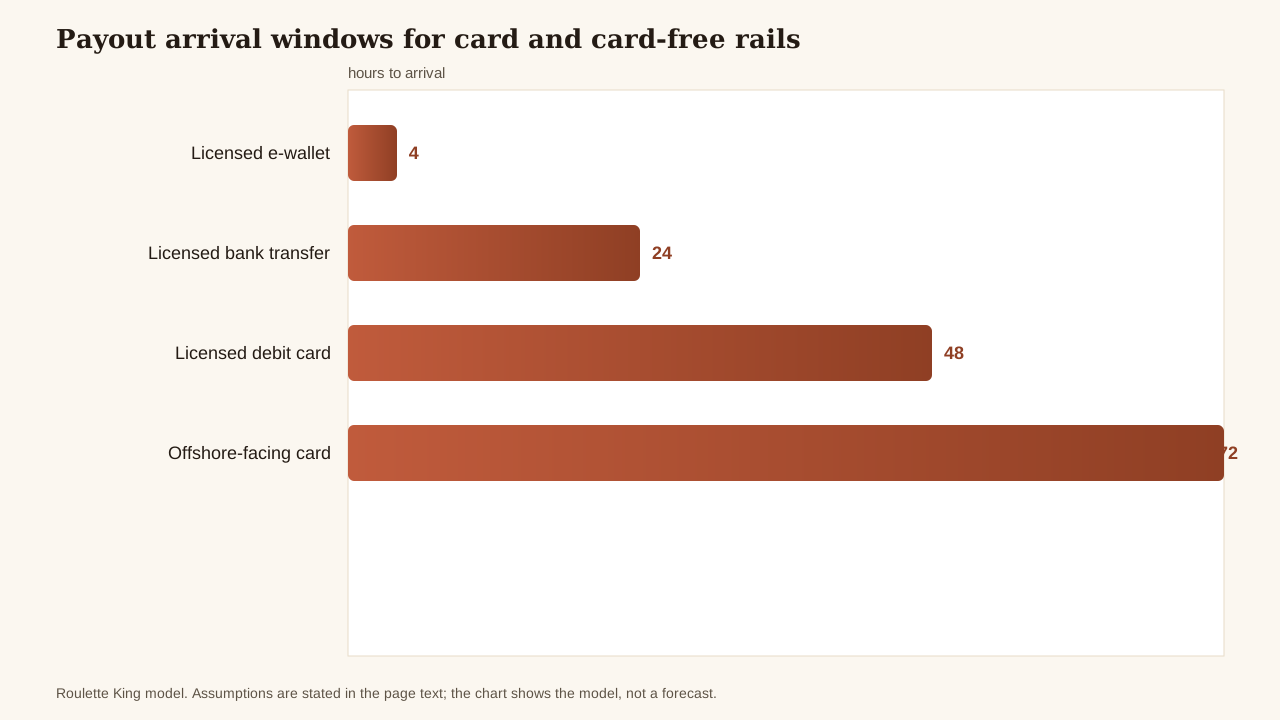
Point the same dispute at an offshore-facing cashier and the frame weakens. There is no UK regulator to escalate to, the operator may not answer an adjudicator it never agreed to recognise, and the card processor behind the deposit may sit in yet another jurisdiction. The figure's model windows give a sense of that distance: the offshore-facing card row carries the longest arrival band and the only fee in the set, because every extra party in the chain is another party a dispute has to cross. Weigh a deposit accordingly before it is made, not after.
A few habits reduce the need for any of this. Most UK banks offer a gambling block, which declines card transactions to betting merchants at the network level and can be locked on for a cooling-off period that cannot be undone on a whim. A separate card or account ring-fences a budget, and clean statement descriptors make the record easy to read months later. None of it changes the odds; all of it changes how much friction sits between an impulse and a payment.
What a UKGC licence buys you
A UKGC licence is the difference between a cashier with rules and a cashier with a referee. The headline purchase is GamStop, the national self-exclusion scheme at gamstop.co.uk, which closes a registered player out of every licensed gambling site in Britain for a chosen term of six months, one year or five years, with no way to undo the choice inside the term. A visa casino on the UK register takes part whether it is a sportsbook, a casino or both, so the exclusion follows the player across the whole licensed set rather than stopping at one site.
Dispute cover is the quieter purchase. Licensed operators must belong to an approved alternative dispute resolution service, so a complaint that stalls with the operator can be carried to an independent adjudicator, and the operator is required to engage with that process and its outcome. The service reviews the file, the terms and the transaction history, and it costs the player nothing to use. Without a licence that route simply does not exist, and a complaint ends where the operator's own inbox ends.
Funds and conduct come next. Licence conditions require customer money to be held separately from operating funds, with the level of that protection disclosed in the operator's terms, which keeps balances away from the day-to-day running of the business. The regulator also holds the enforcement pen: fines, licence conditions, suspensions and revocations are published, and the record can be searched before a deposit is made. That visibility is quiet but real, because it shapes how seriously an operator treats a complaint in the first place.
Offers without a UK licence carry none of it. No GamStop coverage, no adjudicator, no segregated-funds condition and no regulator who acts when a payout is refused, which is why a protections cell for such an operator can only read None. If gambling stops feeling like a choice, the National Gambling Helpline on 0808 8020 133, run by GamCare with BeGambleAware, is free to call and open around the clock, and it takes the same call whether the account at the centre of it is licensed or not.
Checking a licence takes two minutes. Every licensed operator appears on the UKGC's public register, searchable by name, and the register lists the trading names a licence actually covers rather than the ones a site claims in its footer. A badge on a homepage is a claim; the register is a record. Where the two disagree, the register decides, and a cashier that cannot be found there should be read as an offshore-facing proposition, with all of the protections that follow from that label.
Visa casino questions, answered
How fast do Visa casino deposits clear?
At a licensed visa casino, a debit deposit is authorised in seconds and the balance updates straight away, so play can begin immediately. The usual causes of delay sit outside the rail: an unfinished 3-D Secure step in the banking app, or an issuer declining the transaction for its own reasons. If a deposit fails, no money leaves the account, and a pending line on the statement normally drops off within a few days.
How long do card payouts take?
Expect one to three working days after the operator approves the request, with the pending stage adding anywhere from minutes to a day on top. Weekends and bank holidays pause card settlement, so an approval on Friday afternoon often completes in the middle of the following week. E-wallet withdrawals skip the settlement leg entirely, which is why the model prices them at under 24 hours.
Why do some bonuses exclude card deposits?
Most offers accept card deposits, but individual promotions can restrict eligibility to particular rails, and wallets have historically been the usual casualties of such lists. Operators restrict methods to control bonus abuse and to keep their accounting clean across payment providers, and occasionally a card-specific promotion runs the other way and excludes everything else. The only reliable check is the offer's own terms, where an excluded-methods list has to appear in full.
How safe are card deposits at online casinos?
At a licensed operator the layers stack up neatly: 3-D Secure authentication at the till, the scheme's zero liability policy for unauthorised use, segregated customer funds behind the licence, and deposit limits you set yourself. Add a bank gambling block and the rail becomes easy to keep on a short leash. The picture weakens offshore, where none of those structures applies and a deposit is only as protected as the processor holding it.
Do chargebacks work for gambling deposits?
They work for the reasons the scheme recognises: unauthorised use, duplicate charges or services that were never delivered. They do not work as a way to reverse a loss, because banks class settled gambling stakes as the cardholder's own decision, and misusing the process can cost you winnings built on the disputed deposit. Run the operator's complaint route and the independent adjudicator first, and treat the chargeback as the genuine last resort it was designed to be.
What are typical minimum deposits and withdrawals?
Deposits by debit card commonly start at £5 to £10, and several operators accept £5 as a floor across their cashiers. Withdrawal minimums tend to sit between £10 and £20, and fees are rare at licensed sites, though a few offshore-facing processors still charge a small percentage. Exact figures vary more between operators than between rails, so the cashier's help pages are the place to look before funding an account.
What does the licence gap mean in practice?
It means no GamStop coverage, no independent adjudicator for a dispute, no segregated-funds condition and no regulator with power over the operator. Deposits still clear and games still run, so the difference only shows itself when something goes wrong. That is the moment the UK protections, set beside each licensed brand in the comparison table, stop being fine print and become the whole story.