crypto casino
Crypto casino
An on-chain payout can land in under an hour where a card takes days; the model below prices speed, fees and the wagering that rides along.
The shortlist, before the detail
The board below carries this month's featured offers with their headline terms. The prose that follows models offers of this kind and never repeats those figures; the operator's own page is always the binding version.
Roulette King picks
Top roulette offers this month
The shortlist first, then the arithmetic. Four featured packages carry the headline terms below; the rest of the page models what offers of this kind usually cost and what a licence would have added.
Terms checked at the October 2026 review · 18+ · T&Cs apply. Offers move often: the operator’s own page is always the binding version.
- 1
 Night Luck82/100Casino welcome bonus 805% up to €6,400 + 280 FS
- MuchBetter · VISA · Apple Pay
- Crypto welcome 140% up to 1,600 USDT
- VIP pack 800% up to €14,500
Visit siteNight Luck18+ · T&Cs apply - 2
 EliteSpin80/100Welcome bonus €/£5,000 + 500 FS
- MuchBetter · NETELLER · MasterCard
- Lootboxes up to €/£20,000 or 500 FS
- BGaming festival: €80,000 prize pool
Visit siteEliteSpin18+ · T&Cs apply - 3
 Winbeast78/100Welcome pack €5,000 + 500 FS + €650 free bet
- MasterCard · Litecoin · MuchBetter
- Code FORTUNE: wheel on €40+ deposits
- Monday boost: 40% up to €300 (BOOST1)
Visit siteWinbeast18+ · T&Cs apply - 4
 Betportal75/100Welcome package 300% up to €/£1,000 + 150 FS
- Trustly · Bitcoin · Bank transfer
- 1st deposit: 150% up to €/£500 + 100 FS
- 2nd deposit: 100% up to €/£300 + 50 FS
Visit siteBetportal18+ · T&Cs apply
Placements on this board are paid, and the order is part of that arrangement. Featured brands hold no UK Gambling Commission licence, so GamStop, independent dispute resolution and segregated-funds rules do not reach them. Gambling can be addictive. Play responsibly. How we are paid.
Why crypto cashiers behave differently
A crypto casino behaves differently from a card-based one long before any reel spins, because the difference lives in the cashier rather than in the games. A debit card payment passes through an acquiring bank, a card scheme and a processor, any of which can reverse a transaction weeks later through a chargeback. A coin transfer runs across a public ledger instead: once the network has confirmed it, no bank can pull it back. That single design choice reshapes everything around it, from the fees a cashier charges to the checks it runs and the speed at which it pays out.
Settlement mechanics come next. With a card, an operator's processor confirms the money instantly and the banking chain absorbs the fraud exposure. With a coin, the network supplies confirmation on its own, and the cashier simply watches the ledger until a deposit has gathered enough confirmations to be treated as final. Bitcoin blocks arrive roughly every ten minutes, so a deposit credited after two confirmations waits about twenty minutes by design, with congestion stretching that window when the queue of pending transfers grows. Ethereum settles in seconds but prices its capacity through gas, which is cheap on a quiet day and expensive at peak.
Speed asymmetry has the same root. A card withdrawal is slow partly because an operator must wait for settlement cycles and guard against reversals; a coin withdrawal, once approved, is final money moving to an address the player controls, so there is less reason for delay beyond the cashier's own checks. The bottleneck shifts from banking to bookkeeping: queue position, batch cycles and manual review decide when a coin payout actually leaves, which is why two brands on the same chain can post very different arrival times.
Custody is the second fork in the road. Some cashiers hold deposits in coin, credit the account in coin and pay withdrawals from the same float, so the pound value of a balance drifts with the market while it sits there. Others convert on arrival, book the player in pounds behind the scenes and buy coin again only when a withdrawal is approved. The second approach removes price exposure but adds two conversion spreads, one on the way in and one on the way out. Which approach applies is rarely advertised, so the fee schedule and the currency shown beside the balance are the clues worth reading.
Stablecoins sit between those worlds. A coin pegged to the dollar behaves like money rather than like an asset, so a deposit keeps roughly its pound value while it rests in an account. Tether transfers on the Tron network, usually labelled TRC-20, settle for cents and clear in minutes, which explains why they have become the default rail for players who want crypto speed without crypto price risk. A peg is an assumption rather than a law of nature, though, and the worked example later treats it exactly that way, stated and then tested.
Regulation explains the rest of the split. A brand licensed by the Gambling Commission must know where a player's money comes from, must apply affordability checks at defined triggers and must be able to return funds through rails that carry consumer protections. Coin transfers complicate every one of those duties, which is why GB-licensed operators keep their cashiers in pounds, fed by debit cards, bank transfer and a handful of e-wallets. The offshore-facing part of the market faces no such framework, so it can accept coin, set its own limits and price its own risk.
Practically, a cashier page answers most questions in five lines. The currency of the balance, the deposit rails accepted, the withdrawal fee, the minimum withdrawal and the stated approval window together describe a cashier more accurately than any lobby ever will. Where a brand publishes its confirmation counts for each chain, that figure sets the floor on arrival time. Where a brand publishes none of these, the silence is itself information, and the conservative assumption is the one that costs more.
The rest of this page puts numbers on that difference. It prices each rail under stated assumptions, compares the cashier families side by side, works through the bonus terms that ride along with coin deposits and runs a full worked example on price movement. It ends with the licence question, because speed is only one part of what a cashier delivers, and the part that matters most is rarely the part that arrives fastest.
The cashier model: fees and arrival windows by rail
Every figure in this section is modelled rather than measured on any single account, and the assumptions are stated here rather than buried later. The model assumes October 2026 network conditions, with congestion on the major chains at levels typical of that month. It assumes conversion spreads of one per cent on the way in and one per cent on the way out unless a cash figure is given. Amounts sit in the mid-range, around £200 to £500, where fee tiers begin to matter, and the balance is treated as untouched by wins or losses so that the arithmetic isolates the cashier rather than the games. Arrival windows are typical observations of how each rail settles, never promises, and every cashier adds its own approval step on top. Taken together, the rows describe the rails a crypto casino actually runs, alongside the card baseline that licensed play depends on.
| Rail | Model fee | Model arrival | Notes |
|---|---|---|---|
| Bitcoin on-chain | network fee | 10 to 60 minutes typical | confirmation dependent |
| Ethereum on-chain | gas dependent | 1 to 15 minutes typical | gas spikes at peak |
| USDT on TRC-20 | about one dollar | 1 to 30 minutes typical | cheapest stable rail |
| Litecoin | low fee | 2 to 30 minutes typical | low-value payouts |
| GBP debit card | none | 1 to 3 working days | the licensed baseline |
| offshore-facing card | 0 to 3 percent | 2 to 5 days | processor dependent |
Bitcoin's window is the widest in the model because its fee market is an auction. Miners fill each block with whichever transfers pay the most, so a deposit or withdrawal travels as quickly as its attached fee justifies. At two confirmations, a common standard for crediting a cashier account, the wait lands between ten and sixty minutes under October 2026 conditions, and it stretches when the mempool is busy. The network fee itself stays modest for a mid-range transfer, though who pays it varies: some cashiers deduct it from the withdrawal, others absorb it and recover the cost elsewhere in the schedule.
Ethereum behaves differently because its capacity is priced continuously. Block times run in seconds, so once the network has accepted a transfer the wait is short, typically one to fifteen minutes including a cashier's confirmations. The variable is gas: fees spike when the chain is crowded, and a withdrawal scheduled at the wrong hour can cost several times the same transfer sent at dawn. Some cashiers route through cheaper layer-two networks to blunt the spike, but support varies widely, so the figures keep to the main path.
Tether on Tron is the cheapest stable rail in the figures. The network charges a flat cost of about one dollar per transfer, roughly 80p at the assumed exchange rate of 1.25 dollars to the pound, and the pegged value means the amount sent is the amount received. Clearing runs from one to thirty minutes, driven more by a cashier's confirmation policy than by the chain itself. For players moving working balances rather than holding coin, this rail prices cheapest, which is why so many offshore-facing cashiers give it the most prominent place in their menus.
Litecoin occupies a narrower but useful corner. It was built for cheap everyday transfers, so the network fee is low and clearing runs from two to thirty minutes. That makes it the sensible rail for low-value payouts, where a bitcoin fee would eat a visible slice of a small withdrawal. It remains a volatile asset rather than a pegged one, so everything the worked example says about price movement applies to it in full.
The two card rows anchor the other end of the scale. A GBP debit card payout carries no fee and lands in one to three working days at licensed operators, and that window includes the operator's own pending period rather than the bank's, which usually posts the money the day it receives it. An offshore-facing card payout depends on the processor: fees from zero to three per cent, arrival in two to five days, and a higher chance of declines or refunds being held up along the way. The licensed rail is slower on paper and steadier in practice, and it is the baseline every other rail is measured against.
Approval time is the missing column, and it is missing deliberately. The windows quoted here describe what happens once a cashier has approved a payment, not the review that precedes it. Offshore-facing brands commonly hold withdrawals for internal review, with up to forty-eight hours a fair typical observation, and the fastest chain in the world cannot shorten that step. Total arrival is approval plus rail, and approval is nearly always the larger share of the two, which is why a cashier's stated review window deserves as much attention as its choice of chains.
Using the windows well is mostly about sequencing. A player who needs money by a Friday should not begin a coin withdrawal on Thursday night at a brand with a forty-eight hour review window, while a player moving balances between platforms can schedule around quiet network hours to trim fees. None of the windows is fixed; all of them shift with demand; and the only reliable plan is to leave a margin between the moment money is needed and the moment the request is made.
Three cashier families, compared on licence and rails
One table lines the cashier families up side by side on licence, market focus and the rails each runs, because that is where the practical differences live.
| Casino | Licence | Market focus | What it is known for | UK protections |
|---|---|---|---|---|
| Roobet | No UK licence | crypto-native casino | originals and a crypto-only cashier | None |
| Gamdom | No UK licence | crypto-first casino | instant crypto play with community features | None |
| Mystake | No UK licence | offshore-facing casino | broad crypto support beside card rails | None |
| Goldenbet | No UK licence | offshore-facing casino | crypto cashiers with spins packages | None |
| Donbet | No UK licence | offshore-facing casino | crypto-friendly cashier and high limits | None |
| Rolletto | No UK licence | offshore-facing brand | multi-coin cashier with high tables | None |
| NineWin | No UK licence | offshore-facing casino | gamified lobby with a crypto cashier | None |
| Bet365 | UKGC licensed | sportsbook-first giant | no crypto rail: GBP debit cards only | Yes, full scheme |
| Betway | UKGC licensed | global bookmaker | GBP cashier, debit and e-wallet rails | Yes, full scheme |
| Unibet | UKGC licensed | European bookmaker roots | mainstream cashier, no crypto support | Yes, full scheme |
| 888 Casino | UKGC licensed | long-running standalone casino | GBP cashier with debit cards and PayPal | Yes, full scheme |
| PartyCasino | UKGC licensed | casino-first brand | card and e-wallet rails under UK rules | Yes, full scheme |
Roobet and 888 Casino sit at the two poles of that split. Roobet is a crypto-native casino built around originals and a crypto-only cashier, with no UK licence behind it, while 888 Casino is a long-running standalone casino whose GBP cashier runs on debit cards and PayPal under the full UK protection scheme. Their cashiers do not overlap at any point: one never leaves the chain, the other never touches it.
The crypto-native family treats coin as the currency of the account rather than as a payment method. Lobbies in this group lean on original games and community features, balances are credited in coin and the cashier is designed so that a player never needs a bank at all. Speed is the selling point when a crypto casino is built this way, and the figures show why: with approval prompt and the chain quick, a payout can complete inside an hour. What the family lacks is any UK oversight, so the protections column tells a plain story, and every term of play rests on the operator's own words.
The offshore-facing family runs a mixed cashier. Coin sits beside card rails, limits run higher, lobbies are gamified and spins packages are common, which makes this the most flexible group for a player arriving with both pounds and coin. Flexibility has a price that is not denominated in money: these brands operate outside UK regulation, so there is no independent adjudicator for disputes and no expectation of segregated funds, because none of them holds UK permission in the first place.
The licensed family is the counterweight. Its cashiers run in pounds through debit cards, bank transfer and a small set of e-wallets such as PayPal, and coin is not accepted anywhere in the group, because the rules on source of funds and payment protection make it impractical to run a compliant coin rail from Britain. Speed is the trade: a card payout takes days rather than minutes. What arrives with the delay is the full scheme, from GamStop enrolment to independent dispute resolution, and for many players that trade is the entire decision.
The descriptors in the comparison are shorthand, and shorthand omits. Market focus describes where a brand directs its energy, not the quality of its cashier; known-for phrases describe what a brand advertises about itself; and neither carries any judgement about how a brand behaves at withdrawal. Those judgements have to come from the terms, the fee schedule and the protections that sit behind the brand, which is why the licence column outweighs everything else on the page.
Reading the three families together suggests an order of questions: licence first, rail second and lobby last. A cashier can only be as trustworthy as the rules standing behind it, the rail decides the fees and the hours, and the lobby decides almost nothing that involves money. That ordering runs through everything that follows, and it is why the licence section arrives last yet carries the most weight.
Fees, spreads and where the hours actually go
Costs arrive in three layers, and conflating them is how players overpay. The network fee goes to the chain and varies with congestion. The conversion spread goes to whoever swaps coin for pounds, taken once on the way in and once on the way out, and the assumptions here price it at one per cent each way. The processing fee, where one exists, goes to the cashier as a flat charge and hides in the terms rather than on the button. A quote that mentions only the network fee is describing one layer of three.
The figure plots the arrival stage in hours from the moment a cashier approves a payout, and its shape says a lot. On-chain rails bunch at the left, with bitcoin stretching furthest when congestion builds, while the card rails trail away to the right into days. What the figure cannot show is the approval stage, which sits before the first plotted hour begins and can last longer than everything on the chart combined. A fair expectation for a crypto casino payout is approval measured in hours or days, followed by a chain window measured in minutes.
Conversion adds a second currency problem that is easy to miss. Coin is priced globally in dollars, so a pound deposit usually buys dollars first and coin second, with the reverse happening at withdrawal. At the assumed exchange rate of 1.25 dollars to the pound, two spreads of one per cent each way cost about £10 across a £500 round trip before any network fee is counted. Cashiers that price directly in pounds remove one leg of that journey, and their fee schedules usually say so, which is one more reason the schedule is worth reading in full.
Minimums and fixed fees interact badly at small sizes. If a withdrawal carries a fixed network cost of 0.00003 bitcoin, worth about £1.50 at the assumed rate of £50,000 per coin, then a £50 withdrawal costs three per cent in fees while a £500 withdrawal costs 0.3 per cent. Splitting a balance into four small payments quadruples the fixed cost to roughly £6.00, so one consolidated payout saves both money and waiting. The same logic applies to cashier processing fees, which are charged per payment rather than per pound.
Congestion has a rhythm worth knowing. Bitcoin fees and confirmation times rise around busy trading periods, ethereum gas spikes when a popular application draws traffic, and exchange liquidity thins at weekends, which can widen spreads exactly when players have the most free time. None of this appears in a cashier's headline rate, and all of it lands in the round trip. Stablecoin rails dodge the gas spike but not the approval queue, which is why the approval stage deserves as much attention as the chain itself.
E-wallets occupy a middle case worth noting. PayPal and similar services clear faster than cards at licensed operators, often within twenty-four hours, yet they carry no market exposure and no network fee, which makes them the quiet benchmark for speed with certainty in pounds. Their absence from coin play is telling: the same consumer protections that make e-wallets attractive are tied to regulated payment institutions, and coin rails stand outside that system by design.
Reading a fee schedule is a five-minute exercise with a short checklist. Find the currency the balance is held in, because that decides price exposure. Find the withdrawal fee, whether flat or percentage-based. Find the conversion spread, or the statement that there is none. Find the minimum withdrawal and the stated approval window. If any of the five cannot be located, treat the missing line as a cost waiting to be discovered and price it conservatively before any deposit, because terms that are hard to find are usually expensive to learn about.
Bonus terms that ride along with coin deposits
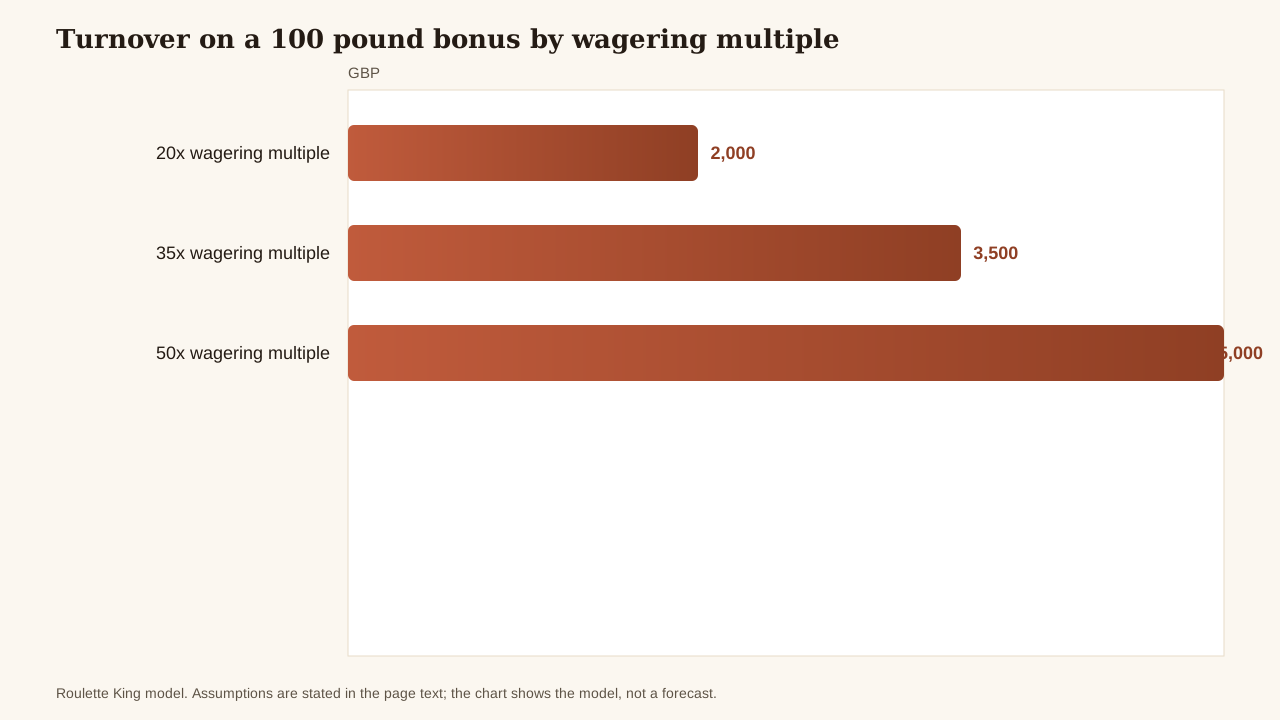
Wagering requirements attach to the promotion, not to the rail, so a coin deposit inherits every multiplier a brand applies to card deposits. Offshore-facing brands commonly state requirements between thirty and fifty times the bonus, sometimes higher. The arithmetic is simple and unforgiving: a 35x requirement on a £100 bonus demands £3,500 of turnover before a withdrawal unlocks, and at ordinary slot stakes that is a long campaign rather than an evening.
The base the multiplier applies to matters as much as the number itself. A requirement quoted on deposit plus bonus doubles the platform: 35x on a £100 deposit and a £100 bonus is £7,000 of turnover, not £3,500. Terms rarely highlight which base applies, so it is worth finding the exact sentence before accepting anything. Declining a promotion is nearly always possible, and it removes the multiplier along with the obligation.
Game weighting then decides how quickly the turnover builds. Slots typically count at one hundred per cent, table games at ten per cent or not at all, and some titles are excluded outright. A max bet rule usually applies while wagering is live, and exceeding it can void winnings in a single move. Coin deposits are rarely excluded from promotion eligibility at offshore-facing brands, but method exclusions do exist elsewhere in the market, so the payment section of the terms deserves a scan.
Worked briefly, weighting changes the shape of a requirement. A 35x bonus requirement on £100 cleared entirely on slots needs £3,500 of spins. If half of it were cleared on table games weighted at ten per cent, every £100 of blackjack would count as £10, so that half would need ten times the table volume. Budgeting by the headline multiplier alone therefore understates the effort whenever low-weighted games are in the mix, and the honest plan is either to clear the requirement where it counts at full value or to skip the promotion.
Caps and locks complete the picture. Winnings from free spins often carry a conversion cap, withdrawal requests stay locked until wagering finishes, and some cashiers let a player forfeit the remaining bonus and release the rest of the balance. Coin adds one more wrinkle: where a requirement is set in coin rather than in pounds, the pound cost of clearing it moves with the market, so the true price of the promotion is not known until the final spin settles.
A few patterns help set expectations. Requirements under twenty times are uncommon at offshore-facing brands. Requirements quoted in pounds are easier to budget than requirements quoted in coin. Any promotion whose terms cannot be read in full before a deposit is a promotion to decline, whatever the rail, because the cost of a bonus is the terms rather than the headline figure.
To turn a stated multiplier, base and weighting into the turnover it actually demands, the effective-rate calculator on this page reduces a set of terms to one comparable figure.
Effective bonus cost calculator
Deposit, match and multiple turned into credited money, turnover and a modelled cost.
Model illustration with stated inputs; the terms of a specific offer always override a model.
Price movement between deposit and payout, worked in pounds
This worked example isolates the cashier from the games by assuming the balance is unchanged between deposit and withdrawal, so every pound of difference comes from the rail itself. The assumptions: a deposit of £500; an entry rate of £50,000 per bitcoin, chosen for clean arithmetic rather than as a forecast; a conversion spread of one per cent on the way in and one per cent on the way out; a deposit network fee of £2; a withdrawal network fee of 0.00003 bitcoin; and forty-eight hours between the two legs. The rail a crypto casino runs is also a market position, which the arithmetic makes explicit at every step.
Entry works like this. The £500 loses £5.00 to the entry spread, leaving £495.00 to convert at £50,000 per coin, which buys 0.0099 bitcoin. The £2.00 deposit fee takes a further 0.00004 coin, so the account is credited with 0.00986 bitcoin, worth £493.00 at the entry rate. Nothing in that paragraph involves the games; it is purely the cost of crossing from pounds into coin.
Suppose the price falls ten per cent across the forty-eight hours, to £45,000. The balance of 0.00986 coin is then worth £443.70. The withdrawal fee of 0.00003 coin leaves 0.00983 to sell, which returns £442.35 at the new rate, and the exit spread of one per cent takes £4.42, so £437.93 lands back in pounds. Against £500 deposited, the shortfall is £62.07, and it splits cleanly: £49.30 of price movement, £5.00 entry spread, £2.00 deposit fee, £1.35 exit fee and £4.42 exit spread.
The upside runs the same arithmetic in reverse. At £55,000, the same 0.00983 coin sells for £540.65, the exit spread takes £5.41, and £535.24 arrives, a gain of £35.24 on the original £500. Friction across the two legs came to £14.06 on that path, against £12.77 on the falling path, because the exit fee is charged in coin and is therefore worth more when prices are higher. The constant is the friction; the variable is the exposure.
Stablecoins tell the opposite story. Assume the dollar peg holds, the exchange rate stays at 1.25 dollars to the pound in both directions, the spread is one per cent each way and the TRC-20 fee is about one dollar, roughly 80p. The £500 becomes £495.00 of stablecoin credit; the fee takes it to £494.20; the exit spread takes £4.94; and £489.26 comes home. The shortfall of £10.74 is entirely friction, with no price term at all, provided the peg holds. That condition does real work in the arithmetic, so it is stated as an assumption rather than smuggled in as a fact.
A depeg would break the example rather than bend it. If the coin traded at 98 cents against its dollar target, the same round trip would carry a two per cent price term, and the tidy separation between friction and exposure would collapse. Peg health is visible on any major price tracker, so it is a checkable assumption rather than a leap of faith.
Card rails flatten everything. A £500 deposit on a GBP debit card at a licensed operator returns £500 with no fee and no market exposure, at a cost of one to three working days; an offshore-facing card return carries up to three per cent in processor fees and two to five days of waiting. Set beside the coin examples, the trade is explicit: the licensed rail sells certainty for days, the coin rails sell hours for exposure. A balance held in coin should be read in pounds every time it is checked, because a drifting number can look like winnings when it is really the same money wearing a different price. The licence section that follows names where free, confidential help is available if that line ever blurs.
What a UK licence buys, and what its absence costs
A licence from the Gambling Commission buys four specific things. It gives access to GamStop, the national self-exclusion scheme. It gives access to independent dispute resolution when a complaint stalls. It requires customer funds to be held separately from operating money. And it puts a regulator behind the counter, one with the power to investigate, fine and suspend. Offers of this kind without a UK licence carry none of those four, whatever the cashier rail. In day-to-day terms, the scheme means a complaint about a withheld payout has somewhere to go, a self-exclusion actually holds across the market, and money in a player's balance is not funding the operator's next marketing campaign.
GamStop deserves the detail. Registration at gamstop.co.uk is free, takes minutes and excludes a player from every GB-licensed online operator for a chosen term of six months, one year or five years, with no route back until the term ends. An offshore-facing brand cannot be part of that system, so any exclusion it offers depends on its own goodwill and its own tools, and it cannot be enforced from Britain. For anyone using self-exclusion as a guardrail, that difference is the whole argument.
Dispute resolution and segregated funds work quietly until they are needed. An unresolved complaint against a licensed operator can be escalated to an independent adjudicator, whose decision the operator is bound to accept, and money held in segregated accounts survives an operator's insolvency rather than joining the creditors' queue. A brand with no UK licence offers neither mechanism: complaints end where the operator decides they end, and balances sit wherever the operator keeps them.
Coin sits entirely outside that frame. Because GB-licensed cashiers do not accept crypto, every coin balance on the market is held at a brand with no UK permission, which means no regulator to escalate to, no adjudicator to appeal to and no segregated-funds expectation behind the float. That is not a claim that any particular offshore-facing brand behaves badly; it is a description of which protections exist and which do not, and it deserves to be weighed at deposit time rather than discovered at withdrawal time.
Checking takes minutes. The Commission's public register shows every business authorised to offer gambling to people in Britain, searchable by name, and a brand that cannot be found there is not licensed by it, whatever its website claims. The register also shows the trading names attached to each licence, which matters because offshore-facing sites sometimes operate sister brands with reassuringly British-sounding names. A few seconds of typing is cheaper than any dispute.
Help is available regardless of where a player's money sits. The National Gambling Helpline on 0808 8020 133, run by GamCare with BeGambleAware, is free to call, open around the clock and staffed by trained advisers, and it exists for people rather than for operators, so it applies equally to play on licensed and offshore-facing brands. Registration at gamstop.co.uk covers the licensed side of the market; elsewhere, self-imposed limits and the helpline carry the load, and the helpline can point towards further free support.
Frequently asked questions
How fast do crypto payouts actually arrive?
Two clocks run in sequence: the cashier's approval, then the rail itself, and the figures in the model describe the second clock only. From approval, bitcoin typically lands within ten to sixty minutes, ethereum within one to fifteen, USDT on TRC-20 within one to thirty and litecoin within two to thirty, under October 2026 conditions. GBP card payouts run one to three working days, and offshore-facing card payouts two to five. Approval is the wildcard: when a cashier reviews payments manually, the wait before the chain can exceed everything after it, so an hour is possible on a smooth run and a day or two is common when queues form. These are typical observations of the market rather than promises from any brand.
What does a crypto deposit actually cost?
Three layers, counted separately. The network fee goes to the chain and, at October 2026 conditions, stays modest for mid-range transfers on bitcoin, varies with gas on ethereum and comes to about one dollar, roughly 80p, on TRC-20. The conversion spread is modelled at one per cent on the way in and one per cent on the way out, about £10 across a £500 round trip. Some cashiers add a flat processing fee per withdrawal, visible only in the terms. Deposit-side costs are often absorbed by the cashier; exit-side costs are where the money goes, which is why the withdrawal schedule deserves more attention than the deposit one.
Do GB-licensed brands accept crypto?
No, and the reason is structural rather than fashionable. A licensed operator must trace the source of a player's funds, must apply affordability checks at defined triggers and must support rails that carry chargeback protections, because those are the duties the licence is built on. Coin transfers frustrate each of them, so licensed cashiers stay in pounds, fed by debit cards, bank transfer and a small set of e-wallets. Anyone hoping for a UK licence and a coin rail together is looking for a combination this market does not currently offer, and the split set out in the comparison reflects that honestly. The divide is deliberate, and it is the sharpest line in the crypto casino market.
How is price movement handled between deposit and payout?
It depends on custody. Where an account is credited in coin, the balance moves with the market minute by minute, and the worked example shows the range: on £500, a ten per cent price fall across forty-eight hours leaves £437.93 once fees and spreads are paid, while a ten per cent rise returns £535.24. Where the cashier converts on arrival and keeps the account in pounds, price exposure disappears but two spreads appear instead. Stablecoins remove most of the exposure while the peg holds, which is why TRC-20 transfers price so attractively for players who want speed without taking a market position.
How does wagering work on crypto bonuses?
By the same mechanics as any other promotion: a multiplier, a base, game weightings, a max bet rule and caps. A 35x requirement on a £100 bonus is £3,500 of turnover; quoted on deposit plus bonus, the same figure becomes £7,000. Weightings slow the pace at which turnover builds on table games, and exceeding the max bet can void winnings outright. The coin-specific wrinkle is a requirement denominated in coin, whose pound cost shifts with the market while it is being cleared. The effective-rate calculator on this page reduces a given set of terms to one figure, which makes two brands' promotions comparable at a glance.
What are typical minimum deposits and withdrawals?
Coin minimums are usually low, with £10 to £20 equivalents common for deposits and similar figures for withdrawals, though every cashier sets its own. The trap sits with fixed fees rather than with minimums: a network fee worth about £1.50 on a £50 withdrawal is three per cent, while the same fee on £500 is 0.3 per cent, so small, frequent withdrawals are the most expensive way to move money. Card minimums sit at similar levels with no network fee attached. Every threshold quoted here is a typical observation across this part of the market, and the cashier's own payments page has the final word.
What does the licence gap mean in practice?
Four absences, each concrete. No GamStop enforcement, because offshore-facing brands sit outside the scheme operated at gamstop.co.uk. No independent adjudicator, so an unresolved complaint ends where the operator says it ends. No expectation of segregated funds, so a balance is only as secure as the operator's solvency. No regulator with authority over the brand, so there is nobody to escalate to. None of that says an individual brand will misbehave; it says that if one does, the protections a British player would otherwise rely on are simply not there. The National Gambling Helpline on 0808 8020 133 remains available either way, because it serves people rather than operators.
Which rail makes the most sense?
Match the rail to the priority rather than to the fastest headline. Players moving working balances tend to favour TRC-20 stablecoins for near-flat costs and pegged value. Players holding coin as coin accept exposure knowingly and usually prefer bitcoin or ethereum for liquidity. Small balances suit litecoin, where fixed fees stay proportionate. Anyone prioritising protections has one answer: a GBP debit card at a licensed operator, slower by days and backed by the full scheme. Speed alone rarely decides anything, because approval time dwarfs chain time at many offshore-facing brands, so the real question is which trade, in hours, fees and protections, a player is choosing to make.