slots sign up bonus
Slots Sign Up Bonus: Game Weighting and the Wagering Maths
A £100 slots bonus leaves about £44 of modelled cash at 20x wagering and about £9 at 60x; the weighting rules and the multiplier decide everything in between.
The shortlist, before the detail
The board below carries this month's featured offers with their headline terms. The prose that follows models offers of this kind and never repeats those figures; the operator's own page is always the binding version.
Roulette King picks
Top roulette offers this month
The shortlist first, then the arithmetic. Four featured packages carry the headline terms below; the rest of the page models what offers of this kind usually cost and what a licence would have added.
Terms checked at the October 2026 review · 18+ · T&Cs apply. Offers move often: the operator’s own page is always the binding version.
- 1
 Night Luck82/100Casino welcome bonus 805% up to €6,400 + 280 FS
- MuchBetter · VISA · Apple Pay
- Crypto welcome 140% up to 1,600 USDT
- VIP pack 800% up to €14,500
Visit siteNight Luck18+ · T&Cs apply - 2
 EliteSpin80/100Welcome bonus €/£5,000 + 500 FS
- MuchBetter · NETELLER · MasterCard
- Lootboxes up to €/£20,000 or 500 FS
- BGaming festival: €80,000 prize pool
Visit siteEliteSpin18+ · T&Cs apply - 3
 Winbeast78/100Welcome pack €5,000 + 500 FS + €650 free bet
- MasterCard · Litecoin · MuchBetter
- Code FORTUNE: wheel on €40+ deposits
- Monday boost: 40% up to €300 (BOOST1)
Visit siteWinbeast18+ · T&Cs apply - 4
 Betportal75/100Welcome package 300% up to €/£1,000 + 150 FS
- Trustly · Bitcoin · Bank transfer
- 1st deposit: 150% up to €/£500 + 100 FS
- 2nd deposit: 100% up to €/£300 + 50 FS
Visit siteBetportal18+ · T&Cs apply
Placements on this board are paid, and the order is part of that arrangement. Featured brands hold no UK Gambling Commission licence, so GamStop, independent dispute resolution and segregated-funds rules do not reach them. Gambling can be addictive. Play responsibly. How we are paid.
What a £100 bonus is worth at each multiplier
A £100 bonus pushed through this model comes out at about £44 of expected cash at 20x, £29 at 30x, £20 at 40x and £9 at 60x. Four assumptions do all the work: the slots played return 96 percent on average, the wagering is measured on the bonus alone, and an edge of 4 percent is charged on the running balance each time it turns over in full. Nothing in that arithmetic depends on any particular site, so the numbers describe offers of this kind rather than any named promotion.
The shape of the fall matters as much as any single bar. Because the 4 percent take is charged on whatever balance remains rather than on the original £100, losses taper as the balance shrinks and the curve decays instead of sliding to zero. A naive subtraction would show nothing left by 30x; the compounding model still shows £29 at that point, £20 at 40x and £9 at 60x. Each extra multiple of turnover costs the same 4 percent in proportion but fewer pounds in absolute terms, which is why the bars bunch closer together as the multiplier climbs.
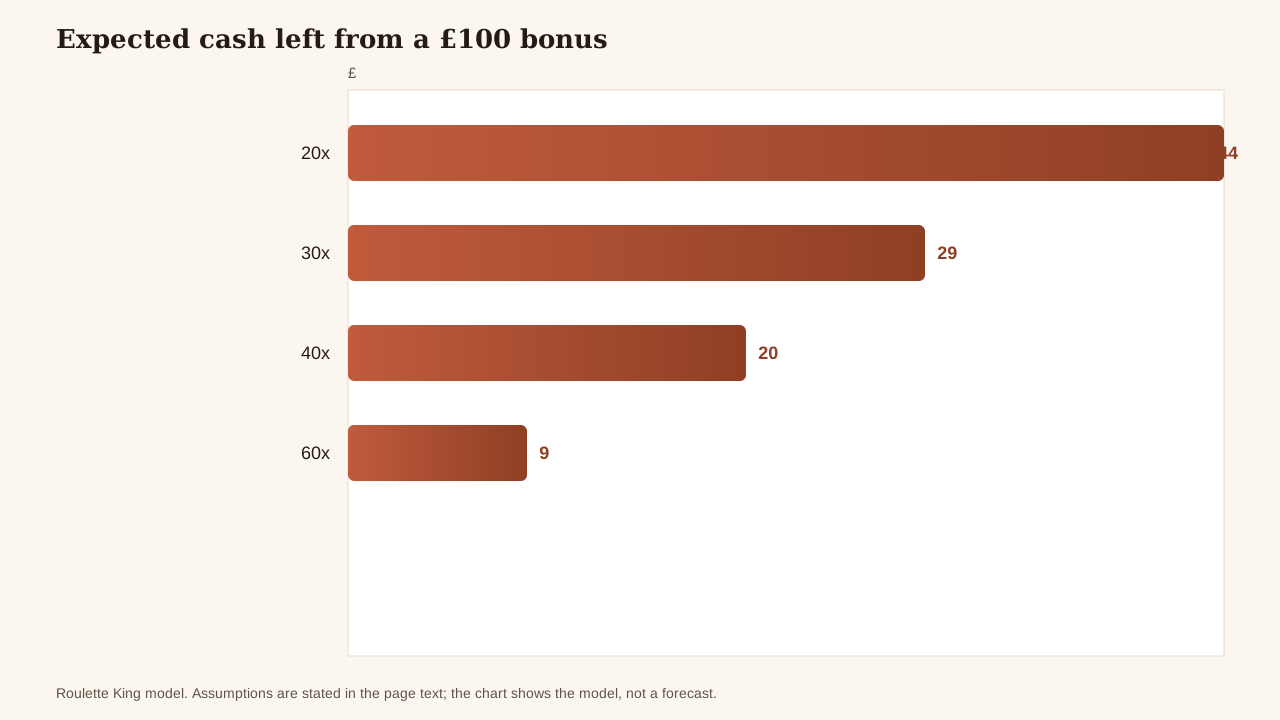
Treat the bars as averages over many attempts at the same offer rather than predictions for any single evening, because slots swing well beyond their average. What the model fixes is the drift: every block of turnover equal to the bonus pulls the expected balance down by 4 percent of whatever it holds, and the multiplier simply counts how many of those blocks stand between the credit and the cash.
What game weighting does to the maths
Weighting decides how much of each pound staked counts towards the multiplier. Standard video slots sit at 100 percent, so £1 of play clears £1 of requirement. Table games such as roulette and blackjack usually count at 10 percent, so the same pound clears 10p. Live dealer tables range from 0 to 10 percent depending on the title, and a short list of games, typically progressive jackpots, bonus-buy slots and titles with unusually high returns, counts for nothing at all.
The effect on a slots sign up bonus is stark, because the multiplier is defined on counted turnover. Take 30x on £100: that is £3,000 counted. On slots at 100 percent it means £3,000 of real stakes. On table games at 10 percent it means £30,000 of real stakes to build the same counted figure, ten times the action for the same credit. On excluded titles it means nothing ever clears, because no fraction of those stakes reaches the counter.
So the contribution list deserves as much attention as the multiplier itself. Two offers both marked 30x can differ by a factor of ten once the bands are applied, and an evening drifting across excluded games can pass without the requirement moving a penny. The next section turns the bands into something more tangible: hours.
From multiplier to hours at the reels
Turnover becomes time once a stake rate is assumed. The model here runs at 400 spins an hour at £1.50 a spin, which is £600 of staked money an hour, a brisk but ordinary pace for online reels. At that rate the £3,000 needed for 30x on a £100 bonus takes about 5 hours of slots play. Stake 20p instead and the pace falls to £80 an hour, stretching the same turnover to about 37 hours, long enough to collide with an expiry set at 7 days.
This table sets out the bands the model uses for a 30x requirement on a £100 bonus, with the assumptions stated alongside every row. The figures are calculated rather than measured, so change the stake rate and the hours scale in direct proportion.
| Game band | Counted weight | Staked money to clear 30x on £100 | Modelled clearing hours | Assumptions in the model |
|---|---|---|---|---|
| Standard video slots | 100 percent | £3,000 | about 5 hours | 400 spins an hour at £1.50 a spin, £600 of turnover an hour, 96 percent return |
| RNG table games | 10 percent | £30,000 | about 50 hours | same counted target; £10 a hand at 60 hands an hour gives £600 an hour |
| Live dealer tables | 0 to 10 percent | £3,000 to £30,000, or never | 5 to 50 hours, or never | many live titles count nothing; the contribution list rules per table |
| Reduced-weight slots | 20 to 50 percent | £6,000 to £15,000 | 10 to 25 hours | a minority band of high-return titles; same £600 an hour stake rate |
| Excluded titles | 0 percent | none | never clears | progressive jackpots, bonus-buy games and a short blocked list, assumed at 10 to 20 titles |
Only the 100 percent band finishes inside an evening. The 10 percent band needs roughly 50 hours even at a brisk table pace, which is another way of saying that clearing a slots bonus on blackjack is a project rather than a plan. The zero percent bands never move the counter at all, and the reduced band in the middle is the quiet trap: a title counting at 20 percent needs five times the staked money of a standard slot for the same credit, and nothing on the reels announces it.
Worked arithmetic you can check
The method is short enough to check by hand. First, counted turnover: the multiplier times the bonus, so £100 at 30x is £3,000 counted. Second, staked money: divide by the weighting, which leaves £3,000 on slots at 100 percent and £30,000 on tables at 10 percent. Third, hours: divide by the stake rate, so £3,000 at £600 an hour is 5 hours. Last, value: each block of turnover the size of the bonus takes 4 percent off the running balance, so 30 blocks leave 100 multiplied by 0.96 taken to the power of 30, about £29.
Wagering calculator
Turnover before withdrawal, modelled from the bonus and the multiple the terms set.
Model illustration with stated inputs; the terms of a specific offer always override a model.
Run the same steps on a smaller credit and the trade between size and multiplier appears. A £40 bonus at 20x needs £800 counted, about an hour and 20 minutes at £600 an hour, and the model values it at 40 multiplied by 0.96 to the power of 20, roughly £18. A £100 bonus at 60x needs £6,000 counted, ten hours at the same pace, and values at about £9. The larger, heavier offer wins on headline, loses on hours, and still loses on expected cash.
Keep the assumptions honest when re-running the figures. The 4 percent edge matches slots near a 96 percent return; titles below that decay faster and the expected cash falls with them. Reduced and zero weight bands contribute at their stated rates, and any turnover on excluded titles contributes nothing, however much of it there is.
Real money first, bonus second
The order in which a site spends balances changes the answer more than most terms do. On a split wallet, deposited cash stays cash: it can be played or withdrawn on its own, while the bonus decays under its wagering. Deposit £100, take a £100 match at 60x measured on the bonus alone, and the model holds your cash at £100 while the bonus grinds towards £9, a combined expectation near £109.
Terms that wager the deposit and the bonus together put your own money in the path of the same edge. Take the same £100 deposit and £100 match, with 30x applied to the pair: £6,000 of counted turnover, sixty bonus-sized blocks, and an expected balance of 200 multiplied by 0.96 to the power of 60, about £17. Measured on the bonus alone, the same 30x leaves your £100 untouched plus about £29 of modelled bonus value, close to £129. The gap between £129 and £17 is the value of knowing which wallet the wagering touches.
Sticky credits add a final twist, because the bonus itself may never be withdrawable no matter how much survives the turnover. In those terms the model's output is an upper bound: whatever the bars show, part of the surviving balance remains a stake to be played rather than money to be banked, so discount the figure before comparing it with cash-first deals.
The no-wagering corner of the market
A different kind of offer skips the decay entirely. Cashiers at this end of the market credit spins or bonus cash as withdrawable money from the first spin, with no multiplier attached and no contribution table to consult. In the model the effect is total: a £10 bundle of spins at 10p each carries its full £10 of value, while a £100 match at 40x carries about £20. Per pound of headline, nothing attached is worth five times more.
The trade is size. No-wagering credits tend to be small, £5 to £20 of spins rather than three figures of match, so the absolute cash can still favour the bigger bonus: £20 beats £10 even after the decay. The fair comparison is therefore between effective value and effort. A slots sign up bonus at 20x leaves about £44 after roughly three hours of modelled play, while a small no-wagering credit delivers its full value in the minutes the spins take. Offers of this kind suit anyone who prefers the maths settled before the first spin.
Weighting barely registers at this end, because there is no requirement left to weight against. What fine print remains is ordinary rather than structural: spins pinned to named titles, values fixed at 10p or similar, winnings paid as cash with no conversion hurdle. The decay curve simply never appears, which makes this corner the natural benchmark for every heavier offer in the market.
The small print that moves the number
Four clauses move the number most. The first is the base of the multiplier: measured on the bonus alone, 20x on a £100 match is £2,000 of counted play, but measured on deposit plus bonus it is £4,000, which behaves in the model like a 40x deal on the bonus alone, worth about £20 rather than £44, before counting what the same turnover does to your own deposit. The second is the stake cap while wagering, commonly between £2 and £5 a spin, which stops anyone pushing past the pace the table assumes.
The third is expiry. Spins often expire within 7 days and matches within 30, and unmet wagering usually forfeits the bonus and its winnings together. The 37 hours modelled for small-stake play at 30x fits inside a week only if the evenings are genuinely spent there. The fourth is the conversion cap, where some promotions limit what a bonus can pay out, often to a multiple of the credit itself; a cap below the modelled expectation trims the top off any attempt that runs hot.
Restrictions belong in the same list even though weighting covers them, because contribution tables change: a title counted at 100 percent last month can sit on the blocked list this month. Reading the significant terms before depositing takes minutes and answers the only question the headline cannot, namely how many hours the multiplier really means at the stakes you actually play.
How slots-first and games-first brands line up
The market divides into a few recognisable shapes: no-wagering pioneers that pay spins as cash, slots-first libraries built on the sheer number of titles, games-led brands leaning on franchise slots and wallet features, and offshore-facing sites competing on headline matches. This comparison lines up examples of each shape with the licence position stated plainly, because protections follow the licence rather than the promise in the advert.
| Casino | Licence | Market focus | What it is known for | UK protections |
|---|---|---|---|---|
| MrQ | UKGC licensed | no-wagering pioneer | spins paid with nothing attached | GamStop, ADR, segregated funds |
| PlayOJO | UKGC licensed | no-wagering model | every spin paid in cash | GamStop, ADR, segregated funds |
| Videoslots | UKGC licensed | slots-first casino | one of the largest licensed libraries | GamStop, ADR, segregated funds |
| Rainbow Riches Casino | UKGC licensed | slot-led brand | franchise focus | GamStop, ADR, segregated funds |
| Amazon Slots | UKGC licensed | Jumpman-run slots brand | wheel-based promotions | GamStop, ADR, segregated funds |
| Virgin Games | UKGC licensed | games-led brand | wallet rails and franchise slots | GamStop, ADR, segregated funds |
| JackpotJoy | UKGC licensed | games brand | daily promotions on franchise games | GamStop, ADR, segregated funds |
| Sky Vegas | UKGC licensed | games-led brand | instant-play tables, low entry stakes | GamStop, ADR, segregated funds |
| Casumo | UKGC licensed | licensed casino | gamified loyalty | GamStop, ADR, segregated funds |
| LeoVegas | UKGC licensed | mobile-first casino | wide slots and roulette lobbies | GamStop, ADR, segregated funds |
| Kinghills | No UK licence | offshore-facing casino | big headline matches, steeper weighting | No UK protections |
Every row carrying a UK licence shares the same floor of protections, which the section after this one sets out properly. The no-wagering entries compete by deleting the decay this article models, which is why their terms read so short. The slots-first and franchise entries compete on library size, daily promotions and familiar brands, and their bonuses still carry the weighting and multiplier machinery described throughout. The offshore-facing row trades the other way: headline matches built on steep weighting that the model would punish hard, with none of the UK protections in the final column. Choosing between these shapes is a decision about safety nets before it is a decision about numbers.
What the licence buys you
A UK Gambling Commission licence is the difference between protections and promises. It places an account under GamStop, the national self-exclusion scheme at gamstop.co.uk, where one registration blocks every licensed site rather than one at a time. It opens a route to independent dispute resolution through an approved ADR body when a complaint about withheld winnings or a wagering decision stalls. It requires customer funds to be held separately from company accounts, so balances survive trouble elsewhere in the business. It also means a regulator with the power to fine, suspend or revoke a licence stands behind the terms.
Offers without a UK licence carry none of that: no GamStop coverage, no ADR route, no assurance on segregated funds and no regulator obliged to act. The bigger headline matches and steeper weighting that tend to travel with such offers are priced against a thinner safety net, and no model of turnover can price that part.
The cost of any offer should be understood before the first spin. If play stops feeling like a priced form of entertainment, free and confidential help exists: the National Gambling Helpline on 0808 8020 133, run by GamCare with BeGambleAware, and GamStop self-exclusion at gamstop.co.uk, which closes every UK-licensed account in one step.
Slots sign up bonus questions, answered
Do all slots count fully towards wagering?
No, and the differences are large. Most video slots contribute 100 percent of every pound staked, so £1 of play removes £1 of requirement. A minority sit in a reduced band of 20 to 50 percent, often because the title returns unusually much, and a short list counts for nothing at all, typically progressive jackpots, bonus-buy games and a few high-return classics.
What does 30x wagering on a £100 bonus mean in pounds?
It means £3,000 of counted turnover before the bonus and anything won from it unlocks. Played on slots at 100 percent weighting, that is £3,000 actually staked. Played on table games at 10 percent, it needs £30,000 of stakes to build the same counted figure, because nine tenths of every pound staked does nothing towards the requirement. The multiplier alone never tells the whole story.
Is a no-wagering offer always the better choice?
Not always, though the model usually favours them per pound of face value. Spins or cash credited with nothing attached keep their full value, while a £100 match at 40x leaves about £20. The catch is size: no-wagering credits tend to be small, often £5 to £20, so a large match can still hold more modelled cash in absolute terms. Weigh the credit and the multiplier together.
Why do some slot titles get excluded?
Exclusions target games where turnover is nearly free or where a single spin can pay life-changing multiples. Titles near a 99 percent return, some three-reel classics and most progressive jackpots are the usual names on the blocked list, and bonus-buy features are frequently barred too, because buying straight into a round sidesteps the base game the weighting rules were written around. Lists change, so check the terms before playing.
Does stake size change the expected cash left?
Barely. The 4 percent edge bites per pound of turnover, so the expected end point hardly moves with stake size; what moves is time. Small stakes stretch £3,000 of required play into about 37 hours, which raises the chance of hitting the expiry, while larger stakes compress the hours but swing harder. Many offers cap stakes during wagering anyway, commonly between £2 and £5 a spin, which fixes the pace at a ceiling.
What happens if wagering is abandoned halfway?
On a split wallet, deposited cash usually remains withdrawable at any point, but the bonus and any winnings attached to it are forfeited the moment you walk away. Nothing in the terms forces completion, and the modelled cost of quitting early is simply the edge already paid. Since the expected remainder shrinks with every block of turnover, the decision to stop is worth making deliberately rather than by drifting past the expiry.
Why does a 20x offer sometimes feel like 40x?
Because the multiplier is sometimes applied to deposit plus bonus rather than the bonus alone. A £100 match with £100 of your own money carries £4,000 of counted turnover at 20x on the pair, which this model values at about £20, the same as a 40x requirement on the bonus alone. The phrase to look for is what the multiple covers, and it is usually in the first paragraph of the significant terms.
At what multiplier does a slots sign up bonus stop being worth taking?
The model runs out of money quickly past 60x, where £100 of bonus value leaves about £9. Each extra multiple multiplies the balance by 0.96, so 75x leaves roughly £5 and by 120x the remainder is under £1. Low twenties are where most of the face value survives and the sixties are where it dissolves; between those points the weighting, the expiry and the stake cap decide whether the hours are worth the leftover.