no kyc casinos
No kyc casinos
Playing without identity checks sounds faster; the model below prices where the check lands instead, and what its absence costs when a payout stalls.
The shortlist, before the detail
The board below carries this month's featured offers with their headline terms. The prose that follows models offers of this kind and never repeats those figures; the operator's own page is always the binding version.
Roulette King picks
Top roulette offers this month
The shortlist first, then the arithmetic. Four featured packages carry the headline terms below; the rest of the page models what offers of this kind usually cost and what a licence would have added.
Terms checked at the October 2026 review · 18+ · T&Cs apply. Offers move often: the operator’s own page is always the binding version.
- 1
 Night Luck82/100Casino welcome bonus 805% up to €6,400 + 280 FS
- MuchBetter · VISA · Apple Pay
- Crypto welcome 140% up to 1,600 USDT
- VIP pack 800% up to €14,500
Visit siteNight Luck18+ · T&Cs apply - 2
 EliteSpin80/100Welcome bonus €/£5,000 + 500 FS
- MuchBetter · NETELLER · MasterCard
- Lootboxes up to €/£20,000 or 500 FS
- BGaming festival: €80,000 prize pool
Visit siteEliteSpin18+ · T&Cs apply - 3
 Winbeast78/100Welcome pack €5,000 + 500 FS + €650 free bet
- MasterCard · Litecoin · MuchBetter
- Code FORTUNE: wheel on €40+ deposits
- Monday boost: 40% up to €300 (BOOST1)
Visit siteWinbeast18+ · T&Cs apply - 4
 Betportal75/100Welcome package 300% up to €/£1,000 + 150 FS
- Trustly · Bitcoin · Bank transfer
- 1st deposit: 150% up to €/£500 + 100 FS
- 2nd deposit: 100% up to €/£300 + 50 FS
Visit siteBetportal18+ · T&Cs apply
Placements on this board are paid, and the order is part of that arrangement. Featured brands hold no UK Gambling Commission licence, so GamStop, independent dispute resolution and segregated-funds rules do not reach them. Gambling can be addictive. Play responsibly. How we are paid.
What verification is, and why it exists at all
KYC stands for Know Your Customer. It is the process an operator runs to confirm that the person behind an account is who the account claims to be, and at a British-licensed gambling business it is not optional. In practice it means a photo ID such as a passport or driving licence, proof of address such as a recent utility bill or bank statement, and, where a player's pattern of deposits justifies it, evidence of where the money came from: payslips, statements covering the relevant months, or similar documents. None of it is bureaucratic decoration. Each item maps to a duty the operator is legally required to meet before it can accept a bet or pay a withdrawal.
Three duties sit behind the paperwork. The first is anti-money-laundering compliance. Gambling accounts can be used to push criminal cash through deposits, bets and withdrawals until it looks clean, so operators must know who they are paying and must run source-of-funds checks once deposits or losses cross the thresholds written into their own anti-money-laundering policies. The second is identity and age protection: confirming a name, address and date of birth keeps under-18s out of the market and stops one person running several accounts to dodge limits. The third is payout protection, and it matters most when money is moving: a verified account holder is the only person who can be paid, a compromised account can be caught before funds leave, and a dispute can be resolved against a documented record rather than a bare assertion.
Timing matters as much as substance. At operators licensed by the Gambling Commission, verification happens at sign-up, or in every case before a first withdrawal is approved. Where basic details can be confirmed from independent data sources, a customer may be allowed to play first and complete the check before the first cash-out; the withdrawal itself will not run until the check is done. That ordering is a protection, and it is worth stating plainly: the check exists so that the payout is defensible, the account belongs to the person claiming it, and the money goes to the right place. When the check is absent, none of that machinery exists either. The search for no KYC casinos is, in truth, a search for a different position in the queue, and that position has a price attached.
Where the check lands, flow by flow
Every flow in this part of the market can be described with one question: at what point does somebody ask for documents? Three answers cover the field. A licensed brand checks at sign-up, or before the first withdrawal at the latest. An offshore-facing brand taking cards usually runs its first check at the first withdrawal. An offshore-facing brand built around crypto may not trigger a check at all until a cash-out is large enough to interest its own risk team. The model below assumes October 2026 practice at this end of the market; it is an estimate built from how operators in this segment describe their own processes, not a measurement of any individual account, and it is only as precise as that description allows.
| Flow | Where the check lands | Modelled first-payout wait | What it protects |
|---|---|---|---|
| Licensed brand | At sign-up or before first withdrawal | 1 to 3 working days after approval | The reader's own payout |
| Offshore-facing, card flow | Often at first withdrawal | Varies by processor | The operator, chiefly against chargebacks |
| Offshore-facing, crypto flow | May not arrive until a large cash-out | Quick while no check triggers, then held once one does | The operator's risk book |
Read the final column against the first and the pattern is difficult to miss. Where the check lands early, it protects the person whose money is at stake: a verified account holder is the only person who can be paid, and any later dispute has a paper trail to lean on. Where the check lands late, or not at all, what is protected is the operator, whether that means its chargeback exposure on cards or its risk book on crypto. The phrase no KYC casinos describes that second position, and the delay is not generosity. It is the wait moved to the one moment at which the player cannot simply walk away from it, because the money is already inside.
What the wait costs in working days
Timing differences become clearer once numbers are attached, so the figure below models the same cash-out request through each flow, measured from the moment the button is pressed to the moment money is in hand.
The licensed flow is straightforward once the assumptions are on the table. Assume £200 requested at 09:00 on a Tuesday, with a complete document pack already approved at sign-up. Approval inside the 1 to 3 working-day window puts a decision no later than Thursday; debit card transit adds 1 to 2 further working days, so the money sits in the bank account between Wednesday and Friday of the same week. Weekends are excluded because banking systems settle on working days, and no public holidays are assumed. The total wait is short, and importantly it is front-loaded: any friction happened long before there was money to lose sleep over.
The same £200 through an offshore card flow runs on different assumptions: the first check lands at the first withdrawal, and processor transit is assumed at 3 to 10 working days. On those numbers the money arrives sometime between the following Monday and the end of the next week, and the width of that range is an assumption rather than a measurement, because processing in that segment depends on whichever payment processor the operator is using that month. A crypto flow with no check triggered moves fastest on the chain, often within hours, but two costs sit outside the model. Converting to sterling carries an exchange spread, assumed here at roughly 1 to 3 per cent, and if a source-of-funds request lands on a large cash-out there is no modelled end date at all, because release depends entirely on the operator's own timetable.
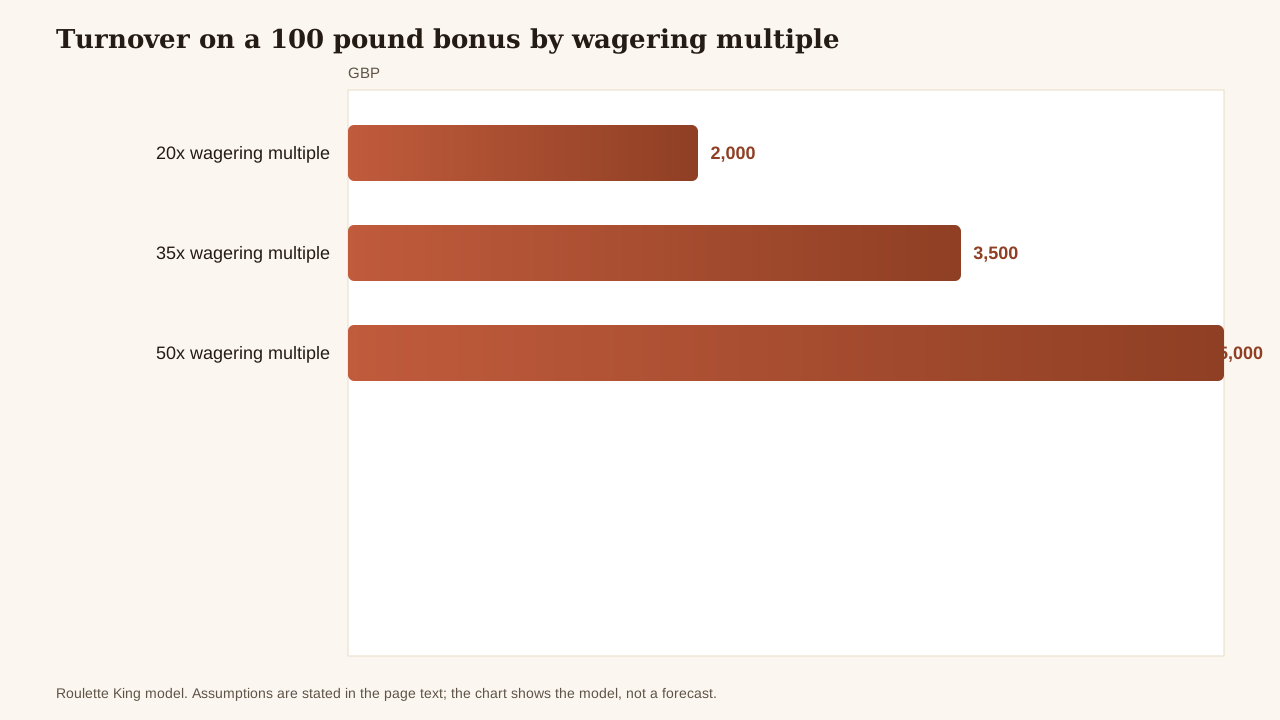
To turn those waits into something comparable, the model below prices the time money spends in transit.
Effective bonus cost calculator
Deposit, match and multiple turned into credited money, turnover and a modelled cost.
Model illustration with stated inputs; the terms of a specific offer always override a model.
How brands in this part of the market compare
The table below sets the two camps behind the no KYC casinos label side by side, using each brand's own market focus as the descriptor, and the final column states plainly whether the Gambling Commission's protections apply.
| Casino | Licence | Market focus | What it is known for | UK protections |
|---|---|---|---|---|
| Roobet | No UK licence | crypto-native casino | wallet-first play with checks at payout | None |
| Gamdom | No UK licence | crypto-first casino | instant crypto play with delayed checks | None |
| Mystake | No UK licence | offshore-facing casino | document checks triggered at withdrawal | None |
| Goldenbet | No UK licence | offshore-facing casino | crypto cashiers with staged verification | None |
| Donbet | No UK licence | offshore-facing casino | staged checks on larger cash-outs | None |
| NineWin | No UK licence | offshore-facing casino | gamified lobby with delayed document checks | None |
| Slots Temple | No UK licence | offshore-facing slots brand | free-games lobby outside the UK scheme | None |
| 888 Casino | UKGC licensed | long-running standalone casino | checks at sign-up or first withdrawal, then arbitration | Yes, full scheme |
| Betway | UKGC licensed | global bookmaker | full verification workflow under UK rules | Yes, full scheme |
| All British Casino | UKGC licensed | licensed casino | verification framed as payout protection | Yes, full scheme |
| Midnite | UKGC licensed | UK-led brand | verification built into onboarding | Yes, full scheme |
Two names show what actually separates the columns. Roobet runs wallet-first play with the check held back until payout, so a stalled cash-out has nowhere to go: no UK body supervises the operator, and no independent arbiter will take the complaint. 888 Casino completes checks at sign-up or before a first withdrawal, and once that is done a customer who disagrees with a decision has a defined escalation route under UK rules, with an outcome the operator must respect. That difference, rather than any speed advantage at the cashier, is the real product each camp is selling.
What the absence of checks actually costs
The costs of playing outside the verification system are concrete rather than abstract, and they cluster around three absences that only become visible when something goes wrong.
The first absence is an arbiter. Complaints against GB-licensed operators that cannot be settled directly must be offered an independent adjudication route, and the operator is bound by the outcome. Businesses in the unlicensed part of this segment answer to whichever regulator they have chosen, if any, and none of those routes is realistically open to a reader in Britain. A withheld payout therefore becomes a private negotiation between one player and one company, conducted on the company's terms, under the law of whichever jurisdiction its small print names, with the company holding both the money and the evidence.
The second absence is segregation. Licensed operators must keep customer funds protected, either by holding them apart from operating money or by stating clearly, in their terms, that they do not; either way the position is disclosed up front. Where no UK licence exists, no such requirement applies, which means balances can sit alongside marketing budgets, software invoices and payroll. If the operator runs into trouble, the money a player is waiting to withdraw is in the same pot as everything else the business owes, and the queue forms without a referee.
The third absence is GamStop, and this is the one to read twice. GamStop, at gamstop.co.uk, is the national self-exclusion scheme, and registration blocks a person from every business licensed by the Gambling Commission. It does not reach operators outside that scheme. A reader who has excluded for six months, five years or for life can still open accounts in the unlicensed part of this market, which makes the segment the exact gap in the fence that exclusion was built to close. If gambling has stopped being a choice, the National Gambling Helpline on 0808 8020 133, run by GamCare with BeGambleAware, is free, confidential and staffed around the clock, and its advisers can talk through options that do not depend on any operator's goodwill.
Set the three absences side by side and the trade becomes legible. The check avoided at the cashier is the same check that would have supplied a verified identity, protected funds and a self-exclusion that actually closes doors. None of it can be recovered later. The missing protections are missing precisely when they are needed, which is the moment something goes wrong, and by then the only lever left is asking the operator nicely.
Practical expectations if this segment still tempts you
Some readers will weigh everything above and look at the label no KYC casinos anyway, so it is worth being precise about what the experience involves, without pretending the paperwork can be wished out of existence.
Expect the check to arrive at the worst possible moment. In this segment verification tends to land at the first withdrawal, or at the first large one, which is exactly when speed matters most to the player and least to the operator. Have documents ready before requesting anything, expect a request to be repeated if a scan is unclear or a statement is missing a page, and expect each round to add days. Never submit a document you did not create, and never alter one. Falsified papers hand an operator a contractual reason to close an account and void a balance, and they are fraud in their own right, whatever the terms say.
Expect no escalation route if a payout stalls. There is no British arbiter for these brands, no ombudsman to write to and no regulator with power over a British player's complaint. Keep records regardless: deposits, chat transcripts, emails and screenshots are the only evidence that will exist if a dispute ever needs arguing anywhere, and assembling them costs nothing.
Expect no GamStop, and treat that as a warning rather than a feature. If you have self-excluded through gamstop.co.uk, the honest description of this segment is that it is the hole in your own fence, and the decision that follows is about more than payout speed. Expect the mechanics of crypto as well: value can move between the moment a cash-out is requested and the moment it is received, exchange spreads take a slice of anything converted, and a wallet address mistyped once is usually a balance gone for good.
For readers whose motive is privacy rather than speed, note what the comparison actually shows. A licensed operator is bound by UK data protection law, must explain what happens to uploaded documents and must delete what it no longer needs; an operator outside the scheme offers no equivalent commitment and answers to nobody in particular if it mishandles either documents or balances. The privacy gain, examined closely, is mostly a transfer of power from the player to the business. And if the motive is sidestepping a question about where the money came from, it is worth knowing that the question protects the player too, because being unable to answer it is usually a sign the play has outgrown what the person can afford.
Frequently asked questions
What does KYC stand for?
KYC stands for Know Your Customer. It is the identity verification a gambling operator runs to confirm a customer's name, address and date of birth, normally with a photo ID and proof of address, and where required with evidence of the source of funds. It exists because operators carry legal duties around money laundering, underage play and paying the right person, and none of those duties can be met for a customer nobody has identified.
When do UK-licensed brands carry out checks?
At sign-up, or before a first withdrawal at the latest. Where an operator can confirm basic details from independent data, play may begin first and the check is completed before the first cash-out is approved. Source-of-funds questions can return later if patterns of play change sharply, but the core identity check is not a per-withdrawal charge; it is done once, at the point where it makes every payout that follows defensible.
Why do offshore-facing brands delay checks?
Because frictionless onboarding is the product. A brand that checks nobody at the door can take a deposit within minutes, and the cost of that speed is pushed to the payout stage, where the player has the least bargaining power. Concentrating checks on larger cash-outs also suits the operator's own risk management, letting small deposits keep flowing while its risk book stays quiet. It is a business model, not a favour.
Is it possible to skip verification altogether?
No, and the question hides where the check actually goes. At licensed operators the check is unavoidable and lands at sign-up or before a first withdrawal. In the part of the market marketed as no KYC casinos, the check is skipped only in the sense that it is postponed: where it lands at all, it lands at withdrawal, and that is the point. The paperwork is not removed; it is moved to the moment you least want it, stripped of the protections that would normally come with it. Attempting to defeat a check with false documents is not a workaround either; it is fraud, and it hands the operator a ready-made reason to void the balance.
What does a stalled payout actually look like?
Quietly, usually. A cash-out sits at processing for days past any stated window, then a document request arrives, then another because a scan was unclear or a statement missed a page. Chat support repeats that the account is under review, emails go unanswered for stretches, and occasionally the account is closed with the balance declared void under a clause buried in the terms. The defining feature is the silence around it: no regulator to notify, no arbiter to write to, and no timetable anyone outside the operator can enforce.
Where can I get help?
The National Gambling Helpline on 0808 8020 133, run by GamCare with BeGambleAware, is free, confidential and open around the clock, and it is the right first call if gambling has stopped feeling like a choice. For self-exclusion, GamStop at gamstop.co.uk covers every Gambling Commission-licensed operator in a single registration. For a dispute with a licensed operator, start with its own complaints procedure, which must lead on to an independent adjudication route if the matter is not resolved.
What does the licence gap actually mean?
It means everything the Gambling Commission requires is absent at once: no independent arbiter for disputes, no requirement to segregate player funds from operating money, no GamStop coverage, no UK data protection obligations, and no regulator with the power to examine a British player's complaint. A brand may operate lawfully somewhere, but the protections people assume come with a casino are tied to the licence, not to the casino itself. Where there is no UK licence there is no scheme, and the only person left holding the risk is the player, holding it alone.