paysafecard casino
Paysafecard Casino: Prepaid Deposits, Caps and the Exit Rail
A prepaid PIN moves money onto a balance in seconds; the model below times the full loop, including the exit leg the voucher cannot carry.
The shortlist, before the detail
The board below carries this month's featured offers with their headline terms. The prose that follows models offers of this kind and never repeats those figures; the operator's own page is always the binding version.
Roulette King picks
Top roulette offers this month
The shortlist first, then the arithmetic. Four featured packages carry the headline terms below; the rest of the page models what offers of this kind usually cost and what a licence would have added.
Terms checked at the October 2026 review · 18+ · T&Cs apply. Offers move often: the operator’s own page is always the binding version.
- 1
 Night Luck82/100Casino welcome bonus 805% up to €6,400 + 280 FS
- MuchBetter · VISA · Apple Pay
- Crypto welcome 140% up to 1,600 USDT
- VIP pack 800% up to €14,500
Visit siteNight Luck18+ · T&Cs apply - 2
 EliteSpin80/100Welcome bonus €/£5,000 + 500 FS
- MuchBetter · NETELLER · MasterCard
- Lootboxes up to €/£20,000 or 500 FS
- BGaming festival: €80,000 prize pool
Visit siteEliteSpin18+ · T&Cs apply - 3
 Winbeast78/100Welcome pack €5,000 + 500 FS + €650 free bet
- MasterCard · Litecoin · MuchBetter
- Code FORTUNE: wheel on €40+ deposits
- Monday boost: 40% up to €300 (BOOST1)
Visit siteWinbeast18+ · T&Cs apply - 4
 Betportal75/100Welcome package 300% up to €/£1,000 + 150 FS
- Trustly · Bitcoin · Bank transfer
- 1st deposit: 150% up to €/£500 + 100 FS
- 2nd deposit: 100% up to €/£300 + 50 FS
Visit siteBetportal18+ · T&Cs apply
Placements on this board are paid, and the order is part of that arrangement. Featured brands hold no UK Gambling Commission licence, so GamStop, independent dispute resolution and segregated-funds rules do not reach them. Gambling can be addictive. Play responsibly. How we are paid.
How a prepaid deposit moves your money
A fifty-pound voucher turns into a fifty-pound balance in the time it takes to type sixteen digits, and that speed is the whole appeal of the rail. The money side of a paysafecard casino session starts at a till: you hand over cash, a printed PIN comes back, and the voucher is yours at face value. There is no application to complete, no credit line to open and no statement to wait for. When the cashier asks for the PIN and the balance updates, the deposit leg is over before the walk home.
The mechanics stay simple. Vouchers are sold in set steps, with £10, £25, £50 and £100 the common denominations at UK shops and a wider range available from online retailers. At the cashier you choose the prepaid option, type the sixteen-digit PIN, and the amount lands on the balance straight away. Partial redemption is normal at most cashiers too: a £100 PIN can fund a £40 deposit and hold £60 for later, which is how one code spreads across several short sessions without a second trip to the shop.
The mypaysafecard account earns its keep from the second or third deposit onward. It stores codes digitally, keeps a running history of what was spent where, and lets you merge the remainders of part-used vouchers into one place. Regular users of this rail tend to keep one, because a paper receipt lost in a coat pocket is a balance gone, and a searchable history of codes beats memory the moment a question arises about where a deposit went.
The budgeting argument does most of the persuading. Since credit cards left gambling payments in 2020, prepaid rails have drawn more attention from players who want the ceiling set before the session starts: the money is loaded at the till, so the limit is whatever cash you chose to part with, and the balance cannot wander into an overdraft on a bad evening. No card details reach the cashier either, and nothing about the deposit builds debt, because the product is prepaid rather than borrowed.
The exit leg the voucher cannot carry
A voucher pays in but cannot pay out, and that single fact shapes everything after a winning session. The PIN is a payment, not an account tied to your name, so the cashier has no verified pipe back to it. Every withdrawal therefore needs a second method, held in your own name and confirmed with the site before the first payout moves. The deposit took seconds. The exit is where the waiting lives.
The usual candidates are an e-wallet, a bank transfer or a debit card, and each carries its own window. An e-wallet sits at the fast end, a bank transfer occupies the middle ground, and a debit card runs slowest once the site's pending period is added. Whichever you pick, the name on the receiving method has to match the name on the account, because a payout aimed at someone else's wallet will be refused.
Verification is the hidden cost of the exit leg. Before a first withdrawal, licensed cashiers ask for photo identification, proof of address and, at larger amounts, evidence of where the deposited funds came from. That process can take hours or days depending on the paperwork, and it only has to be survived once per site. The sensible sequence is to verify before depositing rather than after winning, so the published exit window is the only thing left to wait for when the balance is ready to move.
Pending windows deserve a sentence of their own. Many cashiers hold a withdrawal in a pending state for a stretch of hours before releasing it, and some allow the request to be reversed during that stretch, which is a convenience for some players and a trap for others. The model's midpoints include an ordinary pending stretch; a site that clears faster will beat the assumption, and a slower one will miss it.
The caps that shape a session
Three ceilings stack on this rail, and the lowest of them governs any given deposit. The first is the voucher itself, since shop denominations top out around £100 and anything larger needs several codes. The second is the cashier's own per-transaction ceiling on voucher payments, which the model takes as a figure in the low hundreds because that is the range this part of the market typically publishes. The third is a daily cap applied per method, which resets at midnight rather than on request.
The mypaysafecard account adds a personal layer underneath. Unverified tiers carry modest rolling limits, verified ones lift them, and some cashiers apply a flat ceiling to voucher deposits regardless of tier. The effective cap is therefore always the smallest number in the chain rather than the largest, and no amount of account standing moves the site's own ceiling.
The honest consequence is that this rail does not suit four-figure evenings. High-value players fund sessions by card or bank transfer instead, because a stack of eleven PIN entries is a poor substitute for one transfer, and daily caps would break the stack anyway. For everyone else the caps read as a feature. A £100 ceiling per code, a low hundreds ceiling per transaction and a hard stop when the wallet is empty make overspending deliberate rather than accidental, and the timing model in the next section assumes sessions built on deposits of £100 or less.
Timing the loop from PIN to cleared cash
The model splits the whole journey, from till receipt to cleared winnings, into five stages and scores each in hours. The two deposit stages score zero. Buying the voucher completes at the till, depositing it to a balance completes at the cashier, and neither holds up the clock. Everything the loop owes is owed on the way out: the model takes eight hours for an e-wallet exit, twelve for a bank transfer and forty-eight for a debit card, each one the midpoint of an ordinary window rather than a promise from any particular cashier. The chart below puts those assumptions in one picture.
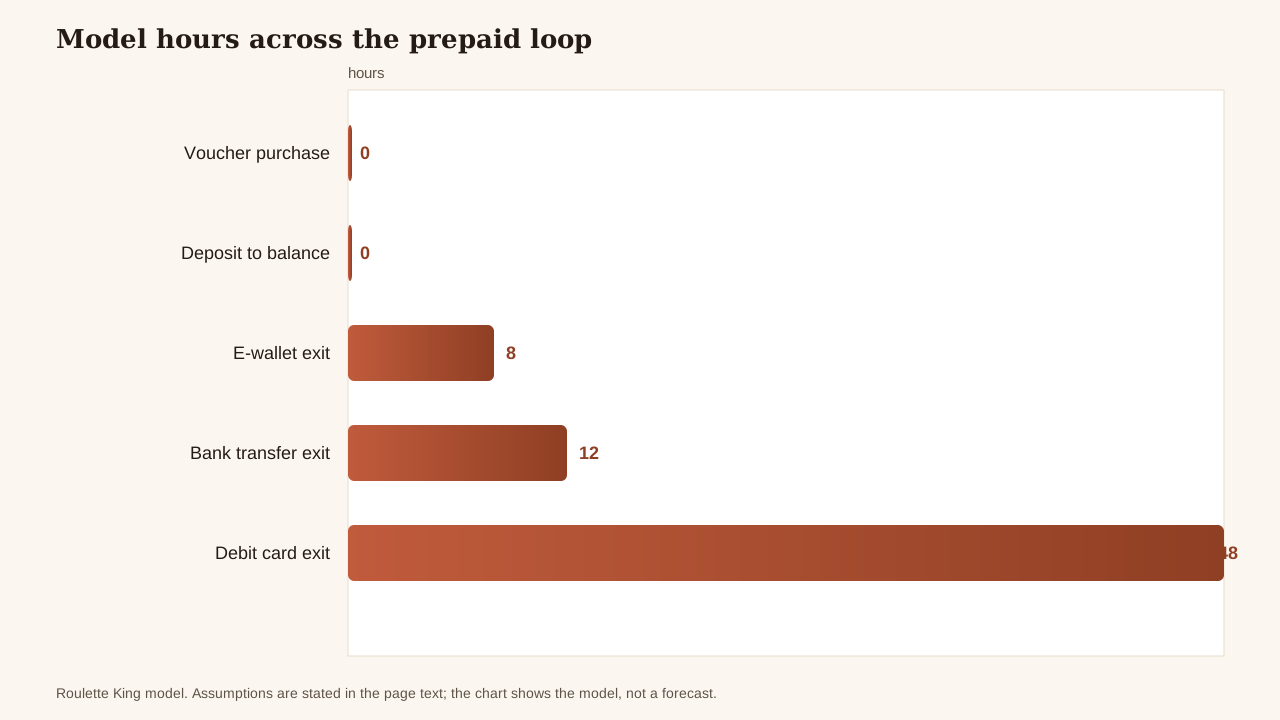
Read as a set, the bars say one thing loudly: the exit leg is the loop. An e-wallet return at eight hours is quick by withdrawal standards, yet it still lands a working day after the session ends. A bank transfer at twelve runs half as long again, and a debit card at forty-eight runs six times the wallet midpoint. Real windows vary from well under an hour for a fast wallet to several banking days for a card, and the midpoints exist so the comparison stands on a single stated number instead of a spread.
The same five stages, with the assumption behind every number written out, look like this.
| Stage | What happens | Modelled hours | Assumption behind the number |
|---|---|---|---|
| Voucher purchase | Code bought at a till or online | 0 | The sale completes on payment, so the model scores it instant |
| Deposit to balance | Sixteen-digit PIN entered at the cashier | 0 | Crediting is automatic, with no pending queue on the deposit leg |
| E-wallet exit | Balance moved to a verified wallet | 8 | Midpoint of an ordinary window of minutes up to a day |
| Bank transfer exit | Balance paid to a verified bank account | 12 | Midpoint of a window that runs across a banking day |
| Debit card exit | Balance returned to a verified debit card | 48 | Midpoint of a window of roughly one to three banking days |
Every figure in the stage table is an assumption stated rather than a measurement taken, and the zeros are the honest part. Nothing on the deposit side adds minutes, let alone hours, which is why the entrance feels identical to the authorisation on a card deposit. The difference between rails is not the way in. It is the way out, and the way out is measured in half-days rather than seconds.
Working the effective cost of a bonus
Vouchers do not change what a bonus costs, but they are often the method attached to a first deposit, so the arithmetic is worth doing once. The model takes forty times, because that is what this part of the market typically asks of a matched amount. A £25 bonus at forty times therefore asks for £1,000 of qualifying play before anything unlocks, and where slots contribute at 100 per cent, that is £1,000 of spins at whatever stake you like. The same deposit without the match carries no turnover at all: a £50 balance funded from a £50 PIN is money you can withdraw whenever the terms allow, while the balance with a bonus attached is money working through a schedule. The gap between £0 and £1,000 of required play is the effective cost the terms create.
Effective bonus cost calculator
Deposit, match and multiple turned into credited money, turnover and a modelled cost.
Model illustration with stated inputs; the terms of a specific offer always override a model.
Scale makes the pattern obvious. A £10 deposit with a £10 match at forty times asks for £400 of play; at twenty times, £200; at ten times, £100. Halve the multiplier and the work halves, whatever the deposit size. The calculator runs that arithmetic on any numbers you feed it, and it earns its place before a match is accepted rather than after, when the turnover is already on the clock.
What the rail costs along the way
Buying a voucher at a shop costs face value: £100 in cash produces a £100 PIN, and the retailer's margin is settled between the shop and the network rather than added to your receipt. Buying online can differ, with some retailers adding a small percentage at checkout, so the model takes the shop route as its zero-fee assumption and treats the online checkout as a check-before-you-buy item. Currency conversion sits outside this loop entirely, because the model assumes a sterling account at a sterling cashier; a conversion fee of a few per cent would bite only if you played in another currency.
Dormant balances are the quiet cost. A part-used PIN or an idle account can attract an administration fee after a long quiet spell under some terms, charged monthly against whatever remains. The loop on this page completes in days, so the model takes that fee as nil, but the lesson generalises: redeem codes promptly and withdraw balances rather than parking them. A £60 remainder left untouched for a year is not a savings plan.
The exit leg carries its own small print. E-wallets may take a modest cut when money moves from the wallet to your bank, some cashiers charge for bank transfers below a minimum amount, and debit card returns are typically free. The model assumes zero fees on the exit routes, which holds for most sterling withdrawals at typical cashiers, and where an e-wallet does charge, the fee comes out of the winnings rather than adding hours to the wait.
Reading a cashier before you commit
Four checks do most of the work before a first deposit. Does the cashier accept vouchers at all, since not every site keeps the option live. Which exit methods sit alongside, because this rail is deposits-only and a second method will be needed within days. Whether the terms exclude any deposit method from bonus eligibility, which some do. And what pending window the site publishes for each withdrawal route, since that window is most of the modelled loop.
| Casino | Licence | Market focus | What it is known for | UK protections |
|---|---|---|---|---|
| PlayOJO | UKGC licensed | No-wagering casino | Voucher deposits where spin returns stay as cash | GamStop, ADR, segregated funds |
| Casumo | UKGC licensed | Licensed all-round casino | Gamified loyalty with voucher support at the cashier | GamStop, ADR, segregated funds |
| Videoslots | UKGC licensed | Slots-first casino | A library counted in thousands of titles | GamStop, ADR, segregated funds |
| Mr Vegas | UKGC licensed | Slots-led licensed brand | Quick e-wallet payouts after a voucher top-up | GamStop, ADR, segregated funds |
| NetBet | UKGC licensed | Established multi-product casino | Bonus terms published in the open | GamStop, ADR, segregated funds |
| PartyCasino | UKGC licensed | Casino-first brand | Bonus terms written plainly | GamStop, ADR, segregated funds |
| 888 Casino | UKGC licensed | Long-running standalone casino | In-house exclusives and a voucher-friendly cashier | GamStop, ADR, segregated funds |
| All British Casino | UKGC licensed | UK-themed lobby | Full protection set with vouchers accepted | GamStop, ADR, segregated funds |
| Magic Red | UKGC licensed | Broad licensed casino | A cashier spanning cards and vouchers alike | GamStop, ADR, segregated funds |
| Prime Casino | UKGC licensed | Compact licensed casino | A plain, no-frills cashier | GamStop, ADR, segregated funds |
| Mystake | No UK licence | Offshore-facing casino | Sportsbook and casino under one roof | None |
| Kinghills | No UK licence | Offshore-facing casino | Big headline matches with vouchers at some cashiers | None |
Scanning the rows, the licensed entries differ widely in character and repeat themselves identically in the last column: a no-wagering lobby, a gamified loyalty scheme, a slots library counted in thousands, a plain cashier, and the same three protections sitting behind each of them. The offshore-facing entries read as a different product. Larger headline matches, a sportsbook bolted onto the casino, vouchers accepted at some cashiers, and an empty final column where those protections would sit. Wherever the licence column changes, the last column empties with it, and no headline match fills the space.
One habit worth forming: screenshot the cashier screen showing accepted methods and published windows before depositing. Terms pages move and cashier line-ups change, and a dated screenshot settles an argument far faster than memory when a payout runs late.
What the licence buys you
A UK licence is a bundle of specific things, and each has a name. GamStop coverage means one registration excludes you from every licensed site at once. Independent dispute resolution means an approved ADR body reviews a complaint the site has not settled, at no cost to you. Segregated customer funds mean balances sit apart from the operating business, so money on account is not funding the company's overheads. And a regulator who acts on complaints means an authority able to fine, suspend or revoke, not a contact form that goes nowhere.
Offers without a UK licence carry none of that. Offshore-facing casinos serving this market operate outside GamStop, outside approved ADR, outside segregated-funds rules and outside any regulator a British player can escalate to, so a withheld payout becomes a correspondence exercise with an uncertain ending. Whatever the lobby looks like, the difference is not the games. It is whether anyone with power is obliged to answer when something goes wrong.
If play has stopped feeling like a choice, free help exists: the National Gambling Helpline on 0808 8020 133, run by GamCare with BeGambleAware, is open around the clock, and GamStop self-exclusion at gamstop.co.uk takes effect across the licensed market in one registration.
Paysafecard casino questions, answered
Can I withdraw back to a paysafecard voucher?
No. The rail is deposits-only, so the voucher that funded the balance cannot receive winnings back. Every payout travels by a second method verified in your name, usually an e-wallet, a bank transfer or a debit card. That is why the sensible move is to set up and verify the exit method before the first deposit rather than after a winning session, when the wait is already running.
How long does a withdrawal take after a voucher deposit?
The model takes eight hours for an e-wallet exit, twelve for a bank transfer and forty-eight for a debit card, each the midpoint of an ordinary window rather than a fixed promise. First withdrawals run longer while identity checks complete, which is one more argument for verifying early. Once verified, later payouts follow the published window for whichever method you chose.
What are the limits on voucher deposits?
Three ceilings apply: the voucher denominations, which top out around £100 at UK shops; the cashier's own per-transaction ceiling, which the model takes as a figure in the low hundreds; and a daily cap per method. A verified mypaysafecard account lifts the personal layer, but the smallest number in the chain always governs, so check all three before planning anything larger.
Do voucher deposits qualify for bonuses?
Usually, but the terms decide, not the method. Some offers exclude particular deposit routes, so read the eligibility line before claiming. Where a match does attach, the multiplier sets the work: a £25 bonus at forty times asks for £1,000 of qualifying play, while the same deposit unclaimed asks for none. A voucher-funded deposit counts like any other once it reaches the balance.
Is a voucher PIN safe to carry?
The PIN is cash in code form: anyone holding all sixteen digits can spend it, so treat the receipt as you would a banknote. Buy from reputable retailers, keep codes out of photographs, and consider a mypaysafecard account, which stores codes digitally and keeps a history of what was spent where. A lost paper code with the digits intact is simply a balance gone.
Can one voucher cover several deposits?
Yes, at most cashiers. Type the full sixteen-digit PIN and set the deposit amount below the remaining value; the difference stays on the code for next time. A mypaysafecard account tracks the remainder automatically, which is tidier than keeping a paper receipt, and leftover value can be merged with later vouchers if you end up holding several part-used codes.
Why choose this rail instead of a debit card?
For the entrance, mainly. The deposit lands in seconds, no card details sit with the cashier, and the spending ceiling is the cash you chose to load, which makes overspending deliberate rather than accidental. The trade is the exit: a voucher cannot receive payouts, so a second verified method is required, and the caps make four-figure sessions impractical. For capped sessions it fits well; for larger ones it does not.