non gamstop paysafe casinos
Prepaid Vouchers at Non GamStop Casinos: Deposits, Caps, Exits
A £100 voucher buys roughly 3,700 expected £1 spins on a European wheel; the model below works out what a prepaid deposit does at a cashier with no UK licence.
The shortlist, before the detail
The board below carries this month's featured offers with their headline terms. The prose that follows models offers of this kind and never repeats those figures; the operator's own page is always the binding version.
Roulette King picks
Top roulette offers this month
The shortlist first, then the arithmetic. Four featured packages carry the headline terms below; the rest of the page models what offers of this kind usually cost and what a licence would have added.
Terms checked at the October 2026 review · 18+ · T&Cs apply. Offers move often: the operator’s own page is always the binding version.
- 1
 Night Luck82/100Casino welcome bonus 805% up to €6,400 + 280 FS
- MuchBetter · VISA · Apple Pay
- Crypto welcome 140% up to 1,600 USDT
- VIP pack 800% up to €14,500
Visit siteNight Luck18+ · T&Cs apply - 2
 EliteSpin80/100Welcome bonus €/£5,000 + 500 FS
- MuchBetter · NETELLER · MasterCard
- Lootboxes up to €/£20,000 or 500 FS
- BGaming festival: €80,000 prize pool
Visit siteEliteSpin18+ · T&Cs apply - 3
 Winbeast78/100Welcome pack €5,000 + 500 FS + €650 free bet
- MasterCard · Litecoin · MuchBetter
- Code FORTUNE: wheel on €40+ deposits
- Monday boost: 40% up to €300 (BOOST1)
Visit siteWinbeast18+ · T&Cs apply - 4
 Betportal75/100Welcome package 300% up to €/£1,000 + 150 FS
- Trustly · Bitcoin · Bank transfer
- 1st deposit: 150% up to €/£500 + 100 FS
- 2nd deposit: 100% up to €/£300 + 50 FS
Visit siteBetportal18+ · T&Cs apply
Placements on this board are paid, and the order is part of that arrangement. Featured brands hold no UK Gambling Commission licence, so GamStop, independent dispute resolution and segregated-funds rules do not reach them. Gambling can be addictive. Play responsibly. How we are paid.
Where a prepaid voucher sits at an offshore-facing cashier
Hand a £100 voucher across an offshore-facing cashier and the arithmetic in this page turns it into about 3,700 expected £1 spins on a European wheel, at an expected cost of £2.70 for every £100 staked. That single number is the spine of everything that follows, because a prepaid voucher behaves like cash once it lands. It has no strings attached, no wagering multiplier and no way for the site to send it back through the same rail.
Non GamStop Paysafe casinos, in the plainest sense of the phrase, are gambling sites that accept British players, take prepaid PIN vouchers at the cashier and operate on licences issued outside the United Kingdom, most commonly under a Curacao-style arrangement. They sit outside the national self-exclusion scheme, which means an exclusion a player has registered is not automatically enforced at their doors. None of this is hidden. These sites publish their licences openly, and those licences are simply not British ones. What a British licence would normally provide, and what is given up here, is set out in full near the end of the page.
For many readers the voucher is the appeal in itself. It is bought with cash at a shop counter or online, it carries a fixed face value, and it cannot be topped up from a bank account in the middle of a session. A £100 PIN is a £100 session by construction. The rest of this page works through what that session looks like: the deposit leg, the expected spins it buys, the caps that shape it and the exit leg every withdrawal must take.
The deposit leg: from PIN to playing balance
The journey starts before the site is involved at all. A Paysafe voucher is bought for a set face value, commonly £10, £25, £50 or £100 a PIN, paid for with cash or a debit card at a retail counter or through an online reseller. The receipt carries a sixteen-digit PIN, and that PIN is the money. A bare voucher has no account attached to it, no statement and no way to recover the funds if the code is read out to a stranger, so the usual advice about treating a PIN like banknotes applies with force.
At the cashier the process is short. Choose the voucher rail, enter the PIN, and the face value lands as cash credit within seconds. The model on this page takes a £20 minimum deposit as a working assumption, because that is what this part of the market typically asks before a match of this kind is triggered, and it assumes the voucher counts in full toward that minimum. Where a cashier treats vouchers differently from other rails, the terms will say so, and the difference is worth reading twice before a deposit rather than after.
One feature matters more than any other at this stage: the rail is deposit-only. A PIN can put money onto a balance, but it cannot take money off one. There is no reverse transaction, no withdrawal to the voucher and no refund path through the same channel. Every pound that arrives by voucher leaves, if it leaves at all, by a different door.
What a voucher buys on a European wheel
Strip the session down to its simplest shape and the arithmetic becomes remarkably clean. A European wheel carries 37 pockets and a single zero, so a £1 stake on an even-money chance expects to lose 2.7p a spin, which is £2.70 for every £100 that crosses the felt. Divide a voucher by that rate and the result is the expected number of £1 spins it buys before the balance is gone: about 925 spins from a £25 voucher, about 1,850 from £50, about 3,700 from £100 and about 9,260 from £250.
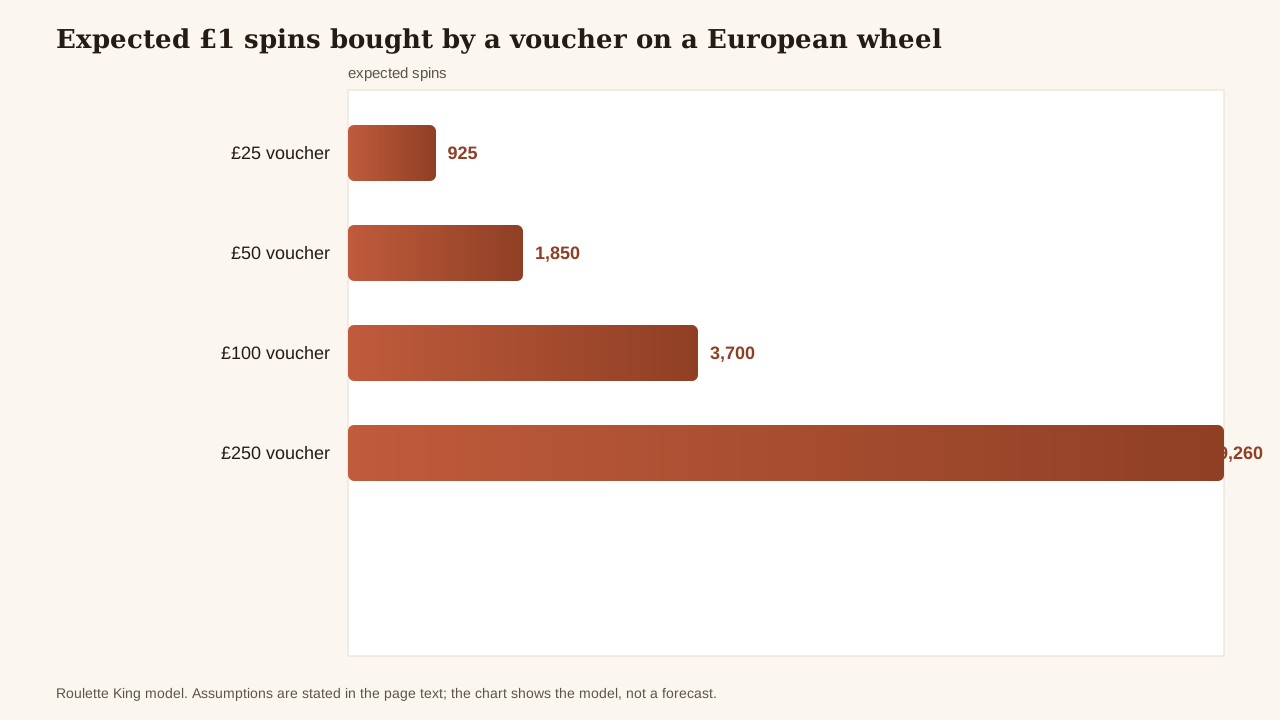
Two caveats keep the model honest. First, expected spins are an average across endlessly repeated sessions, not a promise about any single evening; variance means a session can die at 200 spins or run past 6,000, and both endings sit comfortably inside the mathematics. Second, the model assumes flat £1 stakes on even-money chances and nothing else, because mixing in single numbers at 35 to 1 changes the ride without changing the expected loss. The edge is patient either way, and it does not care how the stake is arranged.
The caps that shape a session
Caps appear at four separate points, and each quietly reshapes the session. The first is the voucher itself: a single PIN commonly tops out around £100, so the £250 figure used elsewhere on this page should be read as several PINs stacked in one deposit run, or as a wallet balance built through a myPaysafe account, where the ceiling sits higher. The model stays neutral on which route is used, because the playing arithmetic is identical either way.
The second and third caps belong to the cashier. On this model, a typical cashier at this end of the market asks £20 as a minimum deposit when a match of this kind is in play, accepts up to £500 in a single voucher transaction and waves through no more than £1,000 a day on the rail. Those are assumptions, stated as such, drawn from the shape of the terms this part of the market tends to publish rather than from any single cashier. A £250 session fits inside one transaction on those numbers. A £1,500 weekend does not, and would be spread across two days or a second rail.
The fourth cap is the quietest and the most expensive: the terms attached to a match. Offers of this kind frequently count roulette at a tenth of its face value toward wagering, or leave it out altogether, and the model takes ten per cent where it counts anything at all. A cap like that does not change how many spins a voucher buys in cash play. It changes, enormously, what a bonus actually costs to clear, and the worked arithmetic later in the page puts a number on it.
The voucher journey, step by step
Pulling those threads together, the table below walks a single voucher through its whole life at an offshore-facing cashier, from purchase to exit, with the assumption behind every figure written alongside it. Read the assumptions column as carefully as the numbers, because the numbers are only as good as what sits underneath them.
| Step | What happens on the model | Figure used | Assumption behind it |
|---|---|---|---|
| Purchase | A PIN is bought for cash or by debit card at a counter or online | £10, £25, £50 and £100 per PIN, stacked to £250 | The £250 session is read as stacked PINs or a wallet balance |
| Deposit leg | The PIN is entered at the cashier and the face value credits as cash | £100 credited, £20 minimum to trigger a match | £20 is the typical minimum where a match is in play |
| Play leg | Flat £1 stakes on even-money chances on a single-zero wheel | 3,700 expected spins, £2.70 expected loss per £100 staked | 37 pockets, even-money bets only, no side wagers |
| Exit leg | Bank transfer to an account in the player's own name | 24 to 72 hours pending, then 1 to 3 banking days | Standard processing times assumed, fees ignored |
| Verification | Identity, address and sometimes source-of-funds checks | Documents requested once, before the first payout | Checks assumed to clear on first submission |
The journey is deliberately unglamorous. Nothing in it requires more than a PIN, a browser and a bank account in the player's own name for the way out, and nothing in it shortens the exit either. If any step looks different at a particular cashier, the difference will sit in the terms, and the terms are the only contract that exists between player and site.
The exit leg: how money leaves the site
Because the voucher rail is deposit-only, the exit leg is where every withdrawal begins. On this model the standard route is a bank transfer to an account held in the player's own name, with a pending window of 24 to 72 hours while the request is reviewed, followed by one to three banking days for the money to land. Where a wallet or a crypto rail was used to deposit at some point, some cashiers will send the payout back along that same rail, and crypto exits, where offered, are often the quickest once approved.
Before any of that happens, verification sits across the road. An offshore-facing cashier on this model asks for photographic identity, a recent proof of address and, on larger payouts, evidence of where the funds came from, all supplied once and checked before the first exit is approved. The model assumes the documents are clean and the checks pass at the first attempt. If they do not, or if a request stalls, the conversation is had directly with the operator, on the operator's timetable, and the model attaches no number to how long that takes.
Practical notes belong here too. Payout minimums on this model sit at £25 for a bank transfer, with some wallet routes set at £50, and fees, where they exist, are deducted before the transfer rather than added after. A session that began with a £100 voucher and finished at £340 therefore exits as one approved transfer of £340, minus any fee the terms disclose, and not as a return to the PIN that started it.
Worked arithmetic: cash play against a matched deposit
Cash play is the easy case. A £100 voucher deposited as cash and staked at £1 a spin on the European wheel turns over £3,700 in expected terms before the balance is spent, and the expected cost of that turnover is 2.70 per cent of it, almost exactly the £100 that went in. The voucher buys roughly 3,700 spins of expected play, and the house expects to keep the whole voucher by the end. Nothing about the rail changes that; the voucher is simply the purse the spins are drawn from.
Effective bonus cost calculator
Deposit, match and multiple turned into credited money, turnover and a modelled cost.
Model illustration with stated inputs; the terms of a specific offer always override a model.
The matched case is where assumptions bite. The model takes forty times, because that is what this part of the market typically asks, applied to the deposit plus the bonus: a £100 voucher deposit with a 100 per cent match creates a £200 balance and an £8,000 wagering requirement. At £1 spins that is 8,000 spins of required turnover, and the expected cost of that turnover at 2.70 per cent is £216, against a bonus worth £100. If roulette is counted at the assumed ten per cent, the actual staking needed to satisfy the requirement climbs to £80,000, with an expected cost of £2,160. The arithmetic explains, better than any adverb could, why matches at this end of the market deserve a full reading before they deserve a deposit.
How this corner of the market lines up
The comparison table in this section places offshore-facing operators beside British-licensed names so the differences sit side by side rather than in the abstract. The licence column is the load-bearing one, and what it buys, or does not buy, is spelled out in the final section of the page. Everything else, from market focus to reputation, is colour by comparison.
| Casino | Licence | Market focus | What it is known for | UK protections |
|---|---|---|---|---|
| Mystake | No UK licence | Offshore-facing casino | Sportsbook and casino sharing one account | None: no enforced exclusion, no ADR, funds not segregated |
| Goldenbet | No UK licence | Offshore-facing casino | Voucher deposits accepted at some cashiers | None of the UK protections apply |
| Rolletto | No UK licence | Offshore-facing brand | High-limit tables and crypto rails | None: self-exclusion not enforced, disputes stay in-house |
| Donbet | No UK licence | Offshore-facing casino | Crypto-friendly cashier | None: no UK ADR, no fund segregation, no enforced exclusion |
| Kinghills | No UK licence | Offshore-facing casino | Headline match offers of unusual size | None of the UK protections apply |
| NineWin | No UK licence | Offshore-facing casino | Gamified lobby with missions and levels | None: exclusion not enforced, no ADR, funds not segregated |
| PlayOJO | UKGC licensed | No-wagering model | Every spin paid in cash, nothing attached | GamStop, independent ADR, segregated funds |
| Casumo | UKGC licensed | Licensed casino | Gamified loyalty journey | GamStop, independent ADR, segregated funds |
| MrQ | UKGC licensed | No-wagering pioneer | Spins paid with nothing attached | GamStop, independent ADR, segregated funds |
| PartyCasino | UKGC licensed | Casino-first brand | Bonus terms published in full | GamStop, independent ADR, segregated funds |
| NetBet | UKGC licensed | Established casino | Card bonuses with published terms | GamStop, independent ADR, segregated funds |
Read the rows as two families rather than as a scored list. The offshore-facing family competes on breadth: a sportsbook bolted onto a casino in one account, voucher and crypto rails at the cashier, high-limit tables, headline match figures and lobbies dressed in missions and levels. The British-licensed family competes on a different axis entirely, and the no-wagering names within it make the simplest promise in gambling, that what a spin wins is paid as cash with nothing hanging off it. Which family suits a reader depends less on the size of a match than on whether the protections attached to a UK licence form part of the calculation, and the next section sets out exactly what those protections are.
What the licence buys you
A licence from the UK Gambling Commission is a bundle of concrete protections, and each one is worth naming. First, GamStop: a registration at gamstop.co.uk closes every licensed British site to the account holder for the chosen period, and the sites are obliged to enforce it. Second, independent dispute resolution: if a payout is withheld or a term is applied unfairly, the complaint can be escalated to an alternative dispute resolution body recognised by the Commission, and its decision binds both sides. Third, segregated customer funds: deposits are held apart from the operating business, so money sitting on balance is not the money paying the staff.
Fourth, and hardest to price, there is a regulator who acts on complaints: cases are investigated, fines are published and licences can be suspended or revoked, which gives an operator a standing reason to settle a fair case quickly. None of that machinery exists at a site operating without a UK licence. Offers of that kind carry none of it: self-exclusion is not enforced at their doors, disputes are argued with the operator on the operator's terms, customer balances are not segregated in any way a British player could rely on, and the licensor named in the footer is a different animal entirely, with a complaints process that is slower, remoter and largely theoretical for a British consumer.
This page describes that gap rather than bridging it, because the gap is the point. Anyone who has self-excluded should recognise what a deposit at these sites represents: the exclusion that person chose does not follow them there, and that is a protection given up, not a technicality. If gambling has stopped feeling like a choice, the National Gambling Helpline on 0808 8020 133, run by GamCare with BeGambleAware, is free to call and open around the clock; GamStop self-exclusion at gamstop.co.uk takes effect at every licensed British site once registered.
Prepaid vouchers at non GamStop casinos: questions answered
Can I withdraw back to a prepaid voucher?
No. A Paysafe PIN is a deposit-only rail: it moves money onto a balance but has no facility to receive a payout. On the model used through this page, withdrawals leave by bank transfer to an account in the player's own name after a pending window of 24 to 72 hours, with wallet or crypto exits available at some cashiers where those rails were used to deposit.
How many spins does a £50 voucher actually buy?
On the European-wheel model, about 1,850 expected £1 spins, with the same £2.70 loss per £100 staked applied throughout. The word expected is doing real work here. Any single session can collapse after a few hundred spins or stretch well past double the estimate, and both endings are ordinary variance rather than the model misfiring.
Does a voucher deposit count toward a match?
The model assumes it does, counting the voucher's face value in full toward the £20 minimum this part of the market typically sets. Real cashiers vary: some exclude specific rails from promotions entirely, others count the deposit but attach a smaller match. The terms at each cashier settle the question, and the terms are where the reading should happen.
What happens to a GamStop exclusion at these sites?
Nothing, in the mechanical sense: sites without a UK licence are not part of the scheme, so a registered exclusion does not block the account there. That is the protection a deposit at such a site gives up, and it is worth stating plainly rather than burying. Anyone who has excluded and wants the barrier to hold already has the stronger tool in place.
Are there fees on prepaid vouchers?
Buying the voucher itself is usually free at retail counters, though online resellers often add a small percentage surcharge. Some schemes levy an inactivity fee on balances left unused for twelve months or more, and a cashier may deduct a flat fee from a bank-transfer payout. The model on this page ignores all three, which makes its figures slightly generous.
Is a larger voucher better value than a small one?
Not in expected terms. The loss rate is £2.70 per £100 staked regardless of the purse, so a £250 voucher expects to buy about 9,260 spins and expects to lose £250 doing it, exactly as a £25 voucher expects to lose £25 across about 925 spins. Size changes the length of the session and nothing else about the arithmetic.
Do these cashiers accept anything other than vouchers?
Most sites at this end of the market run several rails side by side: debit card, a wallet or two, bank transfer and, increasingly, crypto. Each has its own profile on the way in and on the exit leg. The voucher is simply the most cash-like of them, fixed in value and impossible to overdraw, which is precisely its appeal.
What should a reader check before depositing a voucher?
Four things. The licence status in the footer, because it determines the protections in play. The cashier terms for minimums, caps and excluded rails. The exit route, including payout minimums and the pending window. And the verification list, so the documents are ready before the first withdrawal rather than after. Deposit only what an exit would be comfortable carrying.