skrill neteller trustly casino
Skrill, Neteller and Trustly Casinos: E-Wallet Terms Modelled
Wallets clear in hours where cards take days; the model below prices each rail and the terms that ride along.
The shortlist, before the detail
The board below carries this month's featured offers with their headline terms. The prose that follows models offers of this kind and never repeats those figures; the operator's own page is always the binding version.
Roulette King picks
Top roulette offers this month
The shortlist first, then the arithmetic. Four featured packages carry the headline terms below; the rest of the page models what offers of this kind usually cost and what a licence would have added.
Terms checked at the October 2026 review · 18+ · T&Cs apply. Offers move often: the operator’s own page is always the binding version.
- 1
 Night Luck82/100Casino welcome bonus 805% up to €6,400 + 280 FS
- MuchBetter · VISA · Apple Pay
- Crypto welcome 140% up to 1,600 USDT
- VIP pack 800% up to €14,500
Visit siteNight Luck18+ · T&Cs apply - 2
 EliteSpin80/100Welcome bonus €/£5,000 + 500 FS
- MuchBetter · NETELLER · MasterCard
- Lootboxes up to €/£20,000 or 500 FS
- BGaming festival: €80,000 prize pool
Visit siteEliteSpin18+ · T&Cs apply - 3
 Winbeast78/100Welcome pack €5,000 + 500 FS + €650 free bet
- MasterCard · Litecoin · MuchBetter
- Code FORTUNE: wheel on €40+ deposits
- Monday boost: 40% up to €300 (BOOST1)
Visit siteWinbeast18+ · T&Cs apply - 4
 Betportal75/100Welcome package 300% up to €/£1,000 + 150 FS
- Trustly · Bitcoin · Bank transfer
- 1st deposit: 150% up to €/£500 + 100 FS
- 2nd deposit: 100% up to €/£300 + 50 FS
Visit siteBetportal18+ · T&Cs apply
Placements on this board are paid, and the order is part of that arrangement. Featured brands hold no UK Gambling Commission licence, so GamStop, independent dispute resolution and segregated-funds rules do not reach them. Gambling can be addictive. Play responsibly. How we are paid.
What separates Skrill, Neteller and Trustly
Skrill, Neteller and Trustly casinos all promise fast movement of money, yet the three rails behave differently the moment a deposit or a payout is in motion. Skrill and Neteller are e-wallets, and both sit inside the Paysafe family, which is why cashiers and bonus terms tend to treat them as a pair. A wallet holds a balance of its own: money moves from your bank into the wallet, from the wallet to the operator, and back into the wallet at payout, with the bank left out of the last leg entirely. Trustly works the other way round. There is no wallet account at all; the rail links directly to your bank, so a deposit is a bank payment and a payout is a return to the account the money came from.
That structural difference drives most of what follows. A wallet user keeps a buffer in Skrill or Neteller, which decouples the casino from the banking calendar: payouts reach the wallet within hours even when the bank itself is shut for the weekend. A Trustly user has nothing to top up and nothing to maintain, but every movement passes through bank processing, which respects working days and nothing else. Fee patterns split along the same line. Wallets have historically charged small amounts on certain withdrawals and on currency conversion, while Trustly and debit card transactions at GB-licensed operators are typically free at the cashier, with the operator absorbing the cost.
Eligibility is the third separator, and in practice the one that decides where the money goes first. A meaningful share of welcome offers exclude Skrill and Neteller deposits, and the exclusion is written into the terms rather than hidden, whereas Trustly deposits are more often treated as ordinary bank payments and left eligible. A rail that is quick but excluded from the offer you wanted is a different proposition from the same rail with the offer attached, so eligibility gets its own section further down.
Housekeeping is the fourth separator. Two wallets mean two logins, two sets of security settings and two balances to monitor, and a wallet also runs its own verification, which can hold a first payout while identity is confirmed separately from the operator. Trustly carries none of that overhead, but it offers nowhere to park winnings between a cash-out and a bank credit. None of this makes one rail universally correct; it makes each rail a trade-off between speed, housekeeping and small print, and the rest of this page prices those trade-offs.
The model: fees and speeds by rail
The figures below describe normal practice at GB-licensed operators offering Skrill, Neteller and Trustly casinos, modelled for October 2026 rather than measured from any single cashier. Three assumptions sit behind the table and stay behind every number on this page. First, each timing runs from the moment the operator approves the cash-out, because approval queues are the one stage no rail controls. Second, working days mean Monday to Friday, excluding bank holidays, so a payout approved late on Friday and sent through a bank rail starts moving on the next working day. Third, the fee column describes the rail itself rather than the operator: most GB-licensed cashiers absorb deposit fees, while a minority pass on small withdrawal or conversion charges. One warning rides on top of the model: some welcome offers exclude these wallets, and the terms say so in plain language wherever the exclusion applies.
| Rail | Model fee | Deposit speed | Payout speed | Notes |
|---|---|---|---|---|
| Skrill | None to small | Instant | Under 24 hours | Wallet-to-wallet |
| Neteller | None to small | Instant | Under 24 hours | Same family |
| Trustly | None | Instant | 1 to 2 working days | Bank-linked |
| Visa debit | None | Instant | 1 to 3 working days | Card settlement |
Read the table as a ranking of rails rather than a promise of hours. The two wallets share the top line because settlement is wallet-to-wallet: the operator releases money into your wallet balance without waiting for a bank to open, which is why the model holds them at under 24 hours in ordinary cases. Trustly inherits the banking calendar, so its range runs to two working days even though the payment itself is electronic end to end. Visa debit sits last not because cards are inherently slow but because card settlement adds an acquiring stage, and the range widens to three working days where operators batch their card payouts. It is worth noting why the row says debit at all: credit card gambling has been barred at GB-licensed operators since 2020, so the card rail in any modern comparison is a debit rail by necessity.
The casinos compared: licence, focus and protections
Rail behaviour is half the picture; the operator on the other side of the cashier is the other half. The table below lines up eleven names against the questions a wallet user actually asks: whether a UK Gambling Commission licence sits behind the brand, where the operator's centre of gravity lies, what it is known for in this part of the market, and what the licence protects. The protections column compresses four things into one cell, and the licence section unpacks them properly: GamStop access, independent dispute resolution, segregated funds and a regulator who acts.
| Casino | Licence | Market focus | What it is known for | UK protections |
|---|---|---|---|---|
| Mr Vegas | UKGC licensed | Slots-led licensed brand | Fast e-wallet payouts | Full UK scheme |
| Casumo | UKGC licensed | Licensed casino | Quick e-wallet cash-outs | Full UK scheme |
| Unibet | UKGC licensed | European bookmaker roots | Wallet rails both ways | Full UK scheme |
| 888 Casino | UKGC licensed | Long-running standalone casino | Long cashier history | Full UK scheme |
| Betvictor | UKGC licensed | Bookmaker with a compact lobby | Fast cashier | Full UK scheme |
| PartyCasino | UKGC licensed | Casino-first brand | Published bonus terms | Full UK scheme |
| NetBet | UKGC licensed | Established casino | Wallet bonuses with terms | Full UK scheme |
| Magic Red | UKGC licensed | Licensed casino | Broad wallet support | Full UK scheme |
| LeoVegas | UKGC licensed | Mobile-first casino | App cash-outs | Full UK scheme |
| 32Red | UKGC licensed | Long-standing casino brand | Steady terms | Full UK scheme |
| Kinghills | No UK licence | Offshore-facing casino | Wallet variety outside the UK scheme | None of the above |
Two rows carry the wallet story. Mr Vegas presents as a slots-led licensed brand with fast e-wallet payouts, which is precisely the combination the previous section modelled: quick wallet settlement inside a licensed shell. Casumo, a licensed casino known for quick e-wallet cash-outs, sits in the same bracket. Beyond those two, the table splits by heritage rather than by speed. Unibet brings European bookmaker roots and wallet rails that work in both directions; 888 Casino is a long-running standalone casino with a long cashier history; Betvictor operates as a bookmaker with a compact lobby and a fast cashier to match. PartyCasino is a casino-first brand leaning on published bonus terms, NetBet is an established casino listing wallet bonuses with terms, Magic Red is a licensed casino with broad wallet support, LeoVegas remains the mobile-first casino with app cash-outs, and 32Red is a long-standing casino brand with steady terms. The final row is the outlier that makes the rest legible: Kinghills is an offshore-facing casino with no UK licence, and the last column changes accordingly, which is a subject the licence section returns to in detail.
Payout behaviour by rail
In Skrill, Neteller and Trustly casinos the payout question reduces to one line: does the money have to pass through banking hours? The wallets do not. Skrill and Neteller payouts at GB-licensed operators usually complete inside 24 hours of approval under the October 2026 model, and frequently within a few working hours, because the transfer ends in a wallet balance that updates whenever the payment team releases it, nights and weekends included. Trustly payouts start the same way but finish in a bank account, so the rail runs at one to two working days; an approval late on Friday reaches most accounts by Tuesday, assuming the Monday is not a bank holiday. Visa debit runs one to three working days, with the tail explained by operators that release card settlements in batches rather than one at a time.
Weekends sharpen the split more than any other factor. The model treats Saturday and Sunday as outside the working-day count, so a card payout approved at nine in the evening on a Friday waits for the Monday clearing run and can land on a Tuesday statement; the same approval into a wallet posts the same night. Trustly splits the difference, with the clock starting on the next working day and the credit following a day or two later.
Two practical caveats sit ahead of every estimate. A first payout at a GB-licensed operator usually triggers document checks, and the clock in the model starts only once approval clears, so an unverified account adds time that belongs to the operator rather than the rail. Wallets add a second layer of their own, because a new Skrill or Neteller account under review can hold funds even after the operator has released them. Verified on both sides, the under-24-hours figure is the routine number; unverified, it is the optimistic end. Currency is the quieter variable: the model assumes balances held in pounds, and any wallet held in another currency adds conversion costs that trim each payout until the currency is changed.
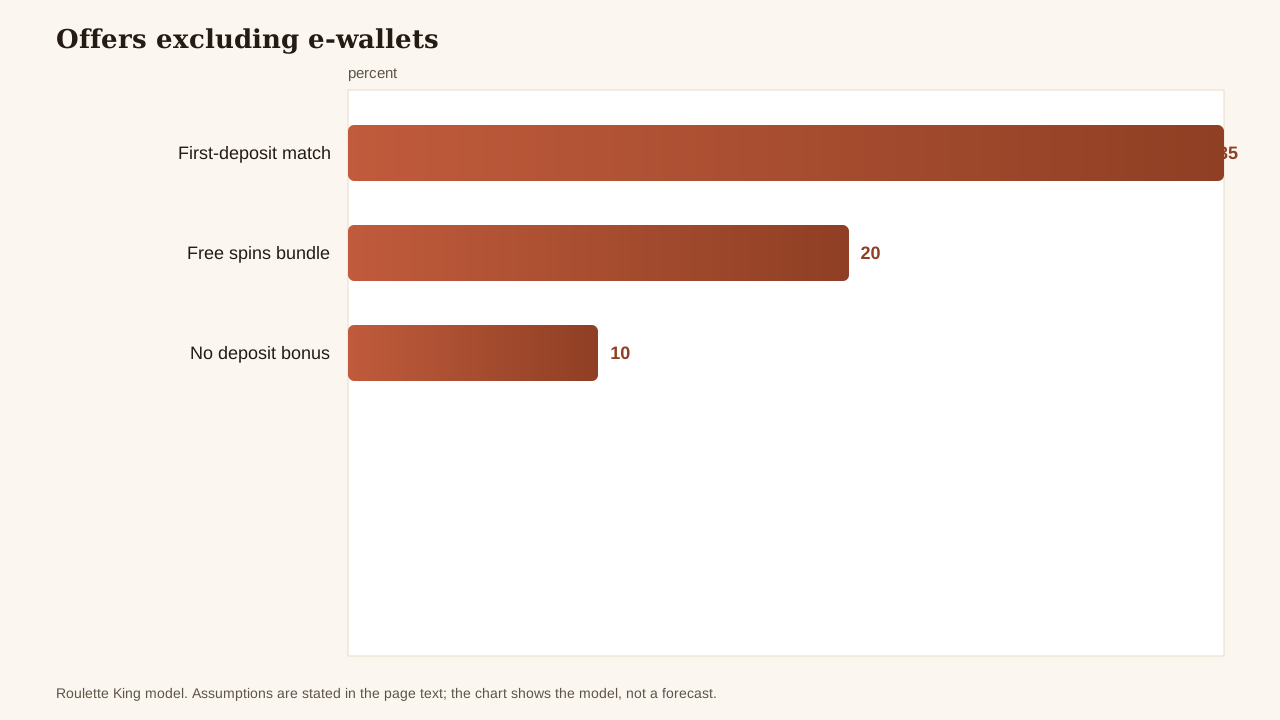
Speed only pays once the wagering has cleared, because no rail can release funds still tied to a bonus. The calculator below prices that turnover. Its worked figures assume the multiplier applies to the bonus funds alone unless your terms state otherwise; on those assumptions, a £25 bonus at a 35x multiplier requires 35 × £25 = £875 of qualifying play before a withdrawal request is worth making.
Wagering calculator
Turnover before withdrawal, modelled from the bonus and the multiple the terms set.
Model illustration with stated inputs; the terms of a specific offer always override a model.
Bonus eligibility on wallet deposits
Eligibility is where the wallets earn their reputation for small print. Operators price offers of this kind against the rails that cost them the most to process, which is why Skrill and Neteller draw the exclusions: a meaningful share of welcome offers at GB-licensed operators leave those two wallets out of the first-deposit offer entirely, and the honest ones state it in the terms rather than implying it elsewhere. Trustly deposits are usually treated as ordinary bank payments and left eligible, though the governing rule never changes: the terms attached to the specific offer decide, and no assumption survives actually reading them.
The mechanics matter when an excluded rail is used regardless. Under common practice, a first deposit made through an excluded method either fails to trigger the offer or triggers a reduced version of it, and winnings from a mis-triggered bonus can be voided when the error is discovered. Two minutes spent on the payment section of the terms is therefore worth more than any rail comparison on this page. Later deposits are a separate matter: a wallet barred from the welcome offer is frequently acceptable for reload offers and for ordinary play with no offer attached, and the distinction is nearly always spelled out in the same document.
One worked example puts the arithmetic on the table, assumptions included. Assume a 100% match to £100 on a first deposit of £100, a 40x multiplier applied to bonus funds only, and no separate cap on winnings. The deposit returns £100 in bonus funds, and clearing it takes 40 × £100 = £4,000 of qualifying play before a payout can be requested. Send the same £100 through an excluded wallet instead and it lands as plain cash with no wagering attached and no offer either, which is exactly the trade the exclusion describes. The comparison rows for NetBet, wallet bonuses with terms, and PartyCasino, published bonus terms, are shorthand for the same discipline: the cashier and the offer terms have to be read as a single document, and the rail you choose is part of the contract.
What the licence buys, and what its absence costs
A UK Gambling Commission licence buys four things that matter to anyone moving money through a cashier, and the comparison table compresses all four into its final column. First, GamStop access: every GB-licensed operator must integrate the national self-exclusion scheme, so one registration spans the entire licensed market at once. Second, independent dispute resolution: when a payout argument stalls with the operator, it can be escalated to a free, independent adjudicator whose ruling the operator has agreed in advance to honour. Third, segregated funds: customer money must be held apart from operating money, so a company failure does not automatically swallow account balances. Fourth, and least visible until it is needed, a regulator who acts: the Commission fines, attaches conditions and removes licences, and that enforcement threat is what makes the first three protections reliable rather than decorative.
Offers without a UK licence carry none of the four. Kinghills appears in the comparison as the worked example: an offshore-facing casino, outside the UK scheme, with wallet variety offered in place of UK protections. The wallets themselves may work smoothly, and fast settlement is genuinely fast, but the safety net is absent by construction rather than by neglect. There is no GamStop registration to lean on, no independent adjudicator to escalate to, no segregation requirement standing behind the balance, and no regulator with jurisdiction over the operator when something goes wrong.
Skrill, Neteller and Trustly casinos that hold the licence therefore differ from lookalikes that do not, and the difference is invisible at the deposit stage and decisive at the worst possible moment, which is a disputed payout. Checking the public register for the trading name, the status and the company behind the site takes a minute, costs nothing and settles the question before any money moves. The wallets will still be there afterwards; the protections are only ever on one side of the line.
Frequently asked questions
Which wallet pays out fastest?
Skrill and Neteller share first place under the model. Both settle wallet-to-wallet, usually inside 24 hours of a cash-out approval at GB-licensed operators and often in a few hours, because nothing in the final leg waits for a bank to open. Trustly follows at one to two working days, since the credit lands in a bank account rather than a wallet balance. Every timing assumes the operator has already approved the payout; approval queues sit outside any rail's control.
Do wallets sometimes lose bonus eligibility?
Yes, and the pattern is specific rather than random. A meaningful share of welcome offers exclude Skrill and Neteller deposits, while Trustly deposits are more often left eligible as ordinary bank payments. The exclusion is always written into the offer terms, which is where the answer lives for any given promotion. Later deposits and reload offers are treated differently from first deposits, so a wallet excluded from one offer is not excluded from the market.
What fees apply on these rails?
The model prices the wallets at none to small: deposits at GB-licensed operators are typically free, while some withdrawals and most currency conversions carry small charges set by the wallet rather than the cashier. Trustly and Visa debit sit at none, on the assumption that the operator absorbs processing costs and the account is held in pounds. Conversion is the one fee worth checking before a first deposit, because it trims every payout until the wallet currency is changed.
How is Trustly different from the two wallets?
Trustly has no wallet behind it. A deposit is a bank payment and a payout is a return to the same account, so there is no balance to top up, no wallet login to maintain and nowhere to park winnings between cash-out and bank credit. That is the trade for its advantages: no wallet fees in the model and no separate verification layer, set against payout speeds of one to two working days rather than hours.
What are the limits on each rail?
Limits start at £10 minimums on the model's assumptions for every rail at GB-licensed operators, with withdrawal minimums sometimes a little higher and wallet ceilings generally sitting above card ceilings. Beyond those patterns, every limit is set by the operator rather than the rail, and the cashier figure and the terms figure can differ. Larger amounts are usually moved by bank transfer at operators that offer one, because card and wallet ceilings were never designed for them.
Do the wallets work outside the UK scheme?
They do. Skrill, Neteller and Trustly casinos operate on both sides of the licence line, and offshore-facing sites of the kind the Kinghills row describes often advertise broad wallet support. The rail itself does not change; the protections do. Outside the UK scheme there is no GamStop, no independent dispute resolution and no segregated funds requirement, so wallet speed arrives stripped of the safety net that makes it worth having.
What does the licence gap mean in practice?
In practice it means the operator answers only to itself. Disputes go to the operator's own support rather than an independent adjudicator, balances rest on the operator's own arrangements rather than a segregation requirement, and self-exclusion runs on whatever tools the site provides rather than GamStop. Nothing in the deposit experience signals the difference, which is why the licence column of the comparison deserves reading before the wallet column, and why the register check described in the licence section costs so little for what it settles.