live casino uk
Live Casino UK: Table Limits, Game Speed and an Hourly Cost
At £5 a spin the model prices a live European table at £5.40 an hour and a fast RNG table at £20.25, figures built on assumed speeds of 40 and 150 rounds an hour and the edge fixed by the wheel in play.
The shortlist, before the detail
The board below carries this month's featured offers with their headline terms. The prose that follows models offers of this kind and never repeats those figures; the operator's own page is always the binding version.
Roulette King picks
Top roulette offers this month
The shortlist first, then the arithmetic. Four featured packages carry the headline terms below; the rest of the page models what offers of this kind usually cost and what a licence would have added.
Terms checked at the October 2026 review · 18+ · T&Cs apply. Offers move often: the operator’s own page is always the binding version.
- 1
 Night Luck82/100Casino welcome bonus 805% up to €6,400 + 280 FS
- MuchBetter · VISA · Apple Pay
- Crypto welcome 140% up to 1,600 USDT
- VIP pack 800% up to €14,500
Visit siteNight Luck18+ · T&Cs apply - 2
 EliteSpin80/100Welcome bonus €/£5,000 + 500 FS
- MuchBetter · NETELLER · MasterCard
- Lootboxes up to €/£20,000 or 500 FS
- BGaming festival: €80,000 prize pool
Visit siteEliteSpin18+ · T&Cs apply - 3
 Winbeast78/100Welcome pack €5,000 + 500 FS + €650 free bet
- MasterCard · Litecoin · MuchBetter
- Code FORTUNE: wheel on €40+ deposits
- Monday boost: 40% up to €300 (BOOST1)
Visit siteWinbeast18+ · T&Cs apply - 4
 Betportal75/100Welcome package 300% up to €/£1,000 + 150 FS
- Trustly · Bitcoin · Bank transfer
- 1st deposit: 150% up to €/£500 + 100 FS
- 2nd deposit: 100% up to €/£300 + 50 FS
Visit siteBetportal18+ · T&Cs apply
Placements on this board are paid, and the order is part of that arrangement. Featured brands hold no UK Gambling Commission licence, so GamStop, independent dispute resolution and segregated-funds rules do not reach them. Gambling can be addictive. Play responsibly. How we are paid.
What a live table actually is
A live table is a physical game streamed from a studio: a human dealer, a real wheel or a real shoe, and a camera feed that lets the table be watched while the bets are placed. The result is produced by physics in front of the lens rather than by a server-side number, which is the format's defining property and the source of most of its appeal.
Everything else follows from that staging. Studio space limits how many tables can run at once, dealers work in shifts, and every round takes as long as the physical actions it needs: a spin cycle with its betting window, or a dealing rhythm across the positions. Studios serving GB-facing licensed operators do all of this inside the UK's regulatory frame, which matters for fairness, complaints and the handling of balances, subjects the licence section below takes up in full.
The player-facing difference is tempo. An RNG table can complete a round in seconds because nothing physical has to happen; a live table cannot hurry a wheel. That single constraint drives the pace assumptions, the limits structure and the hourly model that make up the rest of this page, and it is the reason the same stake costs different money per hour in different corners of the same lobby.
Studio wheels, RNG tables and the hybrids between
Between the two pure formats sits a spread of hybrids. RNG tables are software throughout: fast, flexible, and playable at very low stakes. Live tables are the studio format described above. Between them sit games that borrow from both: RNG outcomes presented by a host on camera, and game-show formats that wrap a wheel or a draw in a produced set. The boundaries move as studios experiment, but the dividing line that matters here is not the scenery, it is the speed.
Speed differences are structural, not cosmetic. A software round takes the time the software needs; a live round takes the time the physical sequence needs, plus a betting window that closes before the wheel settles. Roulette's spin cycle is fixed by the wheel and the dealer's routine, so the model treats live roulette pace as broadly stable across tables, while card games vary more with the dealer and with the decisions made at the table.
For a player choosing between them, the trade is transparency against tempo. The live feed can be watched, which many players value on its own terms, and the price of watching is pace. The hourly model in a later section puts a number on that price at stated stakes, and the number is larger than most people expect the first time they see it.
Inside the studio: oversight, cameras and the room rules
Studios are the physical premises of the live format, and the licence follows the game into the room. A studio serving GB-facing licensed operators hosts its tables under the operator's regulatory umbrella, which is why the game information panel, the published return-to-player figures and the table rules apply to a streamed wheel exactly as they apply to an RNG title in the same lobby. The wheel spins in front of the cameras, the result settles by physics, and the operator answers for both the stream and the settlement, which is a materially different position from the one described in the licence section for lobbies with no UK licence.
What the player sees is governed as carefully as what the player is paid. Tables publish their minimums and maximums on screen before a seat is taken, betting windows close against a visible clock, and the dealer's actions follow a routine any viewer can check against the rules panel. Chat is moderated, a player who abuses the room is muted rather than rewarded, and interrupted rounds are settled by the table's own rules screen rather than by argument. None of this changes the wheel's mathematics by a penny, but all of it changes what a dispute looks like when one happens, because the evidence of what occurred sits on the record rather than in memory.
The account layer around a live table carries the same tools as the rest of the lobby. Deposit limits apply before a stake is placed, reality checks arrive on schedule during a session, and a time-out can be taken from the account menu without waiting for the dealer to finish the round in progress. Those tools are enforced by the licence, not by the camera, which is why the identical studio feed carries them at a licensed operator and not at an offshore-facing one. The wheel is the same mathematics everywhere; the room around it is not the same room.
Etiquette matters less to the hourly bill than pace does, but it shapes the session. A dealer table with conversation and player decisions runs at the slow end of the model's 40 rounds an hour, while an auto wheel grinds through double that without pausing for anyone. Players who want the social pace pick the dealer tables and accept the slower clock; players who want the cheapest hour pick the French-rules table and skip the conversation. Both choices are visible in the model above, and neither of them changes a single pocket on the wheel beneath.
Limits: the floor, the ceiling and the VIP room
Limits come as a floor and a ceiling, and the floor matters more for most readers. Entry minimums step up across a lobby's formats: in the illustrative model used here, an auto wheel takes from 10p a spin, standard live tables start around £1, and VIP rooms open around £25. Those figures are model numbers chosen for the arithmetic, not reported limits from any named operator, and any lobby's own table details state its actual figures before a seat is taken.
Ceilings work the other way. A table maximum caps what a single round can absorb, and high-limit rooms raise both ends of the range together: bigger minimums, bigger maximums, and often better-featured wheels. Offshore-facing lobbies court exactly this end of the market with high-limit tables, which is where the licence section's warnings bite hardest, because stakes and protections should rise together and offshore they do not.
The practical reading is that the floor sets exposure per round while pace sets exposure per hour, and the two multiply. A 10p auto wheel at 80 rounds an hour puts £8 of stakes at risk in the hour; a £1 live table at 40 rounds puts £40 at risk. The minimum on the door is the beginning of the calculation, never the whole of it.
Rounds per hour: the quiet multiplier
Pace is the model's quiet multiplier, and the page carries three working assumptions: about 40 rounds an hour at a live dealer table, about 80 at an auto wheel, and about 150 at an RNG table. These are figures for the arithmetic, chosen to be internally consistent, and any real session will drift around them with the dealer, the format and the crowd.
What drives the differences is mechanical. A live dealer performs every physical action on camera, so the round takes as long as the dealing or the spin, plus a betting window. An auto wheel removes the dealing but keeps the spin cycle, roughly doubling the count. An RNG table removes the physics altogether, and the only limit left is how fast the interface lets a player bet.
Because expected cost scales in step with rounds, pace is the main lever a player controls. Halving the rounds halves the hourly bill at the same stake, which is why a slower live table can make the cheaper evening even at double the stake of a fast RNG game. The next section makes that trade explicit in pounds.
The hourly bill, modelled
The model's arithmetic is one line: stake multiplied by rounds multiplied by edge. At £5 a spin on even-money bets, a live European wheel at 40 rounds an hour expects to cost £5.40 an hour at the wheel's 2.70 percent long-run edge; an auto wheel at 80 rounds costs £10.80; an RNG table at 150 rounds costs £20.25. The same £5 at a live American wheel, whose edge is 5.26 percent, costs £10.52 in 40 rounds, and the French rules cut the live European figure to £2.70. The table sets the rows out with the assumptions beside them.
| Table type | Assumed rounds an hour | Long-run edge | Expected hourly cost at £5 stakes |
|---|---|---|---|
| Live European wheel | 40 | 2.70 percent | £5.40 |
| Auto European wheel | 80 | 2.70 percent | £10.80 |
| RNG European table | 150 | 2.70 percent | £20.25 |
| Live American wheel | 40 | 5.26 percent | £10.52 |
| Live European, la partage | 40 | 1.35 percent | £2.70 |
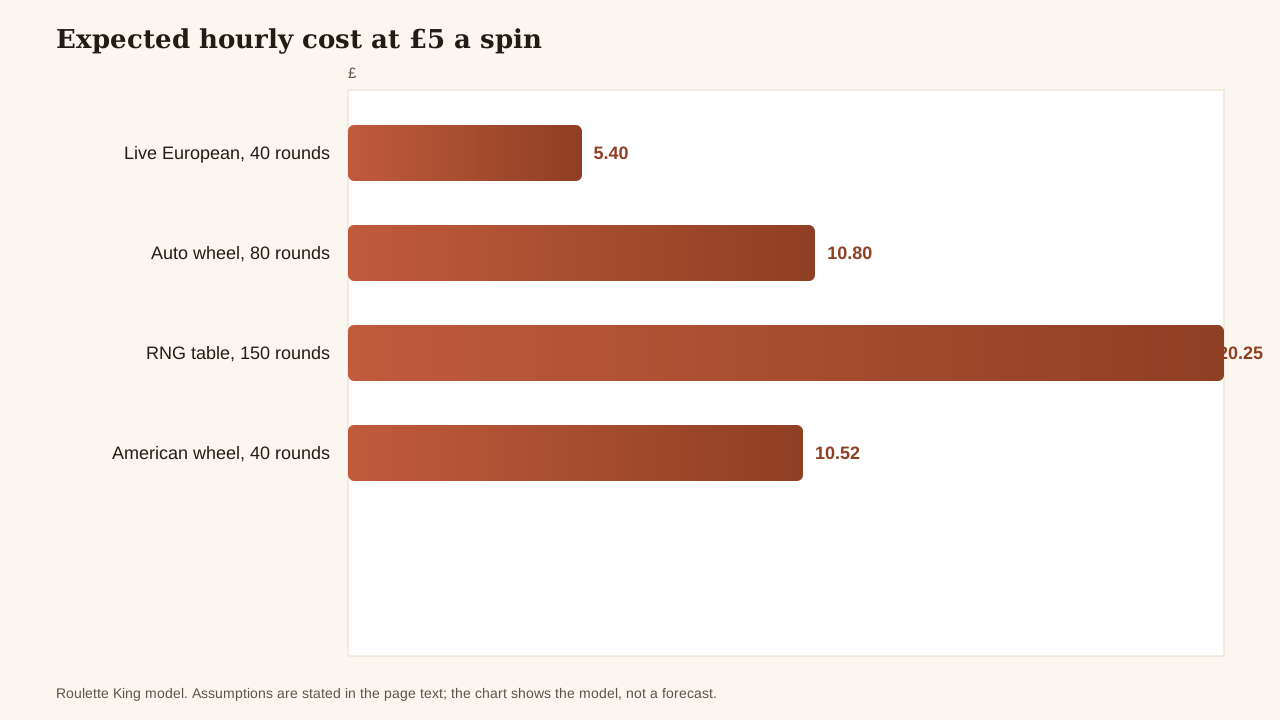
Two readings fall out of the rows. Speed and edge multiply, so an American wheel at live pace costs about as much per hour as a European auto wheel running at double the pace, and the French rules undercut everything at the same speed. The edge figures are long-run properties of the wheels and rules themselves, fixed by the game rather than by the operator, and the wheel-rules section below recaps where each number comes from.
The hourly figure is an expectation across a long run, not a prediction of any evening, and short sessions swing far from it in both directions. Its honest use is budgeting: choosing a stake and a pace whose expected hourly cost fits the entertainment budget, the same way a cinema ticket or a gig price would be chosen.
Live lobbies, side by side
The table gathers operators whose live lobbies are a visible part of how they present themselves, with licence status and the site's standard protections cell beside each name.
| Casino | Licence | Market focus | What it is known for | UK protections |
|---|---|---|---|---|
| William Hill | UKGC | high-street heritage | real-dealer tables | Yes, full scheme |
| Grosvenor Casinos | UKGC | casino-chain brand | land-based heritage in live rooms | Yes, full scheme |
| LeoVegas | UKGC | mobile-first casino | a wide roulette lobby | Yes, full scheme |
| 888 Casino | UKGC | long-running standalone casino | exclusives | Yes, full scheme |
| Unibet | UKGC | European bookmaker roots | clean lobby | Yes, full scheme |
| Bet365 | UKGC | sportsbook-first giant | a deep casino | Yes, full scheme |
| Betvictor | UKGC | bookmaker | a compact, fast lobby | Yes, full scheme |
| Sky Vegas | UKGC | games-led brand | instant-play tables, low entry stakes | Yes, full scheme |
| BoyleSports | UKGC | bookmaker | simple cashier | Yes, full scheme |
| Rolletto | No UK licence | offshore-facing brand | high-limit tables and crypto rails | None |
| Goldenbet | No UK licence | offshore-facing casino | sportsbook and casino under one roof | None |
| Donbet | No UK licence | offshore-facing casino | crypto-friendly cashier | None |
William Hill brings high-street heritage to real-dealer tables, and Grosvenor Casinos carries land-based heritage in live rooms, the two rows whose live credentials come straight from physical casinos. LeoVegas is a mobile-first casino with a wide roulette lobby, and 888 Casino is a long-running standalone casino with exclusives in its lobby. Bet365, a sportsbook-first giant with a deep casino, and Unibet, with European bookmaker roots and a clean lobby, both run live lobbies beside their sportsbooks.
Betvictor keeps a compact, fast lobby, BoyleSports a simple cashier beside its bookmaker, and Sky Vegas, a games-led brand with instant-play tables and low entry stakes, covers the low end of the floor. The offshore-facing rows aim higher: Rolletto is an offshore-facing brand with high-limit tables and crypto rails, Goldenbet runs sportsbook and casino under one roof, and Donbet adds a crypto-friendly cashier. Their protections cells read None, and the licence section below explains what that costs at high-limit stakes in particular.
The edge the wheel fixes
The edges used above are properties of the wheels and rules, not of the operators. A European wheel carries 37 pockets and a single zero, a straight-up bet pays 35 to 1, and the long-run house edge on even-money bets works out at 2.70 per £100 staked. An American wheel adds a double zero for 38 pockets, and the even-money edge rises to 5.26 per £100.
The French rules bend the even-money figure back down. Where la partage or en prison is in force, half of the even-money stake, or all of it, returns when zero lands, cutting the effective edge to about 1.35 per £100. Payouts themselves are fixed by the game's rules and do not change between operators; only the wheel type and the rules in force move the long-run number, which is why the model table could price its rows by format alone.
To express a wheel's edge as an expected hourly figure at your own stake and pace, set the inputs below and the calculator applies the same arithmetic as the model table.
Effective bonus cost calculator
Deposit, match and multiple turned into credited money, turnover and a modelled cost.
Model illustration with stated inputs; the terms of a specific offer always override a model.
What the licence gap costs at the tables
A high-limit room is the sharpest possible place to notice a missing licence. At an offshore-facing live lobby the stakes can look identical to a licensed one's VIP room while every protection behind them is absent: no GamStop coverage reaches the account, no independent dispute resolution exists for a disagreement over a large table payout, player balances have no segregated-funds guarantee behind them, and there is no GB regulator to escalate to when a withdrawal is questioned.
The cost scales with the stakes. A disputed five-figure table payout is exactly the case the licensed route was built for: the operator's complaints procedure, then an approved adjudicator, free to the customer and compelled to engage. Offshore, the same dispute meets the operator's own inbox and stops there, and the practical remedies shrink to whatever the payment chain allows.
Self-exclusion tells the same story. On the UK register, GamStop participation is compulsory, terms run for a minimum of six months, with six months, a year or five years available, and the choice cannot be undone inside the term. Offshore, any exclusion binds one account at most. If play has stopped feeling like a choice, free, confidential help: the National Gambling Helpline on 0808 8020 133, run by GamCare with BeGambleAware. The public register of licensees settles in minutes whether a lobby's name is genuinely licensed.
Frequently asked questions
Do live dealers change the odds?
No. The long-run edge is fixed by the wheel type and the rules in force, and payouts are fixed by the game's rules rather than by the operator. The dealer changes the pace and the presentation, both of which matter to the hourly bill, but not the mathematics of the wheel itself.
How many rounds land in an hour?
The model carries three working assumptions: about 40 at a live dealer table, about 80 at an auto wheel and about 150 at an RNG table. They are figures for the arithmetic rather than measurements, and a real session drifts around them with the format, the dealer and the crowd at the table.
Why is auto roulette dearer per hour?
Because the edge is unchanged while the pace roughly doubles. At £5 a spin the model prices the live European table at £5.40 an hour and the auto wheel at £10.80, the same 2.70 percent edge applied to twice the rounds. Speed, not stake, is doing the damage.
What stakes do live tables take?
The illustrative model uses 10p on auto wheels, £1 on standard live tables and £25 in VIP rooms, chosen for the arithmetic rather than reported from any operator. A lobby's own table details state its real figures, and they are worth reading before sitting down, because the floor sets exposure per round.
Is a live wheel fairer than an RNG table?
Both carry the same long-run edge when the wheels and rules match, and the licence stands behind both formats at a registered operator. What differs is transparency: the live feed shows the physics producing the result, which many players value, while the RNG table trades that view for speed and lower stakes.
What are the French rules worth?
Roughly half the pain on even-money bets. Where la partage or en prison applies, half or all of an even-money stake returns when zero lands, cutting the effective edge to about 1.35 per £100 staked against 2.70 on a standard European wheel, which the hourly table prices at £2.70 an hour in the model.
What is given up at an offshore live lobby?
Everything the licence provides: no GamStop enrolment, no independent dispute resolution behind a large table payout, balances without segregation, and nobody above the operator to appeal to. At high-limit stakes those gaps cost the most, which is why the licence section above sits beside the limits discussion rather than after it.