credit card casino
Credit Card Casino: Where Cards Still Work and What That Costs
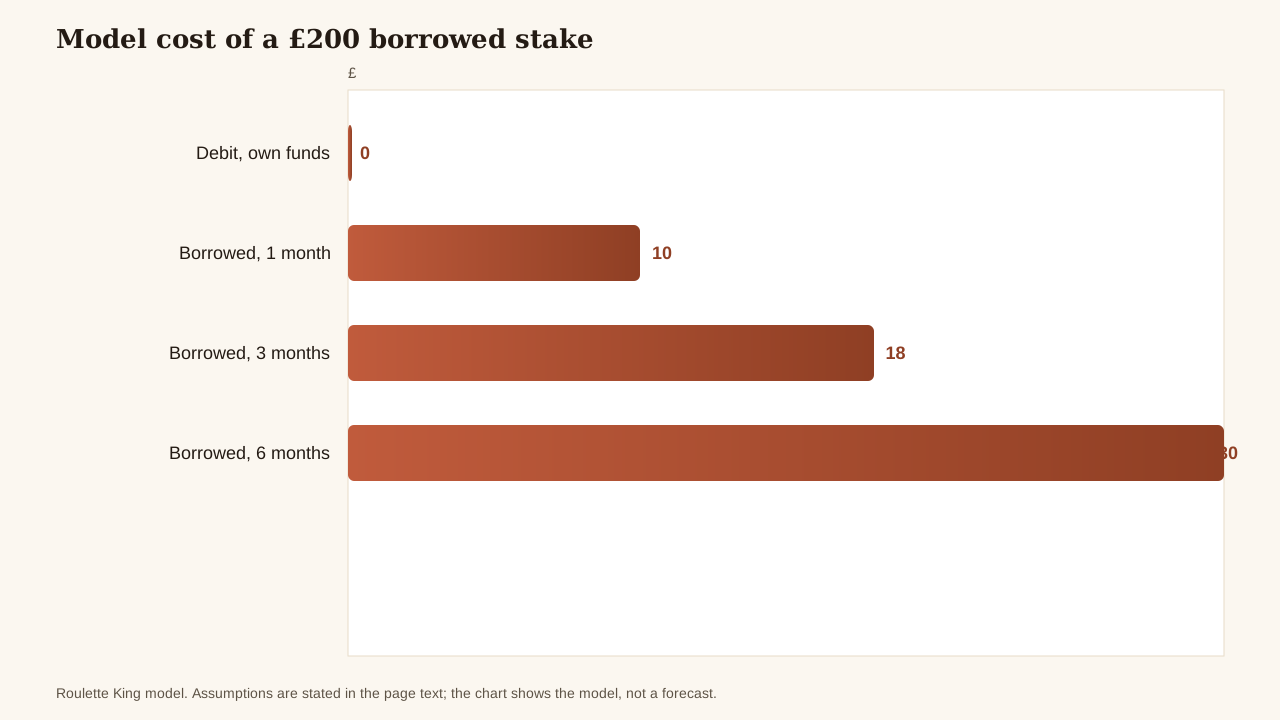
A £200 stake drawn from a borrowed balance carries a model cost of £10 if it is cleared within a month and £30 if it drifts to six; the figures assume a 3 percent processing charge and interest running at 24 percent APR.
The shortlist, before the detail
The board below carries this month's featured offers with their headline terms. The prose that follows models offers of this kind and never repeats those figures; the operator's own page is always the binding version.
Roulette King picks
Top roulette offers this month
The shortlist first, then the arithmetic. Four featured packages carry the headline terms below; the rest of the page models what offers of this kind usually cost and what a licence would have added.
Terms checked at the October 2026 review · 18+ · T&Cs apply. Offers move often: the operator’s own page is always the binding version.
- 1
 Night Luck82/100Casino welcome bonus 805% up to €6,400 + 280 FS
- MuchBetter · VISA · Apple Pay
- Crypto welcome 140% up to 1,600 USDT
- VIP pack 800% up to €14,500
Visit siteNight Luck18+ · T&Cs apply - 2
 EliteSpin80/100Welcome bonus €/£5,000 + 500 FS
- MuchBetter · NETELLER · MasterCard
- Lootboxes up to €/£20,000 or 500 FS
- BGaming festival: €80,000 prize pool
Visit siteEliteSpin18+ · T&Cs apply - 3
 Winbeast78/100Welcome pack €5,000 + 500 FS + €650 free bet
- MasterCard · Litecoin · MuchBetter
- Code FORTUNE: wheel on €40+ deposits
- Monday boost: 40% up to €300 (BOOST1)
Visit siteWinbeast18+ · T&Cs apply - 4
 Betportal75/100Welcome package 300% up to €/£1,000 + 150 FS
- Trustly · Bitcoin · Bank transfer
- 1st deposit: 150% up to €/£500 + 100 FS
- 2nd deposit: 100% up to €/£300 + 50 FS
Visit siteBetportal18+ · T&Cs apply
Placements on this board are paid, and the order is part of that arrangement. Featured brands hold no UK Gambling Commission licence, so GamStop, independent dispute resolution and segregated-funds rules do not reach them. Gambling can be addictive. Play responsibly. How we are paid.
The rule that emptied the card column
Search for a credit card casino and the first thing to establish is what the phrase can legally describe in Britain. Since 14 April 2020, stakes at operators licensed by the Gambling Commission may only be made with debit cards, and the position has not been relaxed since; as of October 2026 the Commission's consumer advice on the point stands unchanged. The measure covers the obvious case, a credit card entered at a cashier, and it also reaches arrangements that depend on borrowing one way or another, which closes most of the side doors a player might imagine existed.
The consequence for this page's subject is blunt. At any site on the UK register, the phrase describes an empty shelf: the cashier will accept a Visa or Mastercard debit card and decline the credit equivalent, whatever the marketing around the brand suggests. That is not a design choice by the operator but a licence condition, and it applies across sportsbooks, casinos and bingo sites alike. What the search term therefore points at, in practice, is either a debit rail wearing a credit label or a cashier aimed at players outside the British scheme, and the second of those is where the rest of this page spends its time.
Where credit card cashiers still appear
Offshore-facing cashiers, the ones serving players outside the British scheme, sometimes still list credit cards among their deposit options. They can do so because no UK licence sits behind the site: the Gambling Commission's rules reach only the operators it licenses, and a brand with no place on the public register is free to build its cashier however it likes. That freedom is exactly what the search term tends to surface, and it is worth being precise about what accepting the card means, because the same freedom that permits the deposit also removes everything that normally stands behind it.
This page describes that arrangement rather than helping anyone reach it. There is no walkthrough for getting around the ban, no advice on disguising where a payment comes from, and no suggestion that a rule written to protect players is something to defeat. The honest model is simpler and less comfortable: a credit deposit at an offshore-facing cashier is gambling with money you owe, on a site with no GB regulator to answer to, and every cost that follows from that combination is set out in the sections below so the choice, wherever it is made, is made with the arithmetic in view.
What borrowed stakes cost under the model
The cost model on this page keeps to stated assumptions so the numbers can be checked against your own card agreement. It takes a £200 stake, levies a 3 percent processing charge on the borrowed route as a flat assumption, and applies interest at an illustrative 24 percent APR, calculated straight line on the original sum and ignoring compounding and repayment schedules. A debit stake of the same size costs nothing to fund, because the money is yours the moment it leaves the current account, and that zero anchors the whole table.
| Funding route | Model fee | Model interest | Model total on £200 |
|---|---|---|---|
| Debit card, own funds | none | none | £0 |
| Borrowed balance, cleared in 1 month | £6, the 3 percent assumption | £4 | £10 |
| Borrowed balance, cleared in 3 months | £6, the 3 percent assumption | £12 | £18 |
| Borrowed balance, cleared in 6 months | £6, the 3 percent assumption | £24 | £30 |
Read down the final column and the shape of the answer appears: time is the expensive ingredient, not the stake. A borrowed position cleared inside a month carries a model cost of £10, of which more than half is the processing assumption; stretch the same debt to six months and interest alone adds £24. The model is deliberately simple, and a real card statement can look worse, because daily interest accrual and minimum payments stretch balances further than straight-line arithmetic suggests. To price the effective cost at your own stake, rate and repayment window, set the numbers into the calculator.
Effective bonus cost calculator
Deposit, match and multiple turned into credited money, turnover and a modelled cost.
Model illustration with stated inputs; the terms of a specific offer always override a model.
The figure plots the same model against the debit baseline, and the gap it draws is the whole argument of this page in one picture. Nothing in it depends on which game is played or how the session goes, because the credit charges accrue whether the wheel is kind or not, and that is precisely what makes them different from every other cost a session carries.
Borrowed stakes meet the house edge
Credit charges stack on top of the game's own arithmetic rather than replacing it. On a European wheel, 37 pockets leave a long-run edge of 2.70 per £100 staked on even-money bets, while the American 38-pocket wheel raises that to 5.26; the French rules, where la partage or en prison applies, cut the effective figure to about 1.35. The site's models use a blended house edge of about 4 percent across the games that count in bonus play, and that assumption runs through this page too. On a £200 borrowed stake, a blended 4 percent implies about £8 of expected long-run cost from the games alone, before a penny of interest is added.
Put the two layers together and the total model cost of a credit-funded session becomes edge plus credit: roughly £18 for the one-month example in the table above, £26 at three months, £38 at six. Winnings themselves carry no player-level tax, since gambling duty is collected from operators rather than players, so nothing on the winnings side softens the borrowing side. The comparison is worth holding onto whenever a large match offer appears to offset the cost of a deposit: the offer changes the turnover requirement, not the interest clock, and the two run on separate schedules that never sync.
Bonuses, terms and the credit question
Offers are costed here by the terms usual for promotions of this kind, with the assumptions printed beside the arithmetic, never by quoting any operator's current conditions. The site's standard model assumes a wagering multiplier somewhere between 20x and 60x, and the worked example runs as follows: a £100 match at 40x the bonus amount requires £4,000 of qualifying turnover before a withdrawal unlocks. At the model's blended 4 percent edge, that turnover carries an expected long-run cost of about £160, a figure that arrives regardless of which rail funded the deposit.
What the funding rail changes is the shape of the exposure. Wagering locks a balance in place for days or weeks, and a credit-funded balance keeps accruing interest while it sits; the repayment window and the promotion clock run in parallel, and the promotion clock does not care about the interest. Excluded-methods lists add a further wrinkle, since some offers restrict which routes qualify, and the only reliable source for that list is the offer's own terms. Before accepting anything, the checks worth making are these:
- Which payment methods the offer names as excluded, and whether your planned route appears there.
- The multiplier, and whether it applies to the bonus alone or to deposit plus bonus.
- The maximum stake allowed while wagering, since an oversized spin can void winnings.
- Time limits, minimum deposits and any cap on what the promotion can pay.
A bonus funded by borrowed money compounds both clocks at once, and the arithmetic in the section above is the reason the combination deserves a second look before opting in.
Cashiers, licences and the credit divide
The table below lines up cashiers on both sides of the credit question, with licence status, market focus and protections carried beside each name; licence entries follow the site's brand records as of October 2026.
| Casino | Licence | Market focus | What it is known for | UK protections |
|---|---|---|---|---|
| Bet365 | UKGC | sportsbook-first giant with a deep casino | debit-only cashier by rule | Yes, full scheme |
| Unibet | UKGC | European bookmaker roots, clean lobby | debit funding at the till | Yes, full scheme |
| Grosvenor Casinos | UKGC | casino-chain brand, land-based heritage in live rooms | debit rails in a casino lobby | Yes, full scheme |
| MrQ | UKGC | no-wagering pioneer, spins paid with nothing attached | debit deposits, nothing attached on exit | Yes, full scheme |
| Pub Casino | UKGC | UK brand, simple cashier | compact debit cashier | Yes, full scheme |
| 32Red | UKGC | long-standing casino brand | debit deposits with published terms | Yes, full scheme |
| JackpotCity | No UK licence | offshore-facing brand, long-running lobby with card cashiers | credit route depends on the processor | None |
| Goldenbet | No UK licence | offshore-facing casino, sportsbook and casino under one roof | credit options vary by processor | None |
| Kinghills | No UK licence | offshore-facing casino, big headline matches | card credit varies by processor | None |
| Donbet | No UK licence | offshore-facing casino, crypto-friendly cashier | credit route depends on the processor | None |
| Roobet | No UK licence | crypto-native casino, originals and crypto-only cashier | crypto-only cashier by design | None |
| Gamdom | No UK licence | crypto-first casino, instant crypto play | card routes secondary to crypto | None |
The split in the licence column is the whole story in miniature. Every row marked UKGC shows the same credit route, which is none, because the rule attaches to the licence and not to the brand's preferences; Pub Casino and 32Red differ in lobby and scale, and not at all in what their cashiers may accept. The offshore-facing rows vary, and that variation is itself the risk: where a cashier's credit route depends on which processor a site has plugged in, the terms attached to your card can change without the game changing at all. The protections column, meanwhile, separates rows where the full British scheme applies from rows where it does not reach at all, and Roobet's crypto-only till makes the point in its own way, since a chain payment sits even further from British supervision than a card does.
Chargebacks and what they cannot reach
A card dispute is sometimes imagined as an escape hatch from a losing session, and the reality is narrower. Chargeback frameworks exist for defined situations: a payment that was never authorised, a charge that was duplicated, a service that was never actually provided. A deposit that arrived cleanly, was staked at a table and was lost matches none of those situations, and no card scheme treats a settled wager as recoverable after the fact. On a credit-funded deposit there is an additional wrinkle: the underlying debt to the card issuer survives the loss regardless of how the dispute goes, so the money is owed either way.
Distance weakens the process further at an offshore-facing cashier. The processor, the merchant of record and the issuer can sit in different jurisdictions, and an operator with no UK licence has no obligation to engage with any British complaint route. Raising a dispute without grounds carries its own exposure, because operators can treat it as a breach of terms and withhold anything built on the disputed deposit. The practical reading is the one this page opened with: treat any credit deposit as money that will not return on a technicality, because the frameworks were never designed to make it, and the honest costing happens before the deposit, not after the loss.
What the licence gap costs on borrowed money
The absence of a UK licence removes four structures at once, and each matters more when the stake is borrowed. GamStop, the national self-exclusion scheme, covers operators licensed in Great Britain, so an exclusion chosen for six months or longer cannot simply be outrun by opening an account at a site the scheme never hears about. Independent dispute resolution is the second absence: licensed operators must belong to a free approved adjudication service, and a complaint that stalls can be carried there, while an offshore-facing site answers to nobody it did not choose to answer to.
Customer fund segregation is the third. British licence conditions require player money to be held separately from operating funds, with the approach disclosed, which keeps balances out of the day-to-day running of the business; no equivalent condition binds a site outside the scheme. The fourth is the regulator itself: with no GB licence there is no commission to escalate to, no enforcement record to check beforehand, and no leverage beyond the operator's own goodwill. Borrowed money amplifies all four, because the losses keep costing interest after the session ends. Free, confidential help: the National Gambling Helpline on 0808 8020 133, run by GamCare with BeGambleAware.
Getting back to money you hold
The structural answer to credit-funded play is unglamorous: close the borrowed route and rebuild the habit on money that is already yours. A debit card restores the direct link to a current account, where the scale of play shows up on a statement rather than on a credit bill. A prepaid voucher goes further and builds a ceiling into the rail itself, because a deposit can only be as large as the PIN in hand, and the paysafecard guide on this hub walks through that loop in detail. Pay-by-phone style billing adds its own per-transaction caps, which some players use as a brake on the deposit screen.
Repayment deserves its own plan, separate from any gambling decision: a balance cleared on a schedule costs the smaller figures in the table above, while one left to drift costs the larger ones. None of these steps changes the odds of any game, and none needs to; the point of the exercise is to remove the interest clock from the session entirely, so that the only costs left are the ones printed in the game's rules. A session funded from money you hold ends when the money does, and that, in the end, is the feature the credit ban was written to protect.
Frequently asked questions
Can you still deposit by credit card at a UK casino?
No. Stakes at British-licensed operators have had to be made with debit cards since 14 April 2020, and the position has not changed as of October 2026. The rule reaches wallets and arrangements that depend on borrowing too, so the credit route is closed at licensed cashiers however it is dressed up.
Why do some sites still take credit cards?
Because no UK licence sits behind them. The Gambling Commission's rules bind the operators it licenses, and an offshore-facing site outside the register can build its cashier as it pleases. Such a site also sits outside GamStop, dispute adjudication and fund segregation, which is the trade being made, whether or not it is described that way.
What does a borrowed stake actually cost?
Under this page's model, a £200 stake funded from a borrowed balance costs £10 if cleared in a month, £18 at three months and £30 at six, assuming a 3 percent processing charge and 24 percent APR. Add the games' own long-run edge, about £8 at the model's blended 4 percent, and the total rises accordingly.
Can a chargeback recover gambling losses?
The frameworks cover unauthorised payments, duplicate charges and services never provided, and a lost wager fits none of those. The debt to the card issuer survives the loss either way, and a dispute raised without grounds can be treated as a breach of terms, putting anything won on the disputed deposit at risk.
Is a wallet funded from a credit card allowed?
At licensed operators, no: the prohibition covers stakes made with borrowed money, and a wallet loaded from a credit line depends on exactly that. A wallet linked to a debit card is a different matter and remains a standard, permitted route into a British-licensed cashier.
What gives a deposit a hard ceiling?
Prepaid rails build the limit into the instrument: a voucher PIN can only ever be worth what was paid for it, and pay-by-phone billing carries small per-transaction caps by design. A debit card paired with a bank-side budget keeps the scale visible on a statement, which is its own restraint.
Does the ban change the roulette odds?
It does not. A European wheel keeps its 2.70 per £100 long-run edge on even-money bets and an American wheel keeps 5.26, funded by debit or otherwise. What the ban changes is whose money is at risk: the stake comes from a current account rather than from a lender, and the interest clock never starts.