300% deposit bonus
300% Deposit Bonus: Large Matches and the Turnover That Follows
A 300% match is the loud end of the market; the model below prices what the multiple actually costs.
The shortlist, before the detail
The board below carries this month's featured offers with their headline terms. The prose that follows models offers of this kind and never repeats those figures; the operator's own page is always the binding version.
Roulette King picks
Top roulette offers this month
The shortlist first, then the arithmetic. Four featured packages carry the headline terms below; the rest of the page models what offers of this kind usually cost and what a licence would have added.
Terms checked at the October 2026 review · 18+ · T&Cs apply. Offers move often: the operator’s own page is always the binding version.
- 1
 Night Luck82/100Casino welcome bonus 805% up to €6,400 + 280 FS
- MuchBetter · VISA · Apple Pay
- Crypto welcome 140% up to 1,600 USDT
- VIP pack 800% up to €14,500
Visit siteNight Luck18+ · T&Cs apply - 2
 EliteSpin80/100Welcome bonus €/£5,000 + 500 FS
- MuchBetter · NETELLER · MasterCard
- Lootboxes up to €/£20,000 or 500 FS
- BGaming festival: €80,000 prize pool
Visit siteEliteSpin18+ · T&Cs apply - 3
 Winbeast78/100Welcome pack €5,000 + 500 FS + €650 free bet
- MasterCard · Litecoin · MuchBetter
- Code FORTUNE: wheel on €40+ deposits
- Monday boost: 40% up to €300 (BOOST1)
Visit siteWinbeast18+ · T&Cs apply - 4
 Betportal75/100Welcome package 300% up to €/£1,000 + 150 FS
- Trustly · Bitcoin · Bank transfer
- 1st deposit: 150% up to €/£500 + 100 FS
- 2nd deposit: 100% up to €/£300 + 50 FS
Visit siteBetportal18+ · T&Cs apply
Placements on this board are paid, and the order is part of that arrangement. Featured brands hold no UK Gambling Commission licence, so GamStop, independent dispute resolution and segregated-funds rules do not reach them. Gambling can be addictive. Play responsibly. How we are paid.
Where the multiple actually lives
A 300% deposit bonus is the arithmetic extreme of the welcome market: hand over £100 and the operator credits £300 on top, giving £400 to play with from a hundred pounds of your own money. Headlines like this are engineered to stop a scroll, and they do exactly that. The interesting question is never the multiple itself; it is what the operator attaches to it, because a credit that generous has to be paid for somewhere, and the paying is always done by the player through turnover.
Inside the UK-licensed market, offers at this multiple are genuinely rare. The Gambling Commission expects bonuses to be presented clearly, with the significant terms given prominence equal to the headline, and it expects operators to know their customers well enough to judge affordability. A standing triple match is difficult to square with that environment, so licensed brands tend to keep their matches at 100% or 200%, with the wagering published in plain sight. When a multiple of this size does surface under a UK licence, it is usually a short-run promotion, a segmented offer aimed at a narrow group of existing customers, or a deal whose small print quietly carries much of the cost.
This part of the market therefore lives mostly offshore. Casinos without a UK licence, marketing openly to British readers through affiliates and comparison pages, are the natural home of the format. The economics are straightforward: a triple match triples the operator's exposure to a new customer, and the house recovers that exposure by requiring players to cycle the funds through the games many times before anything can be withdrawn. Without a regulator insisting on plain, prominent terms, the recovery mechanism can be made as steep as the headline requires.
There is also a selection effect working in the background. Operators competing inside the UK scheme know that a well-informed readership compares wagering multiples, caps and expiry windows before accepting anything, so the terms are forced into the open. Competing offshore, the comparison is far harder for the player to run, and the headline does more of the selling. Offers of this kind cluster where scrutiny is lightest, which is worth holding in mind before the multiple starts to look generous.
The shape of the deal is usually similar wherever it appears. A minimum deposit unlocks the match, often £20 or more; the credit lands as bonus funds rather than cash; and withdrawal of anything is blocked until the wagering is complete. Some versions split the multiple across the first two or three deposits, which stretches the commitment further and gives the operator more than one chance to capture the play. None of this is hidden exactly, but it is rarely summarised next to the headline, and the distance between the two is where the cost hides.
The conversion model, line by line
The model below takes one 300% deposit bonus and runs it through four wagering structures so the differences can be seen in pounds rather than adjectives. The assumptions are stated in full: a £100 deposit; a 300% match credited as a £300 bonus, giving £400 in total; wagering applied to the bonus only, except in the final row where it applies to bonus and deposit together; games weighted at 100%, meaning every £1 staked counts £1 toward the requirement; maximum bet rules switched off for the sake of the arithmetic; and a house edge of 4% across the mix, a fair working estimate for a high-variance slots selection. Turnover is simply the multiplier applied to the relevant base: 35 times £300 is £10,500; 40 times £300 is £12,000; 50 times £300 is £15,000; and 40 times the combined £400 base is £16,000. The cash-out column quotes a band rather than a single figure, because variance decides where within it any particular run lands.
One framing note belongs beside the assumptions. Offers at this multiple are rare inside the UK scheme and common among offshore-facing casinos, which is why the comparison section that follows pairs licensed brands with offshore-facing ones rather than pretending they compete on equal terms.
| Model | Deposit | Bonus credited | Wagering on bonus | Modelled turnover | Modelled cash-out at 4% edge |
|---|---|---|---|---|---|
| 300% at 35x | £100 | £300 | 35x bonus | £10,500 | about £70 to £220 |
| 300% at 40x | £100 | £300 | 40x bonus | £12,000 | about £65 to £200 |
| 300% at 50x | £100 | £300 | 50x bonus | £15,000 | about £55 to £180 |
| 300% at 40x bonus and deposit | £100 | £300 | 40x of £400 | £16,000 | about £50 to £170 |
Two lessons fall out of the table. The first is how little separates the rows at the top: the bonus is £300 in every case, yet the modelled cash-out slides from a band of about £70 to £220 at 35x down to about £55 to £180 once the requirement reaches 50 times the bonus. The second is the size of the final jump. Moving the wagering from the bonus alone to bonus and deposit together adds £4,000 of turnover, roughly a third again, for exactly the same £300 of credit. Headlines never mention the base; the base is where the cost lives.
Licensed and offshore-facing, side by side
The table below gathers the brands a reader is most likely to meet while shopping this part of the market, arranged by licence and market focus rather than by rank. The purpose is not to crown a winner; it is to show where the multiple sits. Every UKGC-licensed name on the list operates inside the framework described later on this page: self-exclusion through GamStop, access to an independent adjudicator when a dispute stalls, customer funds kept apart from operating cash, and a regulator with the power to fine, suspend or remove a licence. The two offshore-facing names sit outside all of that, and it is no accident that multiples like 300% appear far more readily in the offshore-facing half of the table than in the licensed half.
| Casino | Licence | Market focus | What it is known for | UK protections |
|---|---|---|---|---|
| Dream Vegas | UKGC licensed | Licensed casino | Large headline matches | Full UK framework |
| 888 Casino | UKGC licensed | Long-running standalone casino | Long-standing welcome shop | Full UK framework |
| PartyCasino | UKGC licensed | Casino-first brand | Published wagering | Full UK framework |
| LeoVegas | UKGC licensed | Mobile-first casino | Tiered welcome | Full UK framework |
| Casumo | UKGC licensed | Licensed casino | Gamified welcome | Full UK framework |
| NetBet | UKGC licensed | Established casino | Match combinations | Full UK framework |
| Mr.Play | UKGC licensed | Licensed casino | Matches with spins | Full UK framework |
| SpinGenie | UKGC licensed | Licensed casino | Spin-led welcome | Full UK framework |
| Magic Red | UKGC licensed | Licensed casino | Compact matches | Full UK framework |
| Mystake | No UK licence | Offshore-facing casino | Big multiples outside the UK scheme | None of the UK protections |
| Kinghills | No UK licence | Offshore-facing casino | Headline matches aimed at UK readers | None of the UK protections |
Read the table as a spectrum of restraint rather than a league. PartyCasino is the useful example at the careful end: a casino-first brand whose welcome terms publish the wagering multiple openly, which is the single most valuable habit a reader can look for when a headline number is doing the selling. Mystake sits at the other end: an offshore-facing casino whose big multiples exist outside the UK scheme altogether, meaning the protections in the final column simply do not attach. A reader weighing a triple match should ask which half of that spectrum the offer comes from, because the multiple and the protections tend to move in opposite directions.
The pattern generalises. Licensed brands rarely reach 300%; offshore-facing ones rarely stop there. That is the market telling you, without a word of marketing, where the cost of the credit is recovered.
Turnover in pounds and minutes
Turnover is the number that decides everything, so it deserves translating. At 35 times the bonus, a £300 credit demands £10,500 of staking before anything unlocks; at 40 times, £12,000; at 50 times, £15,000; and where the requirement is applied to bonus and deposit together, £16,000. Assume £2 a spin and three seconds per spin, a reasonable pace for a slots session: £10,500 of turnover is 5,250 spins, which is a little over four hours of uninterrupted play. Raise the multiplier to 50x and the same assumptions produce 7,500 spins, nearer six and a quarter hours. Those figures assume no breaks, no bonus rounds pausing the count and no changes of game; in practice the clearing window stretches across several evenings.
Expected loss follows the same arithmetic. At a 4% house edge, £10,500 of turnover costs £420 on average, £12,000 costs £480, £15,000 costs £600 and £16,000 costs £640. Set those against the £400 that a £100 deposit plus a £300 credit places on the balance, and the direction of travel is obvious: the expected cost of clearing the requirement exceeds the starting funds in every row of the model. The modelled cash-out figures are best read as the band of finishing balances among the runs that do clear, with the floor of the band sinking as turnover grows, because a longer journey gives the edge more opportunities to bite.
Stake size changes the texture but not the destination. At £1 a spin the spin count doubles and the hours stretch accordingly; at £5 a spin the clock shortens, though max bet rules, covered below, frequently forbid stakes that high while wagering is active. Table games move the count faster in time terms but are usually weighted at a fraction, so the effective turnover balloons. Nothing in this arithmetic depends on luck being good or bad; the edge is a rate, and the turnover is the distance over which that rate is charged.
Withdrawal mechanics deserve a mention too, because they sit at the end of every modelled run. Licensed operators apply pending periods and may split large withdrawals into instalments; identity checks can pause a payout until documents are supplied. Offshore-facing casinos set their own rules with nobody checking them, and a refused withdrawal there is contested with the operator alone. The cash-out figures in the model assume, generously, that a cleared balance is paid without friction, which is precisely the assumption a licence exists to make safe.
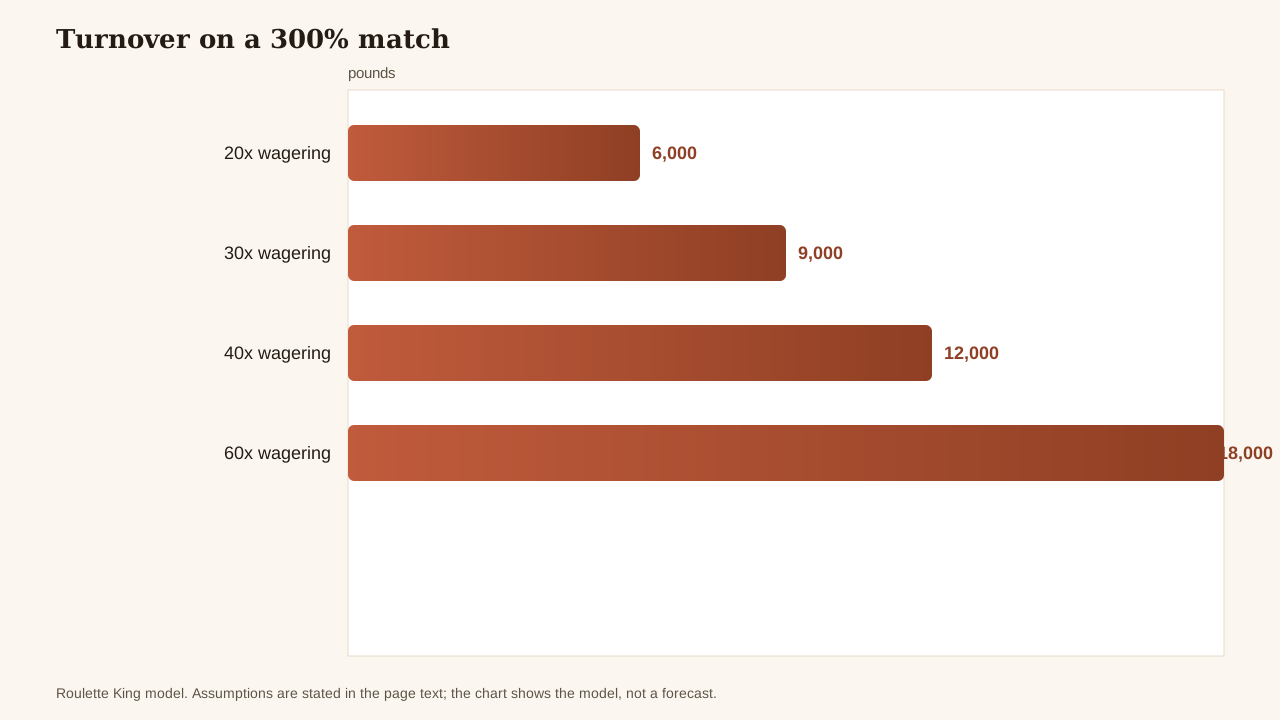
To price a specific offer against your own deposit, enter the multiplier and the base into the wagering calculator below; it runs the same arithmetic as the model, with your figures in place of the assumptions.
Wagering calculator
Turnover before withdrawal, modelled from the bonus and the multiple the terms set.
Model illustration with stated inputs; the terms of a specific offer always override a model.
The four terms that decide the outcome
A 300% match is priced by its terms at least as much as by its multiple, and four of them do most of the work. Each is routine in this part of the market, and each can be checked before a deposit is made, which makes skipping the check a choice rather than an oversight.
Max bet rules cap the stake permitted while wagering is active, most often at £2 to £5 per spin. The usual penalty for a breach is confiscation of winnings rather than a warning, and the breach can be as small as one oversized spin during a feature round. The cap also interacts with the model: clearing £12,000 of turnover at £2 a spin takes 6,000 spins, so a rule that sounds protective quietly sets the timescale of the whole exercise.
Game weighting decides what each £1 staked counts toward the requirement. Slots usually count in full; table games and live dealer tables often count 10% or nothing, which multiplies the real turnover by five or removes the game from usefulness entirely. A reader who plans to clear a bonus on blackjack with a 10% weighting is really accepting ten times the modelled turnover, £120,000 in the 40x case, which is not a plan so much as a donation with extra steps.
Caps limit what can be withdrawn from bonus-derived winnings, sometimes as a flat figure such as £100, sometimes as a multiple of the bonus itself. A cap converts the top of the modelled band into a fixed ceiling: a run that finishes at £400 with a £150 cap pays £150, and the difference is forfeited at withdrawal. Where a cap exists it should be read before the multiple, because it flattens the fortunate outcomes while leaving the turnover untouched.
Expiry sets the clock. Seven days is common among offshore-facing operators; thirty days is the generous end. At 50x, clearing £15,000 inside seven days requires about £2,150 of turnover every day at the modelled £2 stake; spread across thirty days it still needs about £500 a day. Miss the window and the bonus, the progress and any winnings tied to it are usually removed together, so expiry converts a difficult requirement into an impossible one for anyone who plays casually.
Worth adding to the list: deposits made through certain e-wallets are frequently excluded from the match, and one offer per household or payment method is standard everywhere. Neither changes the arithmetic; both change whether the arithmetic applies to you at all.
What a licence actually buys
A licence is easy to dismiss as a badge until something goes wrong, at which point it becomes the only thing that matters. Four protections come with a UK Gambling Commission licence, and each is concrete rather than decorative, so they are worth setting out one at a time.
GamStop comes first. One registration excludes a player from every UK-licensed casino at once, which matters because self-control problems rarely respect brand boundaries. A reader who excludes through GamStop has closed the entire licensed market in a single action; the offshore-facing half of the market takes no notice of it whatsoever.
Independent dispute resolution comes next. Licensed operators must submit to an approved adjudication service, free to the player, which can review a withheld withdrawal, examine the terms and award against the firm if they fall short. Offshore-facing casinos offer a support inbox and nothing more; the decision on a confiscated balance is made by the same business that made the confiscation.
Segregated funds protect balances from the company's own creditors. Licensed firms must keep customer money apart from operating cash so that a corporate failure does not swallow deposits along with the business; without that requirement, a balance is simply an entry in a database owned by the operator.
A regulator who acts is the fourth protection. The Commission can fine, attach conditions, suspend or revoke a licence, and it publishes what it does, which means the deterrent is visible rather than theoretical. That visibility shapes the terms offered across the licensed market, from published wagering to capped stakes.
Set against that list, a 300% deposit bonus offered without a UK licence carries none of these protections. The reader taking it is unsecured in every sense: no self-exclusion that binds, no adjudicator, no fund segregation and no regulator with jurisdiction over the outcome. The multiple is not compensation for that gap; it is the bait that makes the gap easy to overlook. Priced honestly, the four protections are worth more than the headline.
300% deposit bonus questions
What is a 300% match?
It is a match offer that triples the deposit: £100 in, £300 credited as bonus funds, £400 in total to play with. The deposit itself remains the player's money under the terms, while the credit stays locked until the wagering is complete. The multiple is the marketing; the wagering multiplier, the base it applies to, the caps and the expiry window are the actual price of the deal.
Where are these offers found?
Mostly at casinos without a UK licence that market to British readers, because a standing triple match is difficult to run inside a scheme that demands clear, fairly weighted terms. Inside the UK market the multiple appears occasionally as a short promotion or a segmented offer, usually with tighter caps or heavier wagering than the headline suggests. Offers of this kind cluster where scrutiny is thinnest, and the comparison table above shows how neatly the market splits along licence lines.
What does the turnover mean in pounds?
Multiply the base by the multiplier. Thirty-five times a £300 bonus is £10,500 of staking before anything unlocks; forty times the same bonus is £12,000; fifty times is £15,000. Where the requirement applies to bonus and deposit together from a £100 deposit, the base is £400 and forty times that is £16,000. At £2 a spin, £10,500 of turnover is 5,250 spins, which gives a sense of the scale involved.
Is it worth taking?
Rarely as a route to withdrawable money. The model puts the expected cost of clearing above the £400 starting balance in every row, so the honest framing is extended play rather than extractable cash. It can be a reasonable use of a deposit that was planned anyway, on games the player actually enjoys, with any outcome treated as entertainment money. As an instrument for turning a credit into a withdrawal it performs poorly, and the licence behind the offer should weigh more heavily in the judgement than the multiple itself.
How do caps bite?
Through the ceiling they place on withdrawals from bonus play. A cap of, say, £150 converts even a fortunate run into a fixed payout, which removes the top of the modelled band while leaving the turnover unchanged. Since the expected cost of clearing already exceeds the starting funds, a cap ensures the player funds the entire journey while the destination is fixed in advance. Read the cap before the multiple, every time.
What expiry applies?
Typically seven to thirty days from the moment the credit lands, though some operators run separate clocks for the bonus and for any free spins attached to it. The shorter windows are where the trap sits: £15,000 of turnover inside seven days works out at about £2,150 a day at the modelled stake. An expired bonus usually takes the wagering progress and the bonus-derived winnings with it, so expiry can erase weeks of play at a stroke.
What does the licence gap mean?
It means the four protections described earlier do not exist for that offer: no GamStop coverage, no independent adjudication of disputes, no segregation of player funds and no regulator able to act on a complaint. A withdrawal refused by an unlicensed operator is contested with the operator itself, which is rarely a fair fight. Whatever the multiple on offer, the reader is trading enforceable rights for headline value, and the model on this page suggests the headline is already expensive enough.