200% deposit bonus
200% Deposit Bonus: Bigger Match, Longer Turnover, Modelled
A 200% match triples the playing balance and triples-plus the turnover; the model below runs the arithmetic.
The shortlist, before the detail
The board below carries this month's featured offers with their headline terms. The prose that follows models offers of this kind and never repeats those figures; the operator's own page is always the binding version.
Roulette King picks
Top roulette offers this month
The shortlist first, then the arithmetic. Four featured packages carry the headline terms below; the rest of the page models what offers of this kind usually cost and what a licence would have added.
Terms checked at the October 2026 review · 18+ · T&Cs apply. Offers move often: the operator’s own page is always the binding version.
- 1
 Night Luck82/100Casino welcome bonus 805% up to €6,400 + 280 FS
- MuchBetter · VISA · Apple Pay
- Crypto welcome 140% up to 1,600 USDT
- VIP pack 800% up to €14,500
Visit siteNight Luck18+ · T&Cs apply - 2
 EliteSpin80/100Welcome bonus €/£5,000 + 500 FS
- MuchBetter · NETELLER · MasterCard
- Lootboxes up to €/£20,000 or 500 FS
- BGaming festival: €80,000 prize pool
Visit siteEliteSpin18+ · T&Cs apply - 3
 Winbeast78/100Welcome pack €5,000 + 500 FS + €650 free bet
- MasterCard · Litecoin · MuchBetter
- Code FORTUNE: wheel on €40+ deposits
- Monday boost: 40% up to €300 (BOOST1)
Visit siteWinbeast18+ · T&Cs apply - 4
 Betportal75/100Welcome package 300% up to €/£1,000 + 150 FS
- Trustly · Bitcoin · Bank transfer
- 1st deposit: 150% up to €/£500 + 100 FS
- 2nd deposit: 100% up to €/£300 + 50 FS
Visit siteBetportal18+ · T&Cs apply
Placements on this board are paid, and the order is part of that arrangement. Featured brands hold no UK Gambling Commission licence, so GamStop, independent dispute resolution and segregated-funds rules do not reach them. Gambling can be addictive. Play responsibly. How we are paid.
What a 200% match is, and where the cap sits
A 200% deposit bonus is a match offer that credits twice your qualifying deposit as bonus funds, so a £100 deposit produces £300 of playing money in total: £100 of real cash and £200 of promotional balance. That is the whole mechanism. The operator takes your deposit, adds two pounds of bonus for every pound you put in, and locks the added portion behind a wagering requirement until a set multiple of it has been staked. Nothing clever happens at the credit step. The cost sits in the conditions that follow.
Construction is broadly the same across this part of the market. You opt in, or simply make a qualifying deposit, most often £10 or £20 as a minimum, and the bonus lands in a separate wallet from your cash. Real-money stakes come out of the cash wallet first; once that is spent, play continues on the bonus wallet. Winnings from bonus play usually stay in the bonus wallet too, locked until the wagering clears. Only then does anything move across to withdrawable cash. Some operators fold everything into a single bonus wallet from the first spin, which means even your deposited £100 behaves like locked money until the requirement is done. That distinction matters more than it looks, because it decides whether you can walk away with your own deposit or whether it is folded into the lock alongside the promotion.
The cap is the other half of the structure. A 200% headline is almost always capped at a fixed bonus amount, £200 being the common ceiling on a first-deposit match, and the cap decides what the offer is actually worth. Deposit £100 under a £200 cap and you receive the full £200 of bonus. Deposit £300 under the same cap and you still receive £200, with the extra £100 of your own money earning nothing at all while adding exposure. Deposit £50 and you receive £100 of bonus, which reads better against the multiplier but halves the balance you have to survive the wagering with. The model below assumes a £100 deposit and a full £200 credit, which is the cleanest version of the offer and the one the headline implies.
One structural point deserves note before the numbers. In most UK offers of this kind, the wagering requirement attaches to the bonus alone rather than to the balance as a whole. A smaller group applies the multiplier to bonus and deposit combined, and that single change nearly doubles the workload. Both variants appear in the model so the difference can be seen rather than merely described.
The conversion model: four ways the same offer can be priced
The table below prices a 200% deposit bonus under four wagering structures, with every assumption fixed so the rows differ on one axis only. Each model assumes a £100 deposit and a full £200 of bonus credited, the standard capped version of the offer. The multipliers of 35x, 40x, 45x and 50x are typical for this part of the market and are used as given rather than as estimates. Turnover means the total that must be staked before the bonus converts to withdrawable cash, calculated as the multiplier applied to £200 of bonus, or to £300 of bonus and deposit combined in the final row. The cash-out figures apply a 4% house edge to every pound staked, with all wagering on games weighted at 100%, and the ranges reflect session variance rather than a single average outcome.
| Model | Deposit | Bonus credited | Wagering on bonus | Modelled turnover | Modelled cash-out at 4% edge |
|---|---|---|---|---|---|
| 200% at 35x | £100 | £200 | 35x bonus | £7,000 | about £60 to £180 |
| 200% at 40x | £100 | £200 | 40x bonus | £8,000 | about £55 to £170 |
| 200% at 50x | £100 | £200 | 50x bonus | £10,000 | about £45 to £150 |
| 200% at 45x bonus and deposit | £100 | £200 | 45x of £300 | £13,500 | about £40 to £130 |
Read the rows against each other and the price of the multiplier becomes concrete. Moving from 35x to 50x on the bonus alone lifts the required stake from £7,000 to £10,000, an extra £3,000 of turnover for an identical £200 credit. The last row is the one to study. A requirement written as 45x on bonus and deposit sounds adjacent to 45x on bonus, but it multiplies £300 instead of £200, so the workload lands at £13,500, nearly double the £7,000 that a 35x bonus-only demand would set. Two offers can carry similar-looking numbers and price very differently.
Handle the cash-out column with care. It does not promise an outcome; it shows where the model lands once a 4% edge is applied to the full turnover and session variance is layered on top. High-variance play produces a spread rather than a point: sessions that bust early sit at the bottom of each range and sessions that run hot finish near the top. Wider turnover gives variance more room to move, which is why the ranges stretch further on the heavier rows. Treat the column as a picture of the shape of the outcome, never as a forecast for any individual session.
How the market lines up on paper
The comparison below sets the terms of the question before the terms of any individual offer. Licence status comes first because it decides which protections exist at all; market focus and reputation follow because they hint at how an operator tends to build its matches. The final column lists what a UK licence actually attaches to an account, and it is deliberately short.
| Casino | Licence | Market focus | What it is known for | UK protections |
|---|---|---|---|---|
| Dream Vegas | UKGC licensed | Licensed casino | Large headline matches | GamStop, independent adjudication, segregated funds |
| 888 Casino | UKGC licensed | Long-running standalone casino | Long-standing welcome shop | GamStop, independent adjudication, segregated funds |
| PartyCasino | UKGC licensed | Casino-first brand | Match offers with published wagering | GamStop, independent adjudication, segregated funds |
| LeoVegas | UKGC licensed | Mobile-first casino | Tiered welcome offers | GamStop, independent adjudication, segregated funds |
| Casumo | UKGC licensed | Licensed casino | Gamified welcome | GamStop, independent adjudication, segregated funds |
| Mr.Play | UKGC licensed | Licensed casino | Matches with spins attached | GamStop, independent adjudication, segregated funds |
| NetBet | UKGC licensed | Established casino | Match combinations | GamStop, independent adjudication, segregated funds |
| Magic Red | UKGC licensed | Licensed casino | Compact matches | GamStop, independent adjudication, segregated funds |
| SpinGenie | UKGC licensed | Licensed casino | Spin-led welcome | GamStop, independent adjudication, segregated funds |
| Unibet | UKGC licensed | European bookmaker roots | Steady terms | GamStop, independent adjudication, segregated funds |
| Mystake | No UK licence | Offshore-facing casino | Big match headlines outside the UK scheme | None; outside GamStop and UK dispute resolution |
Two rows carry the argument. Unibet arrives with European bookmaker roots and a record of steady terms, which is the sort of profile where wagering tends to be published plainly rather than buried. Mystake sits at the other end: the market focus is offshore-facing and the big match headlines are offered outside the UK scheme, so none of the domestic protections attach to an account opened there. The licence column is not decoration. It marks the difference between an account that answers to a regulator and one that answers to nobody in this jurisdiction.
The turnover maths at each multiplier
Turnover is the number that turns a match into a job. The £200 credit is the reward; the turnover is the work, and the model has already priced it at £7,000, £8,000 and £10,000 for the 35x, 40x and 50x bonus-only structures, rising to £13,500 once the multiplier grips the deposit as well. What those figures mean in actual play rests on three working assumptions: an average stake of £2 per spin, games weighted at 100% so every staked pound counts in full, and a steady pace of roughly one spin every three seconds. On those assumptions, £7,000 of turnover is about 3,500 spins, close to three hours of continuous, on-terms play. A £10,000 requirement is 5,000 spins, around four hours. The combined 45x version is 6,750 spins, which pushes past five hours of uninterrupted play before a single pound becomes withdrawable.
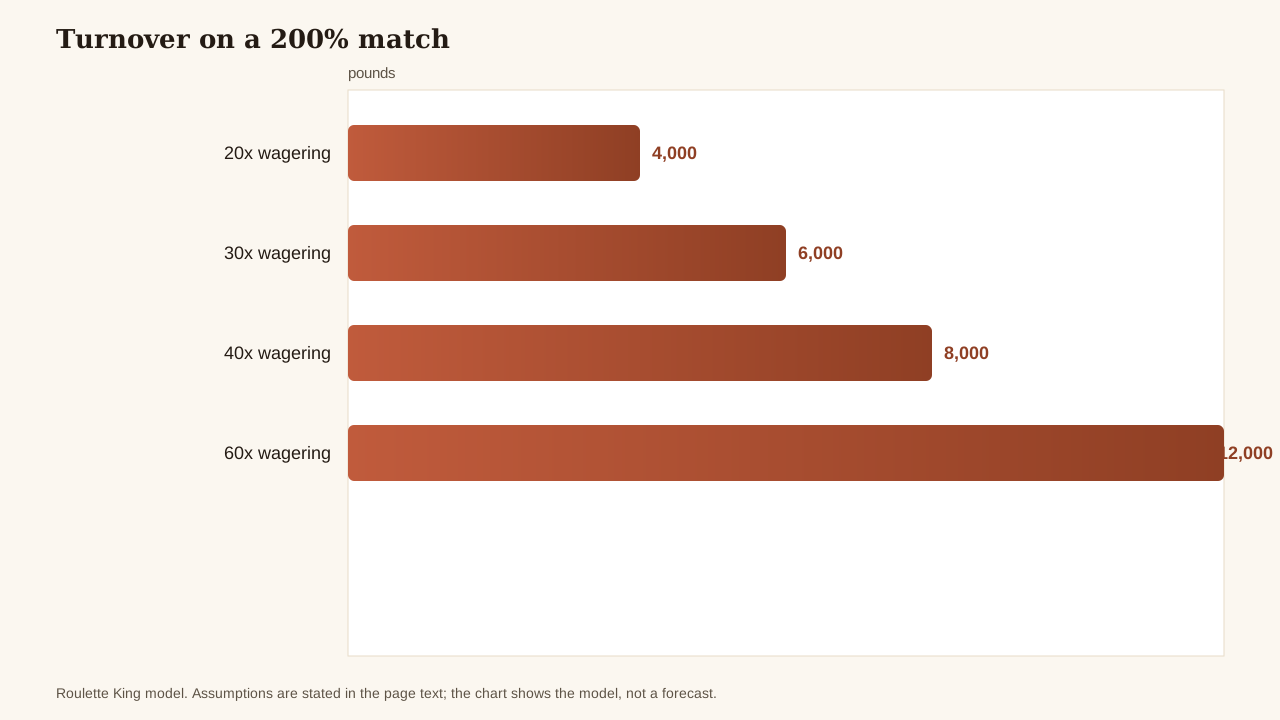
Variance stretches those sessions without changing the arithmetic. A cold run keeps you on the clock longer and eats into the bonus balance sooner; an early win lets you raise stakes within the max-bet limit and clear the requirement in fewer spins. The figure below plots the modelled cash-out from a £100 deposit taken as a 200% match, across the multiplier range, under the same 4% edge assumption and the same variance treatment as the table, so the shape of the curve can be read at a glance.
Anyone who prefers to run their own numbers on a different deposit size or a different edge assumption can use the calculator below. It applies the same method: it takes the deposit, the match percentage and the multiplier, then returns the turnover and a modelled range at the stated assumptions.
Wagering calculator
Turnover before withdrawal, modelled from the bonus and the multiple the terms set.
Model illustration with stated inputs; the terms of a specific offer always override a model.
A caution belongs beside the tool. Every output rests on the stated assumptions of the 200% deposit bonus model, and real terms bend the result in one direction only. Game weighting below 100% raises the true turnover; a max-bet clause sets the pace; a conversion cap clips the top of the range. The model is a straight-line picture of a straight-line version of the offer, and the terms decide how far the real thing departs from it.
The terms that bite while the wagering runs
Four clauses do most of the damage on offers of this kind, and none of them appear in the headline. The first is the max bet rule. Most UK operators cap individual stakes while a bonus is active, commonly around £5 per spin, and going over the cap can void the bonus and anything won with it. The clause exists to stop a player putting the entire bonus on one high-variance spin, and it quietly sets the tempo of the grind: at a £5 average stake, the modelled £7,000 requirement is 1,400 spins, with the 4% edge and the session variance travelling through every one of them.
Game weighting is the second. The model assumes slots count at 100%, which holds for the games operators generally expect bonus play to happen on. Table games, live dealer tables and some low-edge slots are usually weighted at 10% or excluded outright, and the arithmetic is unforgiving: at a 10% weighting, a £10 stake counts as £1, so clearing £7,000 of counted turnover means actually staking £70,000. That is not a harder version of the same task; it is a different task altogether, which is why the weighting table belongs in the terms rather than in the promotions tab.
Expiry is the third clause. On a 200% deposit bonus credited as £200, the clock starts when the funds land, not when you first play, and it runs whether you play or not. Typical windows span 7 to 30 days. A requirement of £8,000 at £2 a spin takes roughly four hours of play on the model's assumptions, which fits a 30-day window easily and becomes a scheduling problem inside 7 days. Whatever is incomplete at expiry is usually forfeited along with any winnings sitting in the bonus wallet, so the deadline converts a maths problem into a diary entry.
The cash-out cap is the fourth, and the one that most often surprises. Some offers limit what can be converted out of bonus play, whether as a fixed maximum or as a multiple of the bonus received, and anything above that ceiling disappears at conversion. Where such a cap applies, the upper end of the modelled range is unreachable by definition, and the effective price of the offer rises even though the headline never moves. None of these clauses is hidden in any meaningful sense; every licensed operator publishes them. They are published below the fold, in exactly the place the headline never points to.
What the licence actually buys
A UK Gambling Commission licence is easy to dismiss as a badge, right up to the moment something goes wrong. It buys four things that matter to a bonus player specifically. First, GamStop: every licensed operator connects to the national self-exclusion scheme, so one registration excludes you across all of them, and the exclusion holds even while marketing keeps arriving from elsewhere. Second, independent dispute resolution: if a licensed operator voids a bonus, withholds winnings or enforces a term you dispute, the complaint can be taken to an independent adjudication service at no cost, and the operator agreed in advance to be bound by the outcome. Third, segregated funds: customer money must be held apart from operating money, which is what stands between your balance and the company's insolvency. Fourth, and hardest to price, a regulator who acts: the Commission fines, suspends and revokes licences when terms are applied unfairly, which is precisely why licensed operators tend to write terms they can defend.
Offers without a UK licence carry none of that. An offshore-facing site has no GamStop connection, so self-exclusion there is a private arrangement with the site itself. There is no independent adjudication route, so a complaint ends where the operator decides it ends. Fund segregation is whatever a foreign licence requires, which may be very little. And no regulator holds jurisdiction over the account, which means terms are enforced exactly as written, and rewritten exactly as the operator sees fit. The big match headlines living outside the UK scheme often look two or three times richer than the domestic equivalents, and the reason is not generosity. Protections have a cost, and removing them is how that cost is refunded to the marketing budget.
Frequently asked questions
What does a 200% deposit bonus actually mean?
It means the operator adds twice your qualifying deposit in bonus funds. A £100 deposit under a 200% deposit bonus produces £300 of playing money: £100 of cash and £200 of bonus. The bonus portion is locked behind a wagering requirement, commonly 35x to 50x the bonus amount, and stays locked until the requirement clears or the terms provide otherwise. The headline describes the credit; the wagering describes the price.
What does the wagering mean in pounds?
Take the multiplier and apply it to the locked amount. On the model's standard assumptions, 35x on a £200 bonus is £7,000 of staked money before conversion, 40x is £8,000 and 50x is £10,000. Where the requirement grips bonus and deposit together, 45x multiplies £300 and produces £13,500. Those figures assume every staked pound counts at 100%, which holds on standard slots and fails on weighted games. The pounds are stakes, not losses; applying the 4% edge assumption to the turnover is what converts the workload into an expected price.
Why do bigger matches carry more turnover?
Because the multiplier applies to the bonus, and the bonus grows with the match. Double the match at the same multiplier and the attached stake requirement doubles with it. A 200% credit at 50x costs £10,000 of turnover where a 100% credit at the same 50x costs £5,000, in exchange for one extra £100 of locked funds. Bigger matches also tend to sit at the upper end of the multiplier range in this part of the market, which compounds the effect: more locked money, priced at a dearer rate, in the same wallet.
What does the cap actually do?
The cap fixes the maximum bonus credit regardless of deposit size. Under a £200 cap, a £100 deposit earns the full £200 of bonus, and a £300 deposit earns exactly the same £200, with the extra £100 of your own money adding exposure but nothing else. The cap effectively defines the price point of the offer: everything deposited above it is a deposit without a reward. Checking the cap before depositing is the cheapest piece of diligence available, because it converts the headline into an exact number.
Do card deposits qualify for the match?
Debit card deposits qualify across licensed UK sites, and credit cards cannot be used for gambling in the UK at all, so the question only ever concerns debit. The methods that more often fail to qualify are certain e-wallets and prepaid options, which some operators exclude from match offers. The eligible-methods list sits in the terms, and it repays thirty seconds of reading, because a deposit made through an excluded method typically receives no bonus and offers no recourse afterwards.
How does expiry work on an offer like this?
The clock starts when the bonus is credited, not when you first play. Windows typically run from 7 to 30 days, and the bonus plus any unfinished wagering usually expire together when the window closes. Winnings sitting in the bonus wallet at expiry are commonly forfeited along with it. On the model's assumptions, an £8,000 requirement at £2 a spin takes about four hours of play, so a 30-day window is generous while a 7-day window demands a planned schedule rather than an occasional session. The expiry date is published in the terms beside the wagering figure, and the shorter of the two clauses is the one that does the damage.
What does the licence gap actually mean?
It means the protections stop. An operator without a UK licence offers no GamStop coverage, no independent dispute resolution, no assurance of segregated funds and no regulator with power over the account. Should a dispute arise over a voided bonus or a withheld balance, the complaint has nowhere to go that can compel an answer. The licence gap is the real dividing line in any comparison of this kind, and it goes a long way to explaining why the richest headlines so often sit on the side of the table with the fewest protections attached.