100% welcome bonus
100% Welcome Bonus: Match Maths, Wagering and Modelled Value
A hundred-pound match is the mid-market standard; the model below follows it through the wagering to a cash-out.
The shortlist, before the detail
The board below carries this month's featured offers with their headline terms. The prose that follows models offers of this kind and never repeats those figures; the operator's own page is always the binding version.
Roulette King picks
Top roulette offers this month
The shortlist first, then the arithmetic. Four featured packages carry the headline terms below; the rest of the page models what offers of this kind usually cost and what a licence would have added.
Terms checked at the October 2026 review · 18+ · T&Cs apply. Offers move often: the operator’s own page is always the binding version.
- 1
 Night Luck82/100Casino welcome bonus 805% up to €6,400 + 280 FS
- MuchBetter · VISA · Apple Pay
- Crypto welcome 140% up to 1,600 USDT
- VIP pack 800% up to €14,500
Visit siteNight Luck18+ · T&Cs apply - 2
 EliteSpin80/100Welcome bonus €/£5,000 + 500 FS
- MuchBetter · NETELLER · MasterCard
- Lootboxes up to €/£20,000 or 500 FS
- BGaming festival: €80,000 prize pool
Visit siteEliteSpin18+ · T&Cs apply - 3
 Winbeast78/100Welcome pack €5,000 + 500 FS + €650 free bet
- MasterCard · Litecoin · MuchBetter
- Code FORTUNE: wheel on €40+ deposits
- Monday boost: 40% up to €300 (BOOST1)
Visit siteWinbeast18+ · T&Cs apply - 4
 Betportal75/100Welcome package 300% up to €/£1,000 + 150 FS
- Trustly · Bitcoin · Bank transfer
- 1st deposit: 150% up to €/£500 + 100 FS
- 2nd deposit: 100% up to €/£300 + 50 FS
Visit siteBetportal18+ · T&Cs apply
Placements on this board are paid, and the order is part of that arrangement. Featured brands hold no UK Gambling Commission licence, so GamStop, independent dispute resolution and segregated-funds rules do not reach them. Gambling can be addictive. Play responsibly. How we are paid.
How a doubled deposit is structured
A 100% welcome bonus is the simplest structure this part of the market produces: the casino matches a first deposit pound for pound, so a £100 deposit brings a £100 bonus and a starting balance of £200. Half of that balance, the deposit, remains your own money from the first spin, subject to nothing beyond the site's ordinary rules. The other half, the bonus, is where every condition attaches: the wagering requirement, the game restrictions, the stake limits and the clock all bind the matched £100, not the money you paid in.
Around that core, packaging varies. Some operators split the match across the first two or three deposits, so the doubling arrives in stages. Some bolt free spins onto the same payment, credited in daily batches with their own small print. Some set a minimum deposit beneath which the match does not trigger at all, and a handful cap the bonus at a figure well short of the deposit. The wrapping changes; the underlying shape does not: a sum of bonus funds, released from restrictions only once a stated multiple of it has been staked.
Keeping the two balances apart in your head is worth the effort from the first spin. Deposited money can usually be withdrawn at any time, though pulling it out mid-wagering normally forfeits the bonus and anything won with it. Bonus funds and their winnings typically sit locked until the requirement clears, which means the £200 showing on the balance is not £200 you control. The question a sensible player asks is therefore not how much the offer hands over, but how much of it converts into withdrawable cash once the conditions have run their course.
The mid-market standard for this structure is a £100 deposit matched with £100, which is why the model in the next section takes that pair as its baseline. The mechanics scale in a straight line either side of it: a £50 match carries half the turnover and a £200 match carries twice as much, so the conclusions about difficulty travel with the arithmetic rather than with the amount.
The conversion model, from deposit to modelled cash-out
The model takes a 100% welcome bonus at the mid-market standard, a £100 deposit matched by a £100 bonus, and follows it through four wagering setups. Three assumptions do the work. The multiplier applies to the bonus alone in the first three rows and to the deposit and bonus together in the fourth, because both formulations circulate and the difference between them is the largest single variable in the whole exercise. A flat 4% house edge is applied to every pound staked, a fair stand-in for a mixed slot session at typical return rates. The final column shows ranges rather than single figures, because session variance pushes individual outcomes well either side of the average, and the ranges reflect that variance rather than any promise.
| Model | Deposit | Bonus | Wagering | Turnover | Modelled cash-out at 4% edge |
|---|---|---|---|---|---|
| £100 at 35x bonus | £100 | £100 | 35x bonus | £3,500 | about £55 to £120 |
| £100 at 40x | £100 | £100 | 40x bonus | £4,000 | about £50 to £110 |
| £100 at 50x | £100 | £100 | 50x bonus | £5,000 | about £45 to £100 |
| £100 at 40x bonus and deposit | £100 | £100 | 40x of £200 | £8,000 | about £40 to £90 |
Read the gaps between rows before anything else. Moving from 35x to 50x adds £1,500 of turnover against the same £100 of bonus, and the modelled cash-out range slides down with it, from about £55 to £120 at the gentlest setting to about £45 to £100 at the steepest. Nothing else in the model moves between those rows; the extra multiplier is the entire difference, which makes it the cleanest available measure of what steeper terms cost.
The fourth row carries the sharpest lesson in the table. A 40x requirement reads the same on a banner whether it attaches to the bonus or to the deposit and bonus together, yet the arithmetic doubles: 40 times £200 is £8,000 of turnover, twice the work for the same £100 of bonus funds. The modelled range falls to about £40 to £90, the weakest of the four. Whenever a match offer lands in front of you, the first question is not how big the multiplier is but what the multiplier multiplies.
A word on why the final column refuses to give a single number. A 4% edge across £3,500 of staking removes about £140 on average, yet individual sessions do not behave like averages: a strong start can bank a cash-out near the top of the band, a cold one can sink the balance long before the requirement is met. The bands describe where most sessions of that shape tend to finish, given that variance, not what any single session will deliver. No honest model can supply the second thing, and any page claiming to should be closed.
The market, compared
Headlines are easy to print and hard to weigh against one another, so this section lines the brands up on the facts that actually shape an outcome: the licence each operates under, the market each focuses on, what each has become known for in this part of the market, and what protections stand behind a UK player. The licence column does the heaviest lifting, because every entry in the protections column flows from it rather than from the brand name.
| Casino | Licence | Market focus | What it is known for | UK protections |
|---|---|---|---|---|
| PartyCasino | UKGC licensed | casino-first brand | published match wagering | GamStop, independent dispute resolution, segregated funds |
| 888 Casino | UKGC licensed | long-running standalone casino | long-standing welcome shop | GamStop, independent dispute resolution, segregated funds |
| LeoVegas | UKGC licensed | mobile-first casino | tiered welcome | GamStop, independent dispute resolution, segregated funds |
| Casumo | UKGC licensed | licensed casino | gamified welcome | GamStop, independent dispute resolution, segregated funds |
| NetBet | UKGC licensed | established casino | match combinations | GamStop, independent dispute resolution, segregated funds |
| Magic Red | UKGC licensed | licensed casino | compact matches | GamStop, independent dispute resolution, segregated funds |
| Mr.Play | UKGC licensed | licensed casino | matches with spins | GamStop, independent dispute resolution, segregated funds |
| Dream Vegas | UKGC licensed | licensed casino | large licensed matches | GamStop, independent dispute resolution, segregated funds |
| Mr Vegas | UKGC licensed | slots-led licensed brand | multi-stage welcome | GamStop, independent dispute resolution, segregated funds |
| Unibet | UKGC licensed | European bookmaker roots | steady terms | GamStop, independent dispute resolution, segregated funds |
| Mystake | No UK licence | offshore-facing casino | big match headlines outside the UK scheme | None of these; no GamStop, no independent dispute resolution, no segregated funds |
Two rows repay a second look. PartyCasino is known for published match wagering, which means the multiplier and its base are stated plainly enough for the model above to be applied directly, and a stated base is always the more workable starting point. Mr Vegas, a slots-led licensed brand, runs a multi-stage welcome, which spreads the wagering across more than one deposit and changes the pacing even where the headline looks familiar. Between a single published match and a staged one sits most of the variation this structure allows, and neither approach is automatically better; the better one is whichever set of terms you can actually clear.
Read the protections column with the same discipline. Every entry operating under a UKGC licence shows the same protections, because those protections attach to the licence rather than to the operator; the entry without one shows none, for precisely the same reason.
The turnover at each multiplier
Turnover is the raw amount that must be staked before the bonus releases, and it decides more about the experience than the headline does. For a standard 100% welcome bonus built on a £100 deposit, the model produces four figures: £3,500 at 35x the bonus, £4,000 at 40x, £5,000 at 50x, and £8,000 where 40x attaches to the deposit and bonus together. Each is simply the multiplier multiplied by the base it names, which is worth checking by hand every time, because the base is where offers store their difficulty.
It is also worth being clear about what counts towards turnover: every stake, settled either way, adds its full amount once, so a win immediately re-staked counts again. There is no discount for winning and none for losing; the requirement counts action, not results.
Turning turnover into time needs two assumptions of its own. Take an average stake of £2 a round and a pace of ten rounds a minute, both realistic for online slots. On those figures, £4,000 of turnover is 2,000 rounds, a little over three hours of continuous play, and £8,000 is 4,000 rounds, nearly seven hours. Halve the average stake to £1 and both durations double. Machine-speed numbers of that kind also assume no breaks, no pauses to read the terms and no stretches on games that count less than fully, all of which stretch the clock further.
The chart plots the modelled cash-out of a £100 deposit match by multiplier, so the slope of the line is the price of steeper terms made visible.
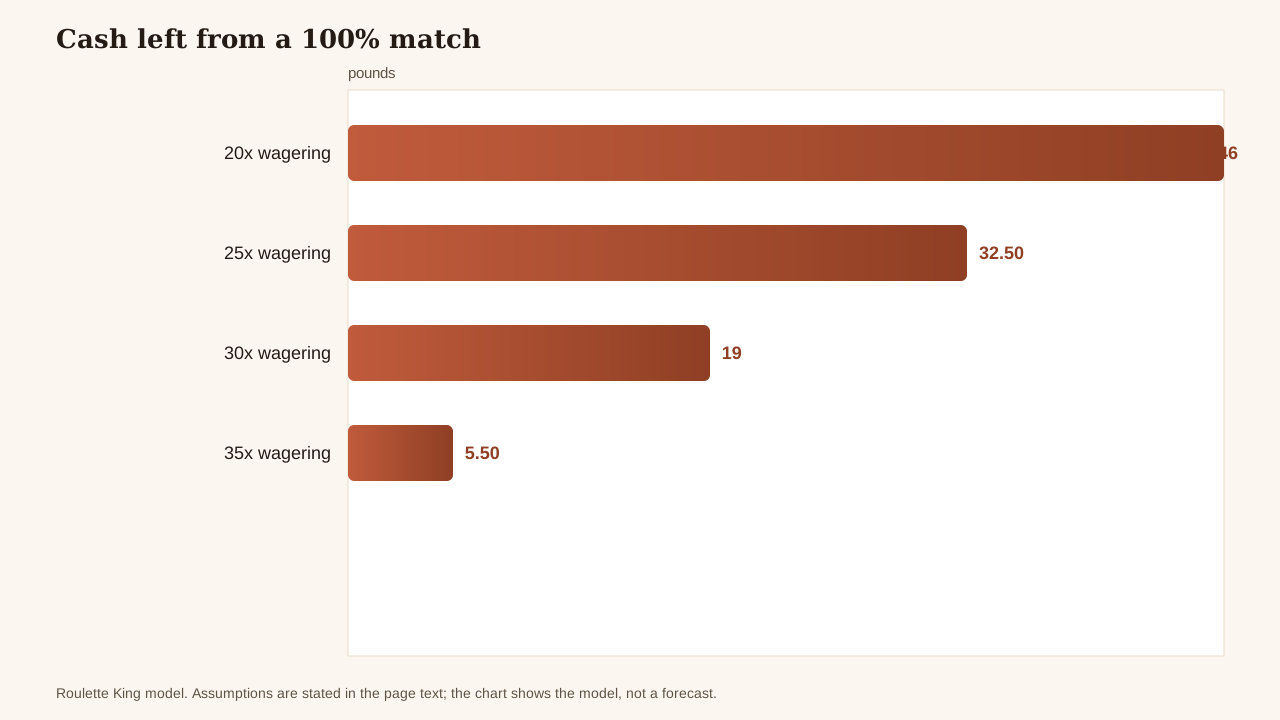
A chart generalises; your own numbers are specific. Put the multiplier and the base you are actually being asked to clear into the wagering calculator below, and it will return the turnover and the modelled position for that combination.
Wagering calculator
Turnover before withdrawal, modelled from the bonus and the multiple the terms set.
Model illustration with stated inputs; the terms of a specific offer always override a model.
The terms that bite
The multiplier attracts the attention, but four quieter terms decide whether a 100% welcome bonus converts at all. Each is standard across this part of the market, each is stated in the offer's terms, and each carries a measurable cost that the model above does not attempt to absorb.
The maximum bet rule caps the size of a single stake while wagering is live, most often at somewhere between £2 and £5 a round. Breach it once, even by accident, and operators are entitled to void the bonus along with everything won from it. The cap also sets a floor under the clearing time: against the £4,000 turnover of the 40x row, a £5 cap means at least 800 rounds and a £2 cap at least 2,000. It is the easiest term to break and the one with the least forgiving consequence, so it deserves reading before the first spin rather than after.
Game weighting decides how much of each stake counts towards the requirement. Slots usually count at 100%, whilst table games and live dealer tables often count at 10% or not at all. The effect is brutal arithmetic: at 10% weighting, £100 staked at a blackjack table clears £10 of the requirement, so the £4,000 job becomes £40,000 of actual staking. A plan to clear a match on roulette or blackjack is usually a plan the terms have already priced out.
Payment exclusions remove whole deposit methods from the offer. Certain e-wallets and prepaid vouchers are the usual names on the excluded list, and a deposit made with one either triggers no bonus at all or leads to bonus winnings being removed later. The qualifying methods sit in the terms; two minutes spent there settles the question before money moves, which is the only cheap moment to settle it.
Expiry sets the clock, usually starting when the bonus credits rather than when the deposit lands. Windows of seven, fourteen and thirty days are the common ones, and whatever wagering is unfinished when the window shuts is normally forfeited along with the winnings built on it. Set the turnover against the window and the required pace becomes concrete: £4,000 across seven days asks for about £570 a day without a single day off, while the same turnover across thirty days asks for about £133 a day, a rhythm an ordinary evening player can hold.
What a licence buys you
A licence from the UK Gambling Commission is not a badge of quality; it is a set of enforceable protections, and those protections hold whether the offer attached to them is generous or mean. The first is access to GamStop, the national self-exclusion scheme, where a single registration closes every UK-licensed gambling site at once. The second is independent dispute resolution: a disagreement over wagering, forfeiture or a stalled withdrawal can be taken to an adjudicator whose decision the operator is bound to honour, at no cost to the player.
The third protection is the least visible and arguably the most valuable: client funds held separately from the company's running money, so that a balance is not simply one more creditor's claim if the operator fails. The fourth is the regulator itself, with powers to investigate, fine, suspend or revoke, and a public register anyone can check in a minute. Complaints about a licensed operator therefore go somewhere and lead to something, which is more than an unhappy player elsewhere can say.
Offers from operators without a UK licence carry none of this. There is no GamStop coverage, so self-exclusion rests on whatever tools the operator chooses to provide. There is no adjudicator with jurisdiction, so a forfeited balance stays forfeited. Funds are not segregated, so the balance is exposed to the operator's own finances. And there is no regulator able to intervene, so the honest answer to 'what can I do' is 'very little'. A doubled deposit without these protections is a different product altogether, however large the headline, and the difference is the reason the comparison earlier in this page leads with the licence column.
Frequently asked questions
What is a 100% welcome bonus?
It is a first-deposit offer that matches your payment pound for pound with bonus funds: pay in £100, receive £100 of bonus, and begin with £200 on the balance. The deposit stays your own money throughout. The bonus is the operator's contribution and remains under conditions, normally a wagering requirement, until it has been cleared. The £100 match is the common mid-sized version in this part of the market, which is why the model on this page is built around it.
What does the wagering requirement mean in pounds?
It is the multiplier applied to whatever base the terms name. At 35x on a £100 bonus, £3,500 must be staked before release; at 40x, £4,000; at 50x, £5,000. Where the multiplier attaches to the deposit and the bonus together, the same 40x becomes £8,000, because the base is £200 rather than £100. The base matters as much as the multiplier, which is why the model shows both formulations side by side.
How do caps bite?
Two caps do most of the damage. A maximum bet rule limits each stake while wagering is live, and breaking it can void the bonus and its winnings outright. A maximum conversion rule, where one exists, limits how much of the bonus can become withdrawable cash; if such a cap sits below the modelled range for your multiplier, the cap rather than the model sets your ceiling. Both figures live in the terms, and both change the arithmetic before the first spin.
Which payment methods qualify for the match?
Debit cards usually qualify without complication. Certain e-wallets and prepaid methods are commonly excluded from match offers, and a deposit made with an excluded method either triggers no bonus or leads to the bonus winnings being removed later. The qualifying list is printed in the offer's terms, and reading it takes two minutes, which is considerably cheaper than discovering the exclusion after the deposit.
How does expiry work?
The clock normally starts when the bonus credits, and the common windows run from seven to thirty days. Whatever wagering remains unfinished when the window closes is usually forfeited, along with any winnings built on the bonus. Dividing the turnover by the days available gives the pace the terms demand: £4,000 across seven days is about £570 a day, every day, while the same turnover across thirty days is about £133 a day.
Is a 100% match worth taking?
It depends on the terms that bite, not the size of the headline. A £100 match at 35x the bonus, with a workable maximum bet, full slot weighting, a qualifying payment method and thirty days to clear, gives a modelled cash-out band of about £55 to £120 and a realistic structure to play through. The same match at 40x on the deposit and bonus, expiring in a week, is a different proposition. Judge the terms as the offer and the headline as its advertisement, and the decision usually makes itself.
What does the licence gap mean?
It means the protections described earlier do not apply: no GamStop self-exclusion, no independent dispute resolution, no segregated client funds, and no regulator with the power to step in. Offers advertised from outside the UK scheme can carry large headline matches precisely because the rules constraining UK operators do not bind them. The absence of a licence is not a detail tucked into the small print; it is the difference between having somewhere to take a complaint and having nowhere at all.