10 deposit
10 Deposit Casino: What a Ten Pound Minimum Buys and What It Costs
Ten pounds is the market's default entry; the model below prices it as a session and as a bonus package.
The shortlist, before the detail
The board below carries this month's featured offers with their headline terms. The prose that follows models offers of this kind and never repeats those figures; the operator's own page is always the binding version.
Roulette King picks
Top roulette offers this month
The shortlist first, then the arithmetic. Four featured packages carry the headline terms below; the rest of the page models what offers of this kind usually cost and what a licence would have added.
Terms checked at the October 2026 review · 18+ · T&Cs apply. Offers move often: the operator’s own page is always the binding version.
- 1
 Night Luck82/100Casino welcome bonus 805% up to €6,400 + 280 FS
- MuchBetter · VISA · Apple Pay
- Crypto welcome 140% up to 1,600 USDT
- VIP pack 800% up to €14,500
Visit siteNight Luck18+ · T&Cs apply - 2
 EliteSpin80/100Welcome bonus €/£5,000 + 500 FS
- MuchBetter · NETELLER · MasterCard
- Lootboxes up to €/£20,000 or 500 FS
- BGaming festival: €80,000 prize pool
Visit siteEliteSpin18+ · T&Cs apply - 3
 Winbeast78/100Welcome pack €5,000 + 500 FS + €650 free bet
- MasterCard · Litecoin · MuchBetter
- Code FORTUNE: wheel on €40+ deposits
- Monday boost: 40% up to €300 (BOOST1)
Visit siteWinbeast18+ · T&Cs apply - 4
 Betportal75/100Welcome package 300% up to €/£1,000 + 150 FS
- Trustly · Bitcoin · Bank transfer
- 1st deposit: 150% up to €/£500 + 100 FS
- 2nd deposit: 100% up to €/£300 + 50 FS
Visit siteBetportal18+ · T&Cs apply
Placements on this board are paid, and the order is part of that arrangement. Featured brands hold no UK Gambling Commission licence, so GamStop, independent dispute resolution and segregated-funds rules do not reach them. Gambling can be addictive. Play responsibly. How we are paid.
Why ten pounds is the common floor
Ask several UK-facing casinos where their welcome packages begin and the same figure keeps appearing: a £10 deposit. The number is not a rounding convenience. It marks the point where a matched bonus still makes commercial sense for the operator, where card and wallet processing costs stay proportionate to the transaction, and where the amount reads as an evening's entertainment rather than a financial commitment. Understanding why the floor sits where it does explains most of what follows, because every rule attached to a bonus is calibrated against this same entry point.
Start with the operator's side of the counter. Every transaction carries fixed processing costs, and a deposit has to generate enough expected play to fund the match attached to it. Below roughly a fiver the economics stop working for a full package, which is why genuinely low minimums tend to arrive without a bonus or with a reduced one. At ten pounds the sums balance: the operator can attach a 100 per cent match, set the wagering terms around it, and still cover the cost of moving the money.
Then there is the behavioural side. Ten is a round number that sits comfortably inside most casual budgets, low enough to feel disposable and high enough to buy a proper session at ordinary stakes. Five pounds buys five spins at £1 a go, which is over almost before it settles. Twenty pounds doubles the entertainment and doubles the exposure, and the market treats it as a deliberate step up rather than a default. The £10 deposit therefore works as the level most packages are designed around, and as the benchmark against which every other minimum gets measured.
None of this makes ten pounds a magic figure. It is simply the admission price the market has settled on, and the shape of everything attached to it, from match percentages to wagering multiples, follows from that choice. The rest of this page prices the entry two ways: first as a plain session of play, then as a bonus package, so the difference between the two shows up in hard numbers rather than in marketing language.
The model: what each entry shape costs and buys
The table below is deliberately simple. It takes the entry amounts the market actually uses and prices each one under identical assumptions, so the rows can be read line against line. The central row is the £10 deposit, because that is the market's most common entry, and the point the model makes is that the bonus attached changes the turnover rather than the entry itself: ten pounds buys the same session whichever way it is dressed, while the paperwork wrapped around it varies enormously.
Every figure rests on the same stated assumptions:
- Each match is assumed to be 100 per cent, so a £10 deposit carries a £10 bonus, and a £5 deposit carries a £5 bonus where a match is offered at all.
- Wagering is measured on the bonus alone, not on deposit plus bonus combined; a 35x requirement on a £10 bonus is £10 multiplied by 35, which is £350 of turnover. Some operators apply the multiple to deposit and bonus combined instead, which would double the figures to £700 to £1,000 on a £10 package; the model uses the bonus-only basis and flags the alternative here.
- All play is assumed to take place on slots that contribute 100 per cent of every stake to the requirement; other game categories contribute less or nothing, which stretches the numbers, as the terms section explains.
- Modelled turnover is the bonus multiplied by the wagering multiple, shown as a range from 35x to 50x because that span covers the common market range.
- Session value counts a £1 stake as one spin, so the spin count is the deposit divided by £1; ten pounds buys ten spins at that stake.
- The table applies no winnings cap, no maximum bet rule and no time limit, because those vary by operator and are priced separately later in the page.
| Deposit | Typical match attached | Wagering on bonus | Modelled turnover | Session value at £1 spins |
|---|---|---|---|---|
| £5 | 100% where offered | 35x to 50x bonus | £175 to £250 | 5 spins |
| £10 | 100% | 35x to 50x bonus | £350 to £500 | 10 spins |
| £20 | 100% | 35x to 50x bonus | £700 to £1,000 | 20 spins |
| £10 with no bonus | none | none | £0 | 10 spins |
Read the rows together and the pattern is linear. Double the deposit and the turnover doubles with it: the £5 row needs £175 to £250 cleared, the £20 row needs £700 to £1,000, and the £10 row sits between at £350 to £500. Session value moves in the same proportion, because spins at a fixed £1 stake are just the deposit divided by one pound. What the bonus changes is not what lands in the balance on day one; it changes how much play has to happen before anything attached to it can be withdrawn.
The fourth row is the control. A £10 deposit with no bonus produces £0 of modelled turnover, because there is nothing to clear, and it still delivers the same ten spins at £1 a stake as the matched version. Comparing the second row with the fourth is the cleanest way to see the trade on offer: the matched version adds £350 to £500 of required play on top of an identical session, in exchange for £10 of bonus funds that start life locked behind those requirements. Neither row is objectively the right choice; the table exists so the choice is made with the sums visible.
How the market lines up at this entry level
Licensing comes first in the comparison below because every other column depends on it. An operator holding a UK Gambling Commission licence works inside the UK's player protection framework, and that framework, rather than the size of any welcome package, is what fills the final column. Market focus and reputation are recorded descriptively: they note how each brand positions itself and what it is generally known for at entry level, not whether one outranks another. Terms in this part of the market move frequently, so the specifics of any package should be confirmed on the operator's own terms pages before a deposit is made.
| Casino | Licence | Market focus | What it is known for | UK protections |
|---|---|---|---|---|
| PartyCasino | UKGC licensed | casino-first brand | published match terms | GamStop, independent dispute resolution, segregated funds, regulator oversight |
| 888 Casino | UKGC licensed | long-running standalone casino | long-standing welcome shop | GamStop, independent dispute resolution, segregated funds, regulator oversight |
| LeoVegas | UKGC licensed | mobile-first casino | tiered welcome | GamStop, independent dispute resolution, segregated funds, regulator oversight |
| Casumo | UKGC licensed | licensed casino | gamified welcome | GamStop, independent dispute resolution, segregated funds, regulator oversight |
| NetBet | UKGC licensed | established casino | match combinations | GamStop, independent dispute resolution, segregated funds, regulator oversight |
| Magic Red | UKGC licensed | licensed casino | compact matches | GamStop, independent dispute resolution, segregated funds, regulator oversight |
| Mr.Play | UKGC licensed | licensed casino | matches with spins | GamStop, independent dispute resolution, segregated funds, regulator oversight |
| 32Red | UKGC licensed | long-standing casino brand | steady terms | GamStop, independent dispute resolution, segregated funds, regulator oversight |
| Mr Vegas | UKGC licensed | slots-led licensed brand | multi-stage welcome | GamStop, independent dispute resolution, segregated funds, regulator oversight |
| Unibet | UKGC licensed | European bookmaker roots | clean lobby | GamStop, independent dispute resolution, segregated funds, regulator oversight |
| Kinghills | No UK licence | offshore-facing casino | low-entry headlines outside the UK scheme | None of these apply |
Two rows illustrate how differently the same ten pounds can be packaged. PartyCasino's reputation rests on published match terms, which is the useful kind of fame: terms written plainly and easy to find make the arithmetic in the model above checkable before any money moves. 888 Casino, the long-running standalone casino in this list, is known for a long-standing welcome shop, the arrangement where several package shapes sit side by side and the entry amount decides which of them unlocks. Neither description is a recommendation. Both record positioning, and both matter less than the column they share, because both brands sit inside the licensed UK framework that the final column is actually measuring.
Two sessions: with and without a bonus
Set the same ten pounds against two different shapes and the contrast becomes concrete. In the first session the money is deposited plain, with nothing attached. In the second it carries a 100 per cent match, so £10 of bonus funds sit alongside the cash. The session itself, ten spins at £1 a stake, is identical in both cases; what changes is everything that happens afterwards.
The plain session is the simpler of the two. Ten spins at £1 each consume the deposit, and under a 96 per cent return to player assumption the expected cost of the session is 40p, because a 4 per cent house edge applied to £10 of stakes is 40p. That expectation says nothing about any single sitting: ten spins can return nothing at all, several pounds, or one large hit, and the spread of outcomes is wide at so small a sample. What the plain session does not carry is any condition. When the deposit is spent, the session is over, and anything won along the way is ordinary, withdrawable cash.
The matched session runs longer and costs more to finish. The ten cash spins behave exactly as above, but the £10 bonus arrives with £350 to £500 of required turnover attached. At eight to ten spins a minute on a fast slot, a £1 stake clears that volume in roughly 35 minutes to an hour, which is a fair approximation of the extra time the bonus demands. The expected cost of that play is larger than the bonus itself: at a 96 per cent return to player, 4 per cent of £350 is £14 and 4 per cent of £500 is £20, against a bonus worth £10. At a 97 per cent return the 35x figure softens to £10.50, still fractionally above the bonus. In the common structure the cash side stays withdrawable while only the bonus sits locked, which is worth knowing when the shapes are compared. The model is not arguing that bonuses are a poor deal in every case; it is showing that the wagering requirement is a genuine cost, paid in play, before a bonus converts into anything moveable.
The figure below collects these numbers in one view: the session each shape buys and the turnover each shape demands.
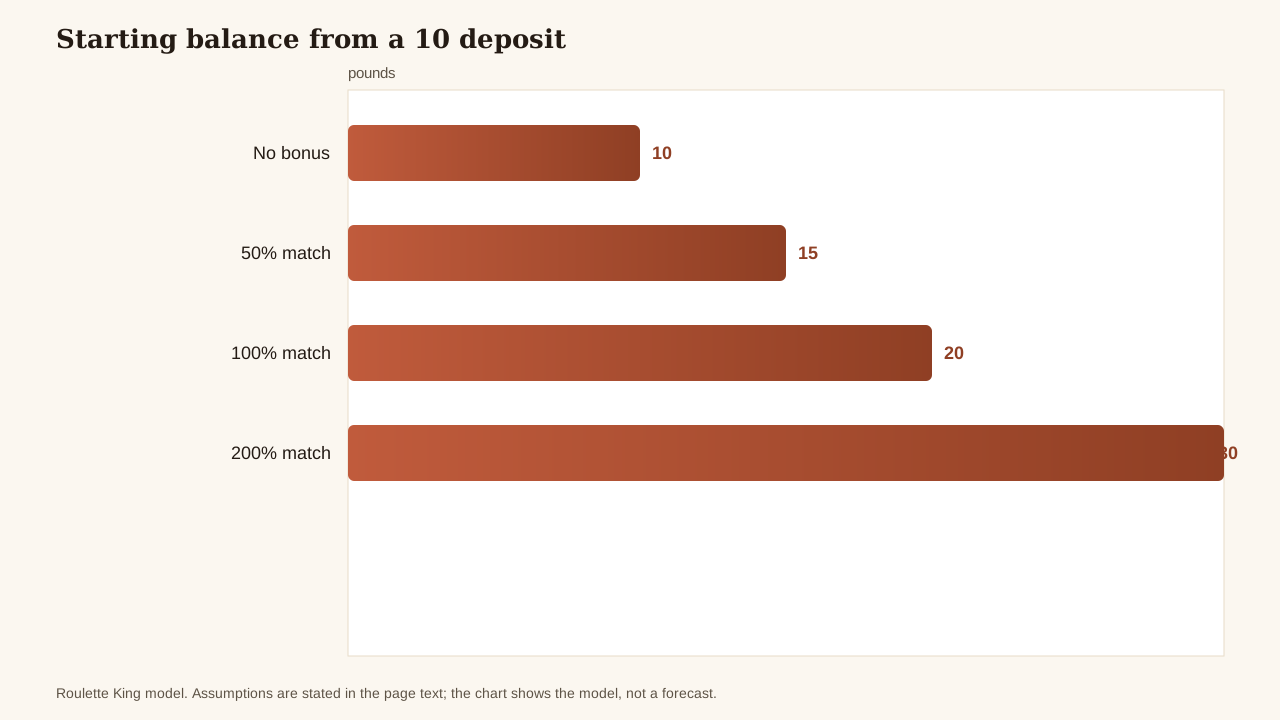
For any combination the table does not cover, the calculator multiplies a chosen bonus by a chosen wagering multiple and returns the required turnover directly.
Wagering calculator
Turnover before withdrawal, modelled from the bonus and the multiple the terms set.
Model illustration with stated inputs; the terms of a specific offer always override a model.
How a small deposit meets wagering and caps
Small deposits keep the absolute numbers modest, but the percentage rules that govern bonuses apply at full strength regardless of size. Four mechanisms do most of the work, and each one interacts with a £10 deposit in a specific way.
- Maximum bet while wagering. Most operators cap individual stakes during bonus play, commonly somewhere between £2 and £5 per spin or an equivalent amount. The model's £1 spins sit comfortably inside that band, which is one reason the session value is quoted at that stake. Exceed the limit, even once, and winnings from the bonus can be voided, so the cap is worth reading before the first spin rather than after.
- Winnings caps. Some packages limit what a bonus can convert to, either as a flat ceiling or as a multiple of the bonus. Take a hypothetical cap of 4x the bonus on a £10 bonus: that is a £40 ceiling on what the bonus side can pay out, however well the spins run. Where such a cap exists, it, rather than the return to player, sets the upper bound of the exercise.
- Game weighting. The model assumes slots contribute 100 per cent of each stake. If a game contributes 10 per cent, the arithmetic inverts: clearing £350 of required turnover on that game means placing £3,500 of actual stakes, ten times the headline figure. This is the single largest multiplier hiding inside small print.
- Time limits. Requirements commonly expire within 7 to 30 days. Spread across a 7-day window, £350 of turnover is £50 of play a day, or 50 spins at the model's £1 stake, which is a manageable but real daily commitment.
- Payment method exclusions. Some e-wallets are excluded from welcome offers at many operators, so the rail used to move the £10 can decide whether the match attaches at all.
Each mechanism applies to the £5 row and the £20 row exactly as it applies to the middle of the model; only the absolute amounts scale with the deposit. That is the practical meaning of the standard entry: the rules are proportional, so a smaller or larger first payment changes the sums, never the structure. Reading the small print with that proportionality in mind turns a page of percentages into arithmetic you can actually run.
What a UK licence actually buys
A licence is the least glamorous column in any comparison and the only one that matters when something goes wrong. The framework administered by the UK Gambling Commission delivers four concrete protections, and each has a practical face worth spelling out.
- GamStop access. One registration excludes a player from every UKGC-licensed operator at once, which turns a decision made on a difficult evening into a barrier that holds across the whole licensed market.
- Independent dispute resolution. If a complaint about withheld winnings or misapplied terms stalls with the operator, it can be escalated free of charge to an approved alternative dispute resolution service, whose decision the operator is bound to honour.
- Segregated funds. Licensed operators must hold customer money according to Commission rules, separately from company running costs, with the level of protection disclosed; the point is that deposits are not simply mixed into the operator's own balance sheet.
- A regulator who acts. Fines, licence conditions, suspensions and published enforcement form the background hum of the UK market, and the existence of that machinery is what gives the other three protections their teeth.
Offers without a UK licence carry none of these. The offshore-facing entry in the comparison table, Kinghills, sits outside the scheme entirely: no GamStop coverage, no approved dispute route, no segregated fund rules and no UK regulator with jurisdiction when a dispute arrives. Low-entry headlines outside the UK scheme are built to look identical to licensed offers on the surface, and the difference only becomes visible at the moment it is needed, which is exactly when it is too late to check. The practical habit is unglamorous and takes seconds: confirm the licence in the footer of a site before the deposit rather than after the dispute. Matches, multiples and caps are all negotiable detail; the licence is the frame that holds the rest of it up.
Frequently asked questions
What does a £10 deposit actually buy?
Two different products, and the model separates them cleanly. As a plain session, ten pounds buys ten spins at a £1 stake, with an expected cost of 40p at a 96 per cent return to player and no conditions attached. As a bonus package, it buys the same session plus £10 of bonus funds carrying £350 to £500 of required turnover at the market's common multiples. The session value is identical in both cases; the bonus adds play, not spins, and the terms section above prices what that extra play tends to cost in expected losses and time.
Which minimums are lower than £10?
A minority of UK-facing operators go below the standard floor. Five-pound deposits appear where a match is offered, and a few brands promote lower headline minimums, though packages at that level are usually smaller, reduced, or absent altogether. Payment methods can impose their own floors as well, so a site that accepts £5 by debit card may still require more through a wallet. The practical check is the cashier page rather than the homepage banner, because the lowest figure promoted and the lowest figure accepted are not always the same number.
What does the wagering cost in real terms?
On the model's assumptions, a £10 bonus at 35x to 50x means £350 to £500 of turnover before the bonus converts. At a 96 per cent return to player, the expected cost of that play is £14 to £20, which exceeds the £10 bonus itself; at 97 per cent the 35x figure softens to £10.50. In time, at £1 a spin and eight to ten spins a minute, clearing the requirement takes roughly 35 minutes to an hour of continuous play. These are modelled expectations rather than predictions of any single session, but they give the requirement a shape that percentage figures alone never do.
How do caps bite at this deposit size?
Three caps matter most. A maximum bet during wagering, commonly £2 to £5, poses no problem for the model's £1 spins but voids bonus winnings if breached. A conversion cap sets a ceiling on what the bonus can pay; a hypothetical 4x cap on a £10 bonus is a £40 limit regardless of how the spins run. Game weighting is the quiet one: at 10 per cent contribution, £350 of required turnover becomes £3,500 of actual stakes. Small deposits keep each ceiling low in absolute terms, yet every mechanism applies at full strength.
Which payment rails accept a £10 deposit?
Debit cards accept £10 almost universally across the licensed UK market, and PayPal is close behind at most major operators. Some e-wallets are excluded from welcome offers at various brands, which turns the deposit method into a term of the bonus rather than a neutral choice. Prepaid vouchers generally deposit only, so withdrawals need a separate route. Credit cards have been barred from UK gambling transactions since April 2020, so the decision is between debit and whichever wallets each operator accepts. Checking the cashier before depositing settles all of it in under a minute.
Is it worth taking a bonus at this size?
Only if the required play is play you would happily make anyway. The model prices the trade precisely: the matched version of the session carries £350 to £500 of turnover against £0 for the plain version, and the expected cost of clearing it at a 96 per cent return to player exceeds the £10 bonus. If the aim is a short, uncomplicated session, the plain deposit delivers the same ten spins without paperwork. If the aim is maximum playing time from the same ten pounds, the bonus extends it, at the price of the conditions above. Both are legitimate choices; the numbers simply make the trade visible before it is made.
What does the licence gap mean in practice?
It means the four protections disappear at once. Without a UK licence there is no GamStop coverage, so self-exclusion registered here does not reach the site; no approved dispute resolution, so a withheld withdrawal has no free escalation route; no segregated fund rules; and no UK regulator with jurisdiction to act. The offshore-facing row in the comparison table exists to make the contrast visible, because low-entry headlines outside the UK scheme are designed to look identical to licensed offers. In practice the check takes seconds: a UKGC-licensed site states it plainly in the footer, and anything vague on that point answers the question on its own.