new online slots
New online slots
A new title gets a shelf, a promo and a month of attention; the model below tracks the release cycle and what it costs to play.
The shortlist, before the detail
The board below carries this month's featured offers with their headline terms. The prose that follows models offers of this kind and never repeats those figures; the operator's own page is always the binding version.
Roulette King picks
Top roulette offers this month
The shortlist first, then the arithmetic. Four featured packages carry the headline terms below; the rest of the page models what offers of this kind usually cost and what a licence would have added.
Terms checked at the October 2026 review · 18+ · T&Cs apply. Offers move often: the operator’s own page is always the binding version.
- 1
 Night Luck82/100Casino welcome bonus 805% up to €6,400 + 280 FS
- MuchBetter · VISA · Apple Pay
- Crypto welcome 140% up to 1,600 USDT
- VIP pack 800% up to €14,500
Visit siteNight Luck18+ · T&Cs apply - 2
 EliteSpin80/100Welcome bonus €/£5,000 + 500 FS
- MuchBetter · NETELLER · MasterCard
- Lootboxes up to €/£20,000 or 500 FS
- BGaming festival: €80,000 prize pool
Visit siteEliteSpin18+ · T&Cs apply - 3
 Winbeast78/100Welcome pack €5,000 + 500 FS + €650 free bet
- MasterCard · Litecoin · MuchBetter
- Code FORTUNE: wheel on €40+ deposits
- Monday boost: 40% up to €300 (BOOST1)
Visit siteWinbeast18+ · T&Cs apply - 4
 Betportal75/100Welcome package 300% up to €/£1,000 + 150 FS
- Trustly · Bitcoin · Bank transfer
- 1st deposit: 150% up to €/£500 + 100 FS
- 2nd deposit: 100% up to €/£300 + 50 FS
Visit siteBetportal18+ · T&Cs apply
Placements on this board are paid, and the order is part of that arrangement. Featured brands hold no UK Gambling Commission licence, so GamStop, independent dispute resolution and segregated-funds rules do not reach them. Gambling can be addictive. Play responsibly. How we are paid.
How new titles arrive and take their shelf space
New online slots reach a UK lobby on a schedule most players never see. Studios publish drop calendars a quarter in advance, operators choose which launches to back with marketing, and a release date is fixed weeks before anyone can play. On the day itself a game does not simply join an alphabetical list. It is placed: front shelves, pinned tiles and a dedicated new-release row are the visible result of commercial terms, supplier relationships and launch budgets agreed long beforehand.
Placement matters because attention is short. A front shelf position, the tile an operator pins at the top of the lobby, puts a title where players already are, and early performance data from the first days decides how long it stays there. Quiet arrivals from smaller studios often appear with no support at all, while heavily backed launches carry promotional spins, leaderboard tournaments and homepage space from the first morning.
Different lobbies handle arrivals in different ways. Games-led brands run a standing new-release shelf that refreshes weekly and is promoted on the homepage. Franchise-led brands slot new entries into an existing family, so a fresh instalment inherits the shelf space of the series that came before it. Slots-first casinos add volume quickly, listing many arrivals at once and letting search and sorting tools do the work. Compact lobbies curate harder, adding a handful of titles a month and retiring others to keep the list short.
Exclusives complicate the picture further. A studio may grant one operator a window of exclusivity, sometimes a fortnight, during which the title appears nowhere else. That window explains why a game can dominate one lobby's promotional space before a wider release, then settle into an ordinary position elsewhere a few weeks later. For the player the practical effect is simple: the same title can be front and centre in one brand and buried in another's catalogue within a month.
Badges and labels carry some of the weight too. A small new tag on a tile, a newest-first sort option and a supplier page within the lobby all steer attention towards recent arrivals without a promotion attached. These cost little to run, which is why even lobbies that rarely buy launch campaigns still mark their new entries clearly.
Shelf space is a form of choice architecture. What sits at the top of a lobby is what gets played, and launch placement is the sharpest example of that rule. Understanding the cycle has a practical use: a title seen on a front shelf in week one will sit somewhere very different by week six, and the offers attached to it will have changed as well.
From there the lifecycle is predictable. Attention peaks in launch week, the title moves to the main shelves, then to category pages, and eventually to archive pages where older games sit beside the classics. Promotional support fades at every step. The next section turns that pattern into numbers.
The lobby model: where a release sits, week by week
What follows is a model of lobby behaviour, not a per-title claim about any named game. It describes where a typical release sits as the weeks pass and what a fixed session looks like at each stage. The arithmetic is deliberately simple and identical for every row: a £50 bankroll staked at 20p a spin divides into 250 spins, and that session length is held constant so that the only variable is the lobby's treatment of the game.
| Release week | Typical lobby weight | Modelled spins on a £50 bankroll at 20p | Notes |
|---|---|---|---|
| Launch week | Front shelves and promos | 250 | Promotional spins often attached |
| Weeks 2 to 4 | Main shelves | 250 | Weighting settles |
| Month 2 | Category pages | 250 | RTP variants settle |
| Older | Archive pages | 250 | Promos rare |
Three patterns stand out. Support is concentrated at the front: launch week is when promotional spins and offers of this kind cluster, and they thin out quickly. Position decays in steps rather than smoothly, which is why a heavily promoted title can seem to vanish within a month. Month 2 is when RTP variants settle, meaning the operator's chosen return-to-player setting becomes the one it keeps from then on, a point the volatility section picks up.
The 250-spin figure is a session length, not a prediction of results. Over 250 spins at 20p a high-volatility title can swing far in either direction, and the model says nothing about outcomes. It fixes only how long the session runs and where the game sits in the lobby while it happens.
Lobby weight matters beyond visibility. Position drives play, play generates the data operators use when planning the following month's promotions, and a title that underperforms on the main shelves can reach the archive without ever seeing a second campaign. The rows above are a simplification, but the direction of travel is consistent across the market.
How UK-facing lobbies compare on fresh arrivals
The table below lines up the lobbies most associated with new online slots in this part of the market, recording licence status and player protections alongside each brand's approach to fresh releases.
| Casino | Licence | Market focus | What it is known for | UK protections |
|---|---|---|---|---|
| Sky Vegas | UKGC licensed | games-led brand | exclusives and new-release shelves | Yes, full scheme |
| Virgin Games | UKGC licensed | games-led brand | curated new releases | Yes, full scheme |
| MrQ | UKGC licensed | no-wagering pioneer | new titles with no-wager spins | Yes, full scheme |
| PlayOJO | UKGC licensed | no-wagering model | kickers on new games | Yes, full scheme |
| Rainbow Riches Casino | UKGC licensed | franchise-led brand | new entries in the franchise | Yes, full scheme |
| JackpotJoy | UKGC licensed | games brand | daily new games | Yes, full scheme |
| 888 Casino | UKGC licensed | long-running standalone casino | exclusives beside new mainstream releases | Yes, full scheme |
| 32Red | UKGC licensed | long-standing casino brand | new-release shelves beside the classics | Yes, full scheme |
| NYSpins | UKGC licensed | licensed casino | city-themed lobby progression | Yes, full scheme |
| Videoslots | UKGC licensed | slots-first casino | new releases at volume | Yes, full scheme |
| Magic Red | UKGC licensed | licensed casino | compact new-release list | Yes, full scheme |
| Slots Temple | No UK licence | offshore-facing slots brand | outside the UK scheme | None |
Sky Vegas and MrQ show how differently two licensed brands can treat the same launch. Sky Vegas leans on exclusives and a dedicated new-release shelf, so its launches arrive with studio-backed promotion and homepage space. MrQ takes the no-wagering route, attaching spins to selected new titles with no wagering requirements, which means anything won from those spins is credited as cash rather than locked behind playthrough rules.
How launch promotions are built
New online slots are marketed hardest in their first month, and the promotions follow a small number of templates. The commonest is a bundle of free spins on the new title, credited for logging in during the promo window, on a qualifying deposit, or as part of a wider package. Spin stakes are fixed by the operator, so a bundle has a defined size whatever the player's own habits happen to be.
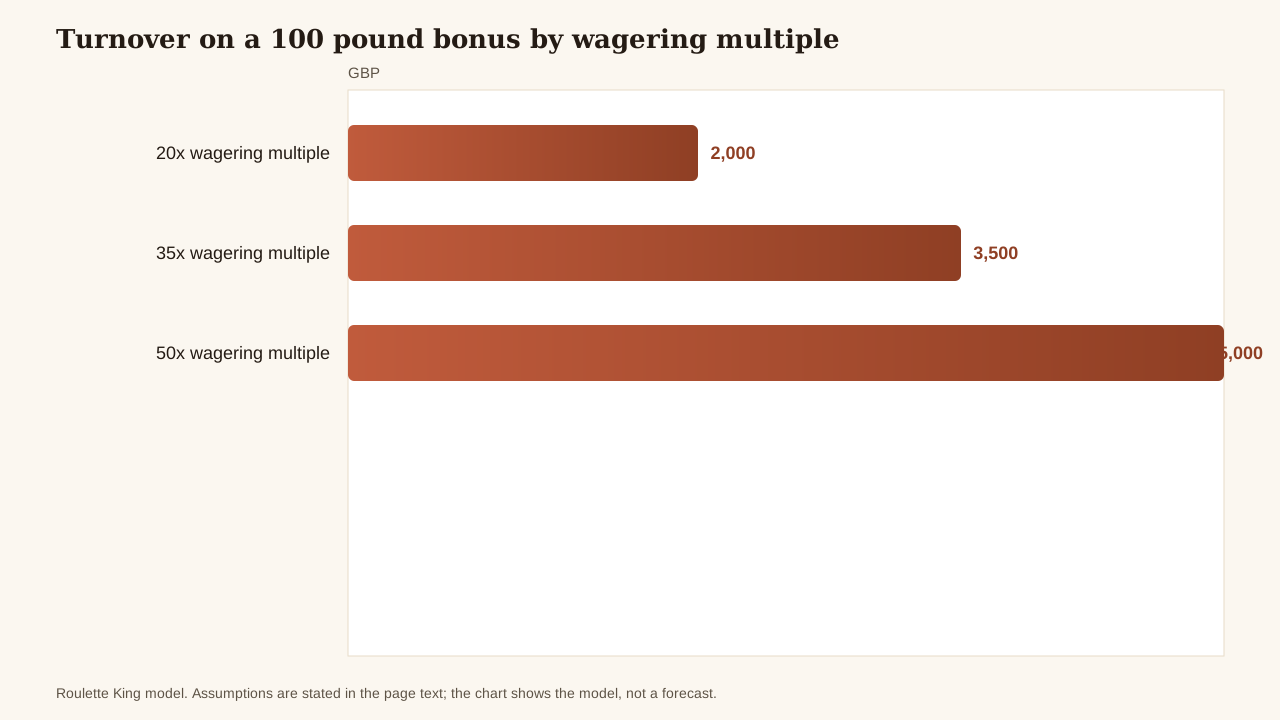
The details that matter sit in the terms. Wagering requirements decide whether spin winnings arrive as cash or as bonus funds: a £10 bonus at 35x wagering means £350 of qualifying stakes before a withdrawal is possible, because 35 multiplied by £10 is £350. Game weighting decides how much each stake counts towards that total, with slots usually counting in full and other games counting for less. Time limits, maximum conversion caps and stake limits while wagering narrow the offer further.
No-wagering operators invert the model. Their launch bundles are smaller on paper because the operator expects nothing back, but winnings from the spins are paid as withdrawable cash. Matched bonuses work in the opposite direction: large face value, heavy playthrough, and a conversion rate that depends entirely on the small print. Neither structure changes the game itself; both change what sits around it.
Tournaments and leaderboards are the other launch staple. Operators run timed competitions on a new release, awarding prizes for the biggest single win, the most spins or the highest multiplier reached. Entry costs nothing beyond stakes a player would place anyway, but prize pools are shared across many entrants, so a leaderboard is better treated as a possible extra than as a plan.
Promotional calendars follow release calendars. A games-led lobby's offers page changes in the same week its new-release shelf does, because both are planned around known launch dates. Anyone tracking a particular studio will find the supplier's published slate more reliable than an operator page, since it lists dates before lobbies are updated.
Reading a launch offer takes about two minutes once the pattern is familiar. Find the wagering multiplier and apply it to the bonus amount; check which games count towards the total and at what rate; note the expiry date and any cap on winnings from the spins; then decide whether what remains justifies arranging a session around it. An offer that looks large but expires in three days under a 40x requirement behaves very differently from a small no-wagering bundle paid in cash.
The calculator below applies the same session arithmetic, holding the 20p stake from the model as its default so results stay comparable.
Session cost calculator
Modelled cost of a session from stake, length and the house edge you set.
Model illustration with stated inputs; the terms of a specific offer always override a model.
What to check on a new title: RTP and volatility
Two numbers shape how a new release plays, and both deserve a look before the first spin. The first is return to player, written as RTP: the share of stakes a game returns over a very long run. A 96% RTP means that across an enormous number of spins £96 of every £100 staked comes back to players as winnings. That figure is a property of the game's design rather than a forecast, and a £100 stake returning £96 is a long-run average, nothing more.
The complication with new titles is the RTP range. Studios increasingly ship the same game at several settings, say 96%, 94% and 92%, and the operator chooses which one to run. New online slots sometimes begin at one setting and move to another once the launch window closes, which is why the model places the settling of RTP variants at month 2. The paytable or info screen inside the game shows the setting in force, and it is the only source worth trusting, because lobby tiles rarely surface it.
Volatility is the second number. It describes how winnings are distributed rather than how much is returned in total. A low-volatility title pays small amounts often; a high-volatility title pays rarely but can pay far more per hit. Labels are broad, usually low, medium or high, sometimes extended with a description such as very high, and the label comes from the studio rather than from the operator.
For a session of the length modelled here, 250 spins at 20p, volatility matters more than the headline RTP. On a high-volatility game many spins can return nothing while the shape of the session depends on a handful of hits; on a low-volatility game the balance moves in smaller steps. Neither pattern changes the long-run return. What changes is the ride.
Maximum win caps and hit rates complete the picture. A cap limits the largest single payout a title can produce, which matters most on high-volatility games where the appeal lies in the outlier hit. Hit rate, where published, estimates how often any winning combination lands, and it explains why a game can feel generous while returning no more than its RTP allows.
A short checklist for launch day: open the info screen and note the RTP in use; read the volatility label and the maximum win cap; check whether a bonus buy feature exists and what it costs; then decide how the session budget, £50 in the model above, should be divided. If a lobby's tiles do not display these details, the game's own menu will.
What a UK licence actually buys you
Every protection mentioned on this page traces back to one thing: a licence from the UK Gambling Commission. A licensed operator must offer GamStop, the national self-exclusion scheme at gamstop.co.uk, through which a single registration excludes a player from every licensed UK operator at once.
The licence also buys independent dispute resolution. If a disagreement over a withdrawal or a bonus cannot be settled with the operator, the case can be taken to an independent adjudicator approved by the Commission at no cost to the player. Customer funds add another layer: licensed operators must keep player balances segregated from operating money under one of several recognised arrangements, so a balance is not simply part of the business's cash flow.
Segregated funds deserve a sentence of their own, because the phrase is easy to skim past. It means the money in a player's balance is held apart from wages, marketing bills and supplier payments, under an arrangement the Commission recognises, so that a business failure does not leave balances treated as company assets. The strength of that protection varies by arrangement, and licensed operators must publish which one they use.
There is also a regulator who acts on complaints. The Commission investigates licensed operators, publishes the outcomes and can suspend or revoke a licence. None of that machinery exists offshore. An operator without a UK licence provides no GamStop coverage, no independent dispute route, no assurance of segregated funds and no regulator with jurisdiction, which is why the comparison table records the protections of the offshore-facing entry as None.
The gap shows up in the tools players use daily. Deposit limits, reality checks and time-outs are licence conditions on UKGC brands rather than courtesies, and self-exclusion through GamStop blocks licensed brands automatically while leaving unlicensed ones untouched. That asymmetry is the practical meaning of the licence column in the comparison above.
Two resources are worth keeping to hand. GamStop, at gamstop.co.uk, covers self-exclusion across the licensed market. The National Gambling Helpline, on 0808 8020 133, is run by GamCare with BeGambleAware and offers free, confidential support to anyone worried about their own gambling or someone else's.
Frequently asked questions
How often do new online slots arrive?
New titles land in UK lobbies every week, with heavier clusters at the start of the month and around supplier launch dates. Across the market as a whole, dozens of titles appear each month, though any single lobby adds a smaller share of that total. Games-led brands tend to refresh a new-release shelf weekly, while compact lobbies may add only a handful over the same period. A supplier's published release calendar is the most reliable guide to what is coming, because it lists dates before lobbies are updated.
What are RTP variants?
Many modern titles ship with several return-to-player settings, for example 96%, 94% and 92%, and the operator chooses which one runs on its site. The game's paytable or info screen shows the setting in force. The difference is material over a long run: a four-point gap at a 20p stake equals 0.8p of expected return per spin, since 4% of 20p is 0.8p. Two brands hosting the same game can therefore offer different long-run returns without anything about the game itself changing.
Do launch promos change the maths?
The base game's return does not change because a promotion sits on top of it. Offers add value or subtract it through their terms. Free spins with no wagering add clean value, though the per-spin stake is fixed by the operator. Bonus funds with wagering convert far less often than their face value suggests: a £10 bonus at 35x requires £350 of qualifying stakes before withdrawal, and game weighting, time limits and conversion caps reduce the realistic outcome further. The session model on this page assumes a plain £50 bankroll precisely so that promotional noise stays out of the arithmetic.
Where do old titles go?
Most lobbies move ageing releases to archive or category pages, reachable through search or through a supplier's own brand page. The game keeps its place and its RTP setting; it loses promotional support and shelf position. Some titles return to the front for anniversaries, franchise relaunches or sequels that pull the original back into view. If a specific game cannot be found, searching the studio's name usually locates its full catalogue on an operator's site.
Which lobbies list RTP?
Practice varies between operators. Some display the RTP in the game information before play begins, others only inside the paytable, and a few rely on the studio's documentation. The dependable habit is to open the info screen of the title itself, because that is where the setting in force is published, and it can differ between operators hosting the same game. Third-party listings exist but can lag behind a change of setting, so the game's own menu remains the source of record.
How is volatility labelled?
Most studios use a three-step label, low, medium or high, sometimes extended with very high for the most volatile titles. The label describes distribution rather than return: a high-volatility game pays less often but with larger individual hits. Labels sit in the info screen beside RTP and the maximum win cap. Because labelling is the studio's own, two games marked high can behave differently, so hit frequency and feature costs in the paytable are worth a glance too.
What does the licence gap mean?
It is the difference between playing inside the UK scheme and outside it. A UKGC licensed operator provides GamStop self-exclusion, independent dispute resolution, segregated customer funds and a regulator who investigates complaints. An offshore-facing brand offers none of those protections, which is why the comparison table records its entry as None. Anyone who wants to step back from gambling can register with GamStop at gamstop.co.uk, and the National Gambling Helpline on 0808 8020 133, run by GamCare with BeGambleAware, is free and confidential.