mobile slots
Mobile slots
A phone session is short and stake sizes creep; the model below prices the common sessions.
The shortlist, before the detail
The board below carries this month's featured offers with their headline terms. The prose that follows models offers of this kind and never repeats those figures; the operator's own page is always the binding version.
Roulette King picks
Top roulette offers this month
The shortlist first, then the arithmetic. Four featured packages carry the headline terms below; the rest of the page models what offers of this kind usually cost and what a licence would have added.
Terms checked at the October 2026 review · 18+ · T&Cs apply. Offers move often: the operator’s own page is always the binding version.
- 1
 Night Luck82/100Casino welcome bonus 805% up to €6,400 + 280 FS
- MuchBetter · VISA · Apple Pay
- Crypto welcome 140% up to 1,600 USDT
- VIP pack 800% up to €14,500
Visit siteNight Luck18+ · T&Cs apply - 2
 EliteSpin80/100Welcome bonus €/£5,000 + 500 FS
- MuchBetter · NETELLER · MasterCard
- Lootboxes up to €/£20,000 or 500 FS
- BGaming festival: €80,000 prize pool
Visit siteEliteSpin18+ · T&Cs apply - 3
 Winbeast78/100Welcome pack €5,000 + 500 FS + €650 free bet
- MasterCard · Litecoin · MuchBetter
- Code FORTUNE: wheel on €40+ deposits
- Monday boost: 40% up to €300 (BOOST1)
Visit siteWinbeast18+ · T&Cs apply - 4
 Betportal75/100Welcome package 300% up to €/£1,000 + 150 FS
- Trustly · Bitcoin · Bank transfer
- 1st deposit: 150% up to €/£500 + 100 FS
- 2nd deposit: 100% up to €/£300 + 50 FS
Visit siteBetportal18+ · T&Cs apply
Placements on this board are paid, and the order is part of that arrangement. Featured brands hold no UK Gambling Commission licence, so GamStop, independent dispute resolution and segregated-funds rules do not reach them. Gambling can be addictive. Play responsibly. How we are paid.
How the small screen changes the session
A game does not turn into a different game on a phone, but the session wrapped around it changes in three ways that bear directly on cost: pace, stake creep and visibility. Start with pace. A touch interface removes nearly every step between the impulse and the spin. Rebet sits where a thumb naturally rests, the stake controls sit beside it, and portrait layouts push the paytable and the rules several taps away while keeping spin and stake at the bottom of the screen. Nothing about that arrangement is accidental. It is built so that the next spin is always the easiest action available, which is why phone sessions tend to start more often and run faster than the same player's desktop play.
Stake creep follows from the same design. Most mobile slots remember the last stake used and treat the step up as a one-tap move, so 10p becomes 20p without ceremony and 20p becomes 40p after a quiet run of spins, because raising the stake feels like the only lever left to pull. No banner announces the change and no running total recalculates in front of you. The balance readout on many titles is small, occasionally expressed in credits rather than pounds, and it competes with win animations for attention. Across an evening, the amount actually staked can end up several times the figure held in mind when the app was opened, and the software will not volunteer that comparison.
Visibility is the third shift. On a desktop the session has edges: a window to close, a balance at the top of the screen, a chair to get out of. On a phone the game fills the frame and the session folds into the rest of the day, wedged between messages, journeys and half-watched television. Five minutes becomes forty because there is no natural stopping point in view and no clock on the screen. Combine that with creeping stakes and a session priced in your head as small change can quietly become one of the expensive rows modelled in the next section.
None of this makes phone play worse by default. It makes the arithmetic easier to lose track of, which is a different problem with a practical answer: price the common sessions in advance, then set the controls that hold pace and stakes where you decided them. The rest of this page does exactly that.
The session model: what common sessions cost
The table below prices four familiar session shapes, and every assumption behind the numbers is stated. First, flat staking: the same stake on every spin, with no mid-session raises, because flat staking is the only way to read a cost cleanly. Second, a blended house edge of 4% across a typical mobile slots mix; that is what a 96% average return to player implies, and individual titles sit either side of it. Third, the model cost is simply 4% of everything staked during the session: 4% of £40 is £1.60, 4% of £80 is £3.20, 4% of £800 is £32 and 4% of £4,000 is £160. Fourth, no bonus value, cashback or loyalty credit is included in the maths. The model cost is a long-run statistical cost of the volume, not a fee and not a prediction; short samples are dominated by variance, so any single session can land well above or below the figure.
| Session | Stakes | Spins | Model cost at 4% edge | Data and battery notes |
|---|---|---|---|---|
| Commute | 10p | 100 | £40 staked, £1.60 | Short sessions suit low stakes; data use stays light on standard titles. |
| Lunch break | 20p | 100 | £80 staked, £3.20 | Brief bursts on Wi-Fi or 4G keep data use and battery drain modest. |
| Evening | £1 | 200 | £800 staked, £32 | An hour or more of play rewards Wi-Fi; screen brightness drives battery use. |
| Weekend long session | £2 | 500 | £4,000 staked, £160 | Long sessions deserve a charged battery, a Wi-Fi connection and a planned break. |
Read the figures as a scale rather than a price list. Doubling the stake doubles the model cost at the same session shape, which is why the lunch break at 20p runs to £3.20 while the commute at 10p sits at £1.60. The evening session at £1 carries a model cost of £32 across 200 spins, and the weekend long session at £2 carries £160 across 500, which is the row worth a hard look before an idle Saturday. Volume is what moves the number, because more money passing through the game means more applications of the edge, even when the screen feels identical.
Two refinements keep the model honest. The 4% edge is a blend, so a session spent on higher-return titles would model slightly cheaper and one spent on feature-heavy, lower-return titles slightly dearer. The flat-staking assumption is the generous part: real sessions often raise stakes after losses, which pushes the true cost above the modelled one. Treat the table as the price of disciplined play, not of average play.
UK mobile casinos compared
Market focus on a small screen is not decorative. It decides how many taps sit between opening a site and reaching a game, whether the cashier is built for thumbs, and whether the lobby is shaped for a five-minute session or an evening on the sofa. Those differences are what the comparison below tries to surface.
Every casino in the table holds a licence from the UK Gambling Commission and treats the phone as a first-class way to play, so the differences worth weighing concern design focus rather than legitimacy.
| Casino | Licence | Market focus | What it is known for | UK protections |
|---|---|---|---|---|
| LeoVegas | UKGC | mobile-first casino | apps built around the lobby | Yes, full scheme |
| Bet365 | UKGC | sportsbook-first giant | one app for book and casino | Yes, full scheme |
| William Hill | UKGC | high-street heritage | casino app beside the book | Yes, full scheme |
| Ladbrokes | UKGC | high-street brand | casino tab inside the main app | Yes, full scheme |
| Coral | UKGC | mainstream brand | app-first cashier | Yes, full scheme |
| MrQ | UKGC | no-wagering pioneer | mobile lobby with no-wager spins | Yes, full scheme |
| Pub Casino | UKGC | UK brand | light mobile site | Yes, full scheme |
| Midnite | UKGC | UK-led brand | app-led onboarding | Yes, full scheme |
| Sun Bingo | UKGC | tabloid-partnered bingo | small-stake mobile play | Yes, full scheme |
| Foxy Bingo | UKGC | bingo-led brand | mobile room play | Yes, full scheme |
| Rainbow Riches Casino | UKGC | franchise-led brand | franchise on a small screen | Yes, full scheme |
| Duelz | UKGC | UK-licensed brand | duel-format gamification on mobile | Yes, full scheme |
LeoVegas and Bet365 show the two shapes this part of the market takes. LeoVegas built its apps around the casino lobby from the outset, so the slots sit a tap from launch, while Bet365 keeps book and casino in one app, so a single login covers both. Neither route changes the arithmetic, because the same stakes and spins cost the same wherever they happen.
Apps, browsers, data and battery
An app and a browser reach the same account and the same games, but they behave differently in ways that shape sessions. Apps launch straight into the lobby, keep you signed in and often support face or fingerprint login, so the gap between deciding to play and the first spin is a couple of seconds. Push notifications are the other side of that convenience: useful for withdrawal updates, and equally effective as engineered reminders to return. If return visits are what you are trying to moderate, switching notifications off in the phone's own settings is one of the few decisions that costs nothing and pays daily.
Browsers trade convenience for friction. Nothing is installed, sessions begin from a bookmark or a search, pages reload, and there are no notifications to silence. Modern slots are built in HTML5 and run cleanly in the mainstream mobile browsers, so the catalogue is broadly the same either way. Some players find the small extra friction of a browser useful precisely because it slows down the start of a session.
Data use depends on the game type far more than on the app-versus-browser choice. Standard video slots download their art and sound once and then run on the device, so an hour of play is a modest amount of data as a rule of thumb rather than a measured figure. Live dealer tables and heavily animated titles stream continuously and can use several times more over the same hour. Long sessions belong on Wi-Fi where possible, and app updates are best left to run overnight on a home connection. Battery tells a similar story: the always-on screen is the main drain, brightness multiplies it and graphics-heavy games add to it. Standard mobile slots are undemanding by modern phone standards, but two hours of screen time is two hours of screen time, whatever is on it.
Stake handling differs a little between the two routes as well. Apps tend to remember preferences across sessions and surface recent stakes first, which saves time and also smooths the path for stake creep, while a browser session is more likely to start from the game's default. Neither is safer by design. What matters is checking the stake box before the first spin, because the model shows how quickly that single number scales the cost of everything that follows.
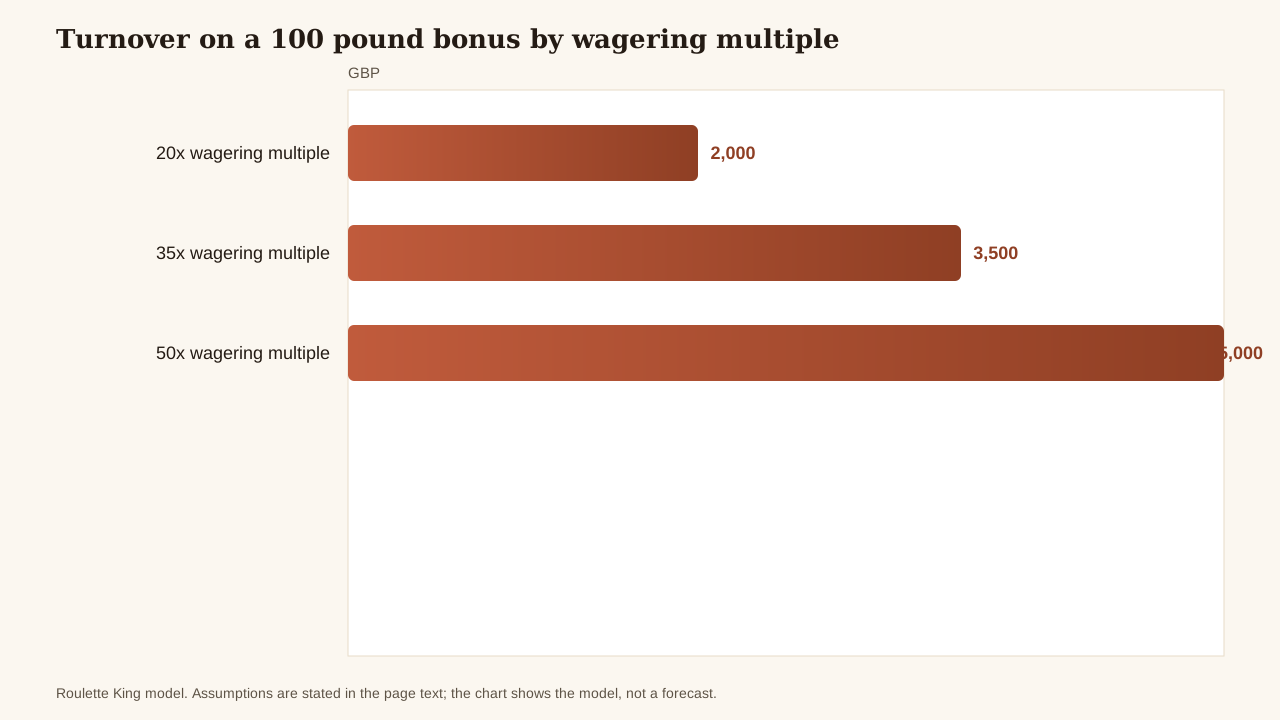
The figure gathers the modelled session costs into one view, which makes the shape of the scale easier to take in at a glance.
To price a session of your own shape, the calculator below applies the same flat-staking assumption and the same 4% blended edge to whatever stake, spin count and length you enter.
Session cost calculator
Modelled cost of a session from stake, length and the house edge you set.
Model illustration with stated inputs; the terms of a specific offer always override a model.
Controls worth setting before you play
Protections work best when they are set before the first deposit, on the device you actually play on. Three matter most on a phone. Reality checks interrupt play at an interval you choose and show how long the session has run; they must be acknowledged before the game continues, which is the point, because they cut through the frame-filling absorption that portrait layouts are so good at building. Session reminders do similar work, and some apps let you set the cadence rather than accept a default. Deposit limits cap what can be added to an account per day, week or month; reductions take effect immediately while increases are held back for a cooling-off period, so change is deliberately easier in one direction than the other.
Mobile habits decide whether controls exist or merely work. Find the limits pages in the app or mobile site before depositing, because they are sometimes a few menus deep and harder to reach mid-session. Consider whether one-tap payments suit you: convenience that speeds deposits also speeds top-ups, and removing stored cards restores a small, honest pause. Push notifications deserve the same treatment described earlier. Autoplay, for what it is worth, has been removed from mobile slots on GB-licensed sites and spins run at a minimum pace, so the fastest loops of a few years ago are gone; pace creep now arrives through session length and stake size, which is where reality checks and limits earn their keep.
One habit closes the loop. Account history on licensed sites records amounts staked as well as deposited, and staked is the only figure that maps onto the model earlier on this page. Checking it once a week turns a vague worry about stake creep into a number you can set against the modelled rows. If the number is higher than the row you had in mind, stakes or sessions have drifted, and both are adjustable before the next session rather than during it. Blocking software that covers every gambling site and app on a phone is free to install and sits underneath everything else as a backstop.
What the licence buys you
Everything on this page rests on one line in an operator's footer: a licence from the UK Gambling Commission. That licence is what turns a list of features into enforceable protections, and it buys four things in particular.
Access to GamStop comes first. Registration at gamstop.co.uk excludes you from every online operator licensed for Great Britain at once, for a period you choose, free of charge, and operators are required to enforce it. Independent dispute resolution comes second: if a complaint about a withheld withdrawal or a disputed balance stalls, it can be taken to the independent adjudication service the operator is tied to, and the operator must honour the outcome. Segregated funds come third: Commission rules on how customer money is held keep deposits apart from the company's own funds rather than mixed into its cash flow. A regulator who acts on complaints comes fourth: the Commission can fine, suspend or revoke licences, investigates complaints, and keeps a public register you can check before depositing anything.
The licence gap is what exists where none of that applies. Offers without a UK licence carry no GamStop, no independent dispute resolution, no segregated funds and no UK regulator to escalate to, whatever their terms pages claim. Two sites can look near-identical on a phone screen and differ completely in what happens when something goes wrong, which is why the licence check is worth the thirty seconds it takes.
Verifying a licence is deliberately simple. The licence wording and the operator's registered company details belong in the footer of the site and the information pages of the app, the adjudication service is named on the site's complaint pages, and the Commission's public register lets you confirm that a licence is live rather than lapsed. If any of those steps dead-ends, that is the answer.
Where play stops feeling like a choice, the National Gambling Helpline on 0808 8020 133 is free, confidential and open around the clock. It is run by GamCare with BeGambleAware, and it exists for worries about your own play or someone else's, from a first hesitant question to a crisis.
Mobile slots FAQ
Do apps cost more to play than the same casino on a desktop?
No, the arithmetic does not change with the device. A title's return to player is fixed, so a session at a given stake and spin count carries the same model cost on an app, a browser or a desktop. What apps change is friction: biometric login, remembered sessions and one-tap rebets shorten the distance between an impulse and a spin, and push notifications prompt return visits. Those conveniences raise volume for some players, and volume is what the edge feeds on. Price the session, not the app.
What does a typical session cost?
Under the model's assumptions of flat staking and a 4% blended edge, the sessions priced earlier run from £1.60 for a commute at 10p stakes to £160 for a weekend long session at £2. Short sessions at 10p to 20p sit in single figures, which is why they suit most casual play. Two caveats matter. The model cost is a long-run statistical cost rather than a prediction, so individual sessions swing well above and below it, and the total staked is the lever that moves the number. Pick a row, decide it is affordable, and hold the stake and length there.
How does stake creep work?
Stake creep is the drift from the stake you intended to the stake you finish on. Lobbies remember the last stake, place the step-up a single tap away and never summarise the cumulative effect, so 10p becomes 20p and then 40p across an evening without one decision you would describe as a decision. It accelerates after a losing run, when raising the stake feels like a route back to even. The cost is linear: at the same spin count, doubling the stake doubles the model cost. Fixing the stake before the first spin and re-checking it after any break is the whole defence.
Which controls exist on mobile?
The core set is reality checks, session reminders, deposit limits, cool-offs and self-exclusion. Reality checks interrupt the session at a chosen interval and must be acknowledged before play continues. Deposit limits cap daily, weekly or monthly deposits, apply immediately when reduced and are delayed when raised. Cool-offs lock an account for a short period you choose, and self-exclusion through GamStop covers every GB-licensed operator at once. All of them live in the account or cashier area, cost nothing to set, and work best when configured before the first deposit rather than after.
Do mobile slots use much data or battery?
Less than most people expect for standard titles, and more than most expect for live tables. Conventional video slots load their graphics and sound once and then run on the device, so an hour of play is a modest data amount as a rule of thumb. Live dealer games stream video continuously and cost several times that over the same hour. Battery drain is driven mainly by screen time and brightness, with graphics-heavy titles adding to it. Wi-Fi, a dimmed screen and a charged battery cover the practical side; neither data nor battery is the reason to shorten a session, but both are reasons to plan one.
Is the app or the browser better?
They reach the same account and the same games, so the choice is about behaviour rather than capability. Apps are smoother, sign in faster and support notifications, which is convenient for withdrawal updates and equally capable of nudging you back; browsers carry a little more friction, install nothing and stay silent. Players trying to moderate how often they play often prefer the browser for exactly that friction. On protections there is no difference: a licensed operator offers the same reality checks, limits and GamStop coverage whichever route you take.
What does the licence gap mean?
It means the enforcement layer is absent. A site without a UK Gambling Commission licence cannot offer GamStop, has no independent dispute resolution to escalate to, holds customer money under no segregated-funds rules and answers to no UK regulator, so the protections described on this page do not exist there. Checking the footer for a licence and confirming it on the Commission's public register takes under a minute, and it is the most informative check available before a deposit. Offers of this kind should be read with that missing layer in mind.