best non gamstop casinos
Best non gamstop casinos
Headline bonuses at this end of the market often run three to five times the licensed norm; the model below prices that in turnover and the comparison shows what the licence gap removes.
The shortlist, before the detail
The board below carries this month's featured offers with their headline terms. The prose that follows models offers of this kind and never repeats those figures; the operator's own page is always the binding version.
Roulette King picks
Top roulette offers this month
The shortlist first, then the arithmetic. Four featured packages carry the headline terms below; the rest of the page models what offers of this kind usually cost and what a licence would have added.
Terms checked at the October 2026 review · 18+ · T&Cs apply. Offers move often: the operator’s own page is always the binding version.
- 1
 Night Luck82/100Casino welcome bonus 805% up to €6,400 + 280 FS
- MuchBetter · VISA · Apple Pay
- Crypto welcome 140% up to 1,600 USDT
- VIP pack 800% up to €14,500
Visit siteNight Luck18+ · T&Cs apply - 2
 EliteSpin80/100Welcome bonus €/£5,000 + 500 FS
- MuchBetter · NETELLER · MasterCard
- Lootboxes up to €/£20,000 or 500 FS
- BGaming festival: €80,000 prize pool
Visit siteEliteSpin18+ · T&Cs apply - 3
 Winbeast78/100Welcome pack €5,000 + 500 FS + €650 free bet
- MasterCard · Litecoin · MuchBetter
- Code FORTUNE: wheel on €40+ deposits
- Monday boost: 40% up to €300 (BOOST1)
Visit siteWinbeast18+ · T&Cs apply - 4
 Betportal75/100Welcome package 300% up to €/£1,000 + 150 FS
- Trustly · Bitcoin · Bank transfer
- 1st deposit: 150% up to €/£500 + 100 FS
- 2nd deposit: 100% up to €/£300 + 50 FS
Visit siteBetportal18+ · T&Cs apply
Placements on this board are paid, and the order is part of that arrangement. Featured brands hold no UK Gambling Commission licence, so GamStop, independent dispute resolution and segregated-funds rules do not reach them. Gambling can be addictive. Play responsibly. How we are paid.
What the phrase actually describes
The phrase best non GamStop casinos describes operators that hold no licence from the UK Gambling Commission, which means a reader in Great Britain who opens an account there sits entirely outside the domestic protection framework. That framework is not decoration. It covers self-exclusion through GamStop, independent dispute resolution with binding outcomes, debit-card-only deposits, affordability checks, segregation of customer funds and advertising rules enforced by the Commission. None of it follows you across a border. The label is therefore less a recommendation than a description of a gap: these are casinos that British regulation does not reach, whatever their own marketing says about trust, scale or pedigree, and every cost this page describes later traces back to that one missing document.
Who runs the segment is easy to answer and worth answering precisely. Most of the operators hold licences from offshore regulators, Curaçao chief among them, with the remainder scattered across jurisdictions that welcome online gambling under lighter supervision. Some run casino lobbies alone. Others attach a sportsbook to the same account so that a single balance covers slots, table games and football markets. Several have built their identity around crypto, accepting Bitcoin, Ethereum or stablecoins and settling withdrawals on-chain, while a comparable group sticks to cards, bank transfer and e-wallets. What they share is the absent UK licence, and with it every obligation written for British customers: the complaint route that ends in a binding decision, the technical standards the games must meet, and the rules governing how a bonus may be presented in the first place.
The audience is a mixture, and it helps to name the parts. Some readers are experienced players who find UK stake and bonus limits restrictive and are willing to trade protections for freedom of choice. Others are chasing headline matches several times larger than the licensed norm and accept the terms that come attached. A third group, and the one this page worries about most, consists of people who have already self-excluded through GamStop and are looking for a route back into play. For that group the honest answer is uncomfortable: offshore-facing brands do not check GamStop, so an account there defeats the exclusion you chose for yourself, and the right first move is the National Gambling Helpline on 0808 8020 133 rather than a deposit of any size. The rest of this page is written for the other two groups, and it is written with that boundary kept firmly in view.
Marketing at this end of the market leans on a short list of themes: headline matches of 200 per cent or more, long menus of payment methods, and claims about light or absent identity checks. Treat the last of those as a warning rather than a perk. Identity checks exist to keep minors out, to stop stolen payment methods from being used and to make sure a withdrawal reaches the person who deposited. A cashier that skips them also skips the safeguards, and the cost tends to surface at withdrawal time, when documents are demanded in bulk, balances freeze and the queue has no adjudicator at the end of it. Responsible gaming pages exist at most offshore-facing brands too, complete with limits and time-outs, but the national scheme they sit beside is precisely the thing their licence does not join, and a limit you set with an operator is only as durable as that operator's willingness to honour it.
What this page will and will not do is worth stating up front. It will model, calculate and cite: the comparison table lines the brands up at descriptor level, the model table prices typical terms in turnover, and the later sections explain cashiers, licences and checks without ornament. It will not push anyone towards a sign-up, because no bonus in this part of the market is worth the protections surrendered to reach it. It will not pretend that a personal checklist can replace a regulator, and it will not dress estimates up as measurements, since every figure here comes with its assumptions printed beside it. Where the licence gap costs the reader something concrete, the text says so in the same concrete terms, because that is the only honest way to write about this segment.
The market at a glance
The comparison table lines up the licence, the market focus and the known strengths of the leading names in this part of the market, and it lets the protections column do most of the talking.
| Casino | Licence | Market focus | What it is known for | UK protections |
|---|---|---|---|---|
| Mystake | No UK licence | offshore-facing casino and sportsbook | a broad lobby that runs big headline matches | None |
| Goldenbet | No UK licence | offshore-facing casino | sportsbook and casino under one roof | None |
| Rolletto | No UK licence | offshore-facing brand | high-limit tables and crypto rails | None |
| Donbet | No UK licence | offshore-facing casino | crypto-friendly cashier with spins packages | None |
| Kinghills | No UK licence | offshore-facing casino | headline matches aimed squarely at UK readers | None |
| NineWin | No UK licence | offshore-facing casino | gamified lobby outside the UK scheme | None |
| JackpotCity | No UK licence | offshore-facing brand | a long-running lobby with card cashiers | None |
| Roobet | No UK licence | crypto-native casino | originals and a crypto-only cashier | None |
| Gamdom | No UK licence | crypto-first casino | instant crypto play with community features | None |
| Bet365 | UKGC licensed | sportsbook-first giant | the licensed contrast: GamStop, arbitration, debit-only rails | Yes, full scheme |
| Mr Vegas | UKGC licensed | slots-led licensed brand | fast e-wallet payouts under UK rules | Yes, full scheme |
| Casumo | UKGC licensed | licensed casino | gamified loyalty with full UK protections | Yes, full scheme |
Mystake and Roobet show how split this market is even within its offshore-facing side: the former pairs a broad lobby that runs big headline matches with a sportsbook under the same account, while the latter is crypto-native through and through, with originals and a crypto-only cashier and no card route at all. Choosing between those two approaches is really a choice between fiat convenience and chain-only speed, because the protections column reads identically for both. Both are described at descriptor level here, and both are priced properly by the model in the next section.
The licensed rows behave differently for a structural reason rather than a marketing one. Bet365, Mr Vegas and Casumo hold UKGC licences, so their known-for cells mention GamStop, arbitration, debit-only rails, fast e-wallet payouts under UK rules and gamified loyalty with full UK protections, because a licence obliges every one of those things. When readers search for the best non GamStop casinos they are usually searching for bigger bonuses; what the licensed cells show is the other side of that trade, and the remainder of this page prices it in hard numbers.
Market focus is doing quiet work in the table as well. A sportsbook-first giant, a slots-led licensed brand and a crypto-first casino are not interchangeable products, and neither are offshore-facing casino and sportsbook hybrids. The descriptor tells you where a brand's energy actually goes, which matters more to day-to-day play than any percentage at the top of an advert, and it also tells you which failure modes to expect: a crypto-only cashier cannot reverse a mistaken transfer, a sportsbook-first operation may treat the casino as an afterthought, and a gamified lobby earns its character from loyalty mechanics whose value should be measured rather than assumed.
One limitation belongs on the record. The comparison is deliberately descriptor-level: it says what each brand is known for and where its licence sits, and it makes no attempt to score the lobbies, verify payout speeds or order one brand against another, because scores invite false precision and the protections column already carries the only difference that regulation recognises. Treat the table as a map of the market's shape rather than a contest with a winner, since on the only axis a regulator would score, the market divides into two columns and one of them is empty.
What the bonuses actually cost: a model in turnover
The multipliers in the model table are taken as given because they are typical for this part of the market, where 35x to 60x on a bonus is unremarkable, and the turnover column is bonus times the multiplier throughout. The model assumes a £100 first deposit, sizes the bonus by the match percentage and respects the cash-out caps shown in the terms column. Where a headline applies its multiplier to bonus and deposit combined, as the third row does, the model multiplies the locked total instead, and the row says so. Game weighting, max bet rules and expiry windows are deliberately excluded from the arithmetic, which means the real-world cost is, if anything, understated, since table games often contribute little or nothing towards wagering and short windows cut sessions short before the requirement clears.
| Term | What it says | Model at £100 | What it costs in turnover |
|---|---|---|---|
| 200% match at 35x bonus | £200 bonus, cap £1,000 | £200 credited | £7,000 |
| 100% match at 40x bonus | £100 bonus, cap £500 | £100 credited | £4,000 |
| 100% match at 45x bonus and deposit | £100 bonus | £200 locked | £9,000 |
| no-deposit credit at 60x | £20 credit | £20 credited | £1,200 |
If the offer in front of you carries different numbers, the calculator that follows applies exactly the same arithmetic to whatever multiplier and bonus amount you enter.
Wagering calculator
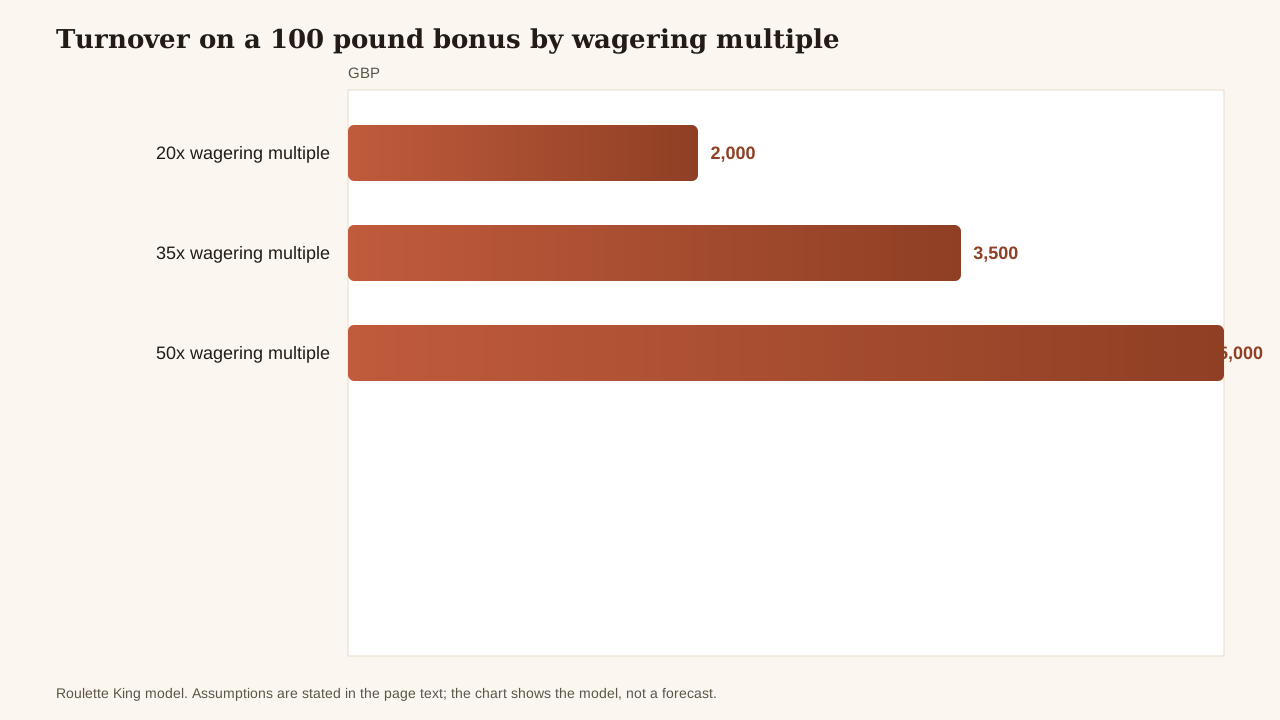
Turnover before withdrawal, modelled from the bonus and the multiple the terms set.
Model illustration with stated inputs; the terms of a specific offer always override a model.
Take the first row slowly. A 200 per cent match on £100 returns £200 of bonus money, comfortably inside the £1,000 cap, and at 35x the bonus the wagering requirement is 35 × £200, or £7,000. At £2 a spin that is 3,500 spins; at a steady 600 spins an hour it is just under six hours of continuous play before any bonus-derived balance unlocks, and every loss along the way comes out of your own £100. The second row halves the amounts and raises the multiplier: £100 of bonus at 40x is 40 × £100, or £4,000, which is the same turnover bill dressed in a smaller headline, and the £500 cap never comes into play because the bonus never approaches it. Both rows assume the bonus is credited in full and forfeited if unfinished, which is the common shape of terms in this part of the market. Vary the stake and the hours move with it, but the shape never changes: a wagering requirement is a sum of money, not a mood, and the model exists to put the number in front of the headline.
The third row is where combined multipliers bite. A 100 per cent match looks identical to the row before it, but 45x applied to bonus and deposit together means 45 × £200, because the £100 you deposited is locked alongside the £100 of bonus, and the bill comes to £9,000. That is more than double the cost of the second row for an identical headline, which is why the word and in a terms page deserves as much attention as any percentage. The fourth row inverts the pattern: £20 of no-deposit credit at 60x is only 60 × £20, or £1,200, yet it carries the heaviest multiplier in the model, and no-deposit offers of this kind usually arrive with the tightest caps and the shortest windows of all, so the modest bill is harder to pay than it looks.
None of this says a large bonus is automatically a bad one; it says the headline is a quotation, not a price, and the price is the turnover. A licensed operator can run demanding terms too, but it must present them clearly, must not use them to mislead, and answers to a regulator that polices the line between generous and misleading. At this end of the market the same clauses arrive with no such backstop, so enforcement falls to your own arithmetic, which is what the model and the calculator are for. Read the multiplier first, the expiry window second and the cap third, because those three numbers, and not the percentage at the top, decide what an offer of this kind is actually worth.
Headline value and real value
The figure indexes the headline first-deposit bonus of each market segment to the licensed norm, which is set at 100, so a segment plotted at 300 advertises three times the licensed headline and one plotted at 500 advertises five times it. That is the shape of the gap people are pointing at when they talk about the best non GamStop casinos: the numbers at the top of the advert really are bigger here, often by a multiple rather than a margin, and pretending otherwise would make the rest of this page pointless.
What the index does not show is what happens downstream of the headline. A segment indexed at 400 that carries a 45x combined multiplier, a tight max bet rule and a seven-day window is worth less in practice than a segment indexed at 100 that clears cleanly, because turnover, expiry and caps are subtractors that operate after the advert has done its work. The index measures the size of the promise; the model table measures what the promise costs to keep, and the two do not always point the same way.
There is a behavioural cost to large headlines as well. Bonuses sized at three to five times the norm encourage deposits sized to trigger them, longer sessions dedicated to clearing them and a tolerance for terms that would look unreasonable attached to a smaller figure. Deposit, session and loss all scale with the number at the top of the advert, which is why regulators care about how offers are presented and why this page keeps returning to the clauses underneath. The practical version of the effect is simple: the bigger the number at the top, the slower the reader should go through the small print, and the less the headline alone should be allowed to make the decision.
Read the figure alongside the comparison table rather than instead of it. The segments with the largest headlines sit, almost without exception, in rows whose protections column reads None, and the licensed rows cluster near the baseline. That correlation is not a coincidence. Headline size is one of the few competitive levers left to an operator that cannot advertise arbitration, scheme membership or regulatory oversight, so the market spends its energy where it can, on the number at the top, and the number at the top is exactly the thing a turnover model exists to discount. Where a licensed brand runs a large headline as well, the index alone cannot settle the question, and the turnover model has to do the work instead.
One more reading of the index is worth making explicit. Because the baseline is the licensed norm, the figure says nothing about absolute amounts: a £100 deposit modelled across the segments produces headline bonuses that scale with the index, but turnover costs scale faster whenever a combined multiplier is involved, which is why the most aggressive headline in the model produced neither the largest bonus nor the smallest bill. An index is good at showing shape and poor at showing price, and this page deliberately keeps both in view so that neither can be quoted without the other.
Cashiers, crypto and the speed of payouts
Payment is where the licence gap becomes tactile. Offshore-facing brands compete hard on cashier breadth: debit cards, bank transfer, a spread of e-wallets and, increasingly, a full crypto counter carrying Bitcoin, Ethereum, Tether and sometimes half a dozen smaller coins. Crypto rails settle quickly when the network is quiet and the operator's review queue is short, and that speed is one of the genuine selling points of the segment, particularly for readers who value discretion over recourse. The same rails, however, are irreversible: a deposit sent to the wrong address, or sent in a moment of pressure, cannot be recalled by a bank, because no bank sits anywhere in the chain, and the consumer protections that attach to card payments simply do not exist on-chain.
Card payments behave differently and fail differently. UK-issued cards frequently decline transactions with unlicensed gambling merchants, partly down to issuer policy and partly to the blocking regime that surrounds gambling transactions, so readers report success and failure with the same brand from different banks. Where a card deposit does go through, the withdrawal leg is the weak point: payout queues measured in days rather than hours are common, per-transaction caps are standard, and a pending verification request can freeze a balance while documents are collected in bulk. None of that is a scandal in itself; it is simply what operating outside the framework looks like from the customer's chair, and it is why the licensed rows in the comparison mention payment rails in their known-for cells at all.
The licensed contrast is unglamorous and effective. Debit cards only for deposits, e-wallets under the same rules, faster payments for withdrawals, published complaint statistics and an arbitration route if a payout stalls. Mr Vegas is known for fast e-wallet payouts under UK rules, a mundane claim that happens to matter more than any headline percentage when the question is when your money arrives. Speed under a regulator comes from process rather than promise: funds must be held properly, verification happens once rather than repeatedly, and an adjudicator exists for the cases where the process fails, which changes how an operator behaves long before any dispute is ever filed.
Currency deserves its own paragraph. Crypto deposits expose a balance to coin price movements between deposit and withdrawal, which can add or subtract more than any bonus percentage over a week of wagering; fiat cashiers at offshore-facing brands often settle in euros or dollars with a conversion spread applied somewhere in the chain, and the reader sees it as a shortfall nobody can quite explain. The model elsewhere on this page prices everything in pounds because the reader thinks in pounds, but the cashier may not, and that mismatch is a quiet cost that never appears in the terms. It belongs in any honest account of what this part of the market costs.
Withdrawal limits deserve three sentences of their own. Caps per day, per week or per transaction are standard at this end of the market, so a large win can arrive in instalments spread across months, during which the operator's terms and the operator itself remain the only counterparties. Such limits exist under a UK licence too, but there they sit inside a framework where the customer can escalate and the escalation has teeth, which keeps the limits honest. The practical guidance here is limited and deliberate: know the cap before you deposit, know the queue before you win, and treat any cashier that changes its limits after a withdrawal request as the warning it plainly is.
What a licence buys you, and what GamStop does
A UK Gambling Commission licence buys a specific and concrete set of things. Customer funds must be held so that they survive the operator's insolvency. Games must meet technical standards, and the returns they advertise must be fair. Complaints must be escalation-ready: where an operator cannot resolve a dispute, an approved alternative dispute resolution body takes it, and its decision binds the operator. Advertising must be truthful and must not target people who are vulnerable. Identity and affordability checks must run, and participation in GamStop is mandatory for every GB-licensed online operator without exception. Each of those lines is a protection the licensed rows in the comparison carry and the offshore-facing rows do not, which is why the licence column and the protections column in that table say the same thing twice.
GamStop itself is the national online self-exclusion scheme, free to use at gamstop.co.uk. You register your details, choose an exclusion period of 6 months, 1 year or 5 years, and every GB-licensed operator must then block you from opening or using accounts for the period you picked. The exclusion cannot be lifted early: when the term runs out, the scheme asks what you want to do next, but nothing shortens it in the meantime, and no operator has the power to override it. It covers GB-licensed operators only. Offshore-facing brands are not part of the scheme, do not check it and are not blocked by it, which is the single fact this market is built around and the reason a licence column matters more than any lobby feature.
That last sentence carries the weight of the whole section. A reader who self-excluded for five years and then opens an account with an offshore-facing brand has not broken the scheme; the scheme simply cannot see that brand, and the brand has no reason to care. An exclusion is a decision made at a moment of clarity about future behaviour, and this segment exists in part to catch the moment that clarity weakens. This page will not help with that, because helping would mean helping someone defeat their own protective decision, and no bonus in the model is worth more than the reason the decision was made in the first place. There is no softer way to put it, and the page does not try.
If gambling has stopped feeling like a choice, the National Gambling Helpline is open every day on 0808 8020 133, run by GamCare with BeGambleAware. The call is free and confidential, the advisers are trained for exactly this conversation, and you do not need to be in crisis to ring, because the helpline takes calls from people who are simply unsure whether their gambling still counts as entertainment. BeGambleAware funds treatment services across Britain and publishes self-help tools for people who want to understand their own patterns, and registering with GamStop at gamstop.co.uk takes minutes. None of these routes costs anything, none of them judges the caller, and all of them work whether or not the operator involved holds any licence at all.
For readers without an exclusion, the licence section still earns its place, because it defines the missing column in the comparison table. When a row reads No UK licence and None, it means no fund segregation you can rely on, no binding arbitration, no Commission to write to and no GamStop check at the door. An offshore regulator may run a complaints mailbox, and some operators answer complaints promptly and fairly, but that behaviour is discretionary; a licence turns it into obligation. The page's overall position is accordingly plain: the protections are the product, everything else in the table is price, and the reader who forgets which is which has already paid for the wrong one.
Checks worth making before an account anywhere
This checklist is deliberately short and works for any operator, licensed or otherwise. It will not manufacture protections where none exist, because only a licence does that. What it does is turn a marketing impulse into a ten-minute reading exercise, which is usually long enough for the weaker offers of this kind to disqualify themselves without any help. Ten minutes of reading is cheaper than every alternative on this page.
- Confirm any claimed licence on the regulator's public register rather than on a footer badge, and note that no GB entry means none of the protections described in the licence section apply.
- Read the bonus terms end to end: the multiplier, what the multiplier applies to, the expiry window, the cash-out cap, the max bet while wagering and the game weightings.
- Find the withdrawal rules before the deposit rules: limits per transaction, review queues, document demands and the brand's own stated payout times.
- Check whether the operator participates in GamStop, remembering that offshore-facing brands do not, whatever a responsible gaming page may imply.
- Set your own limits first: a deposit amount, a session length and a loss point at which you stop, written down before the cashier is ever opened.
- Ask what happens when something goes wrong, and whether the answer involves any body with the power to make the operator pay.
Two of those checks deserve emphasis. The terms check matters because the model earlier on this page shows how a single word, and, can double the cost of a bonus, and because caps and expiry windows do the quiet work of deciding whether a headline is real. The GamStop check matters because the segment's defining feature is the absence of that very check, so any brand marketing itself on responsible gaming while sitting outside the scheme is asking to be read with scepticism, and the scepticism should be applied before any deposit rather than after.
Verification is the check readers most resent and most need. Expect to prove who you are before a meaningful withdrawal clears, and treat a brand that promises otherwise as describing a risk rather than a perk, because a cashier that skips identity checks at deposit can demand anything it likes at withdrawal, with nobody to arbitrate the demand. Collecting your own documents in advance, in the formats operators actually ask for, does not make the process pleasant; it makes it shorter, and shortness at a payout queue is worth more than any bonus percentage.
The final check is not about the operator at all. If the reason you are reading about the best non GamStop casinos is that a self-exclusion is in place, the honest sequencing is helpline first and account never, because the exclusion was the protection and everything on this page describes life without it. For readers without an exclusion, the checks in this list still end in the same place: a licence, or the absence of one, decides more than any feature list ever will, and it decides it before the first spin rather than after.
A closing note on how these checks fail. They fail quietly, one skipped clause at a time, and usually at exactly the moment the reader is least inclined to pause, which is after a win or during a promotion. The defence is to do the reading while nothing is at stake: terms read before a deposit cost ten minutes, and the same terms read after a frozen withdrawal cost considerably more. Nothing in this checklist creates a protection, and nothing in it is intended to; its entire job is to make sure the reader knows which protections are missing before the money moves, because after the money moves, knowledge is the only tool left.
Questions readers ask about this market
What does the phrase non GamStop casino actually mean?
It describes an online casino that holds no licence from the UK Gambling Commission and therefore does not take part in GamStop, the national self-exclusion scheme. For a reader in Great Britain it means playing outside the domestic protection framework: no scheme check at registration, no binding dispute resolution and no regulator with power over the operator. The phrase tends to travel with the word best, as in best non GamStop casinos, but the superlative carries no regulatory meaning; the licence column in the comparison does the real work. Search volume around the phrase is high because the bonuses are large, and the licence, not the lobby, is what separates this part of the market from every other.
Is it legal to read about or discuss these brands in the UK?
Yes. Comparing, modelling and discussing these operators is lawful, and this page does exactly that in the open, without sign-up pressure in either direction. The legal exposure sits with the operators themselves, since offering gambling to customers in Great Britain without a licence is an offence and advertising such services to a British audience is restricted in turn. Reading about the market, and thinking carefully about it before parting with any money, breaks nothing.
What is GamStop, and can an exclusion be cancelled early?
GamStop is the free national online self-exclusion service at gamstop.co.uk. You register, choose 6 months, 1 year or 5 years, and every GB-licensed operator must block you for the period you picked. It cannot be cancelled early, plainly and without exception: the term runs its course no matter what, and no operator, email or explanation shortens it. Offshore-facing brands are not part of the scheme, which is why this market exists and why the scheme alone is not a complete wall.
Do I pay tax on winnings at these casinos?
No. Gambling winnings are not taxed in the UK for the player, wherever the site is licensed, and personal gambling winnings require no declaration. The tax burden falls on operators through duties on their own profits. The only bookkeeping worth noting is that a withdrawal arriving in crypto or a foreign currency can move in value between request and arrival, but the winnings themselves carry no tax bill.
Which protections go missing at an offshore-facing brand?
The missing protections are specific: GamStop checking, alternative dispute resolution with binding outcomes, fund segregation requirements, UK technical standards, structured identity and affordability checks, and the debit-card-only deposit regime with its associated blocking. Add the Commission itself, since no regulator holds power over the operator once the licence column reads No UK licence. Whatever remains after that is goodwill, and goodwill is not enforceable when a withdrawal stalls or a bonus is voided. A complaints page and a live chat are not substitutes for any item in that catalogue.
How do payouts compare with licensed sites?
Crypto cashiers can be genuinely fast when everything goes right, and that speed is one of the segment's real attractions. Card and bank payouts at offshore-facing brands are more variable, with review queues, per-transaction caps and document requests that can hold a balance for days or weeks. Licensed operators publish complaint statistics and sit under an arbitration scheme, so a stalled payout becomes somebody else's enforceable problem rather than a private dispute. When the question is when the money arrives, the licence is usually the difference.
What do the bonus terms actually look like?
The multipliers run high, commonly from 35x to 60x, and sometimes apply to bonus and deposit combined rather than the bonus alone. Caps, short expiry windows, max bet rules and game weightings fill out the rest of the clause list, and each subtracts value after the headline has finished its work. The model and the calculator earlier on this page turn any given set of terms into a single turnover figure, which remains the only honest way to compare offers of this kind.
Where can I get help if gambling stops feeling like a choice?
The National Gambling Helpline is open every day on 0808 8020 133, run by GamCare with BeGambleAware, and the call is free and confidential. GamStop registration for online self-exclusion takes minutes at gamstop.co.uk, and choosing the longest period you can imagine needing is the option this page would point to. BeGambleAware funds treatment services across Britain and publishes self-help tools for anyone who wants to understand their own patterns. You do not have to be in crisis to use any of these routes.